The 21 influencer marketing mistakes I see most, with real examples of bad outreach and exactly what to do instead.
Influencer marketing mistakes land in my inbox every week.
People I've never met ask me to promote their launch. They make the message about what they need, not what they can offer. They treat me like an ad slot instead of a person.
Then they wonder why influencers ignore them.
I've been building relationships with influencers since 2013, when I had zero connections. Those relationships became the speakers and partners behind every summit I've hosted, from The Branding Summit to the AI Creator Summit. What made them work was always the same: add value first, ask later.
Here are the 21 influencer marketing mistakes I see most, with real examples and exactly what to do instead.
What influencer marketing really is
Influencer marketing is partnering with creators whose audience already trusts them, so they introduce you to people you couldn't reach alone.
Most people think it's about finding someone with a million followers. It isn't. The best partnerships happen with creators whose audience actually cares about what you offer, whatever the size.
Ads interrupt people. A recommendation from someone they trust doesn't. That's why it works, and why every mistake below is really a trust mistake.
21 influencer marketing mistakes to avoid
1. Reaching out without clarity 🤔
"Hey, love your content! Wanna collab?"
That's not an invitation. It's homework for the other person. If you don't know why you're reaching out, what the opportunity is and what success looks like, you're wasting both your time and theirs.
Do this instead: before you write anything, get clear on your goal. Are you growing your email list, booking interviews, or selling a course through affiliates? If you can't explain what's in it for them, and for you, in 2 clear sentences, you're not ready to reach out.
2. Making it all about you 🤳
The fastest way to get ignored is a list of demands from someone who clearly doesn't know who they're writing to.
"We're launching a summit that's featured some BIG names. You'd be perfect. All we need is 2 solo emails, 2 social posts and a list of 10k+..."
Jon Schumacher, a summit host, shared one of these invites with his network, and it didn't go well for the sender. Derek Halpern got a similar invite with a 5,000 subscriber minimum, and jokingly replied that his list was "only 1k":
And in the comments, other creators said what everyone thinks when they get one:
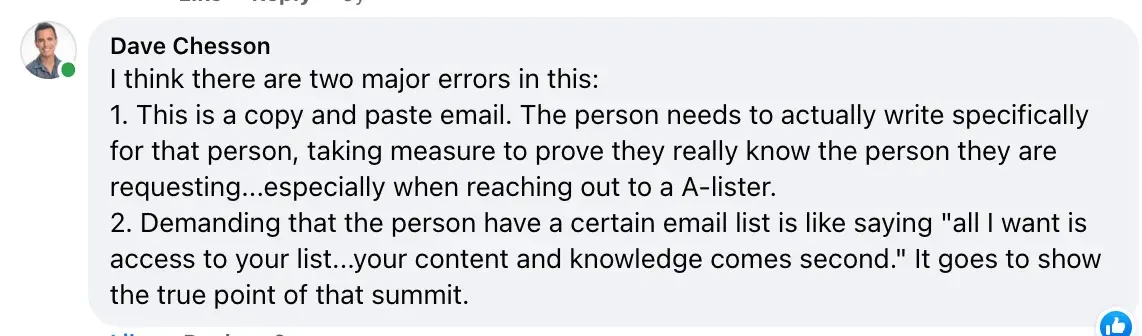
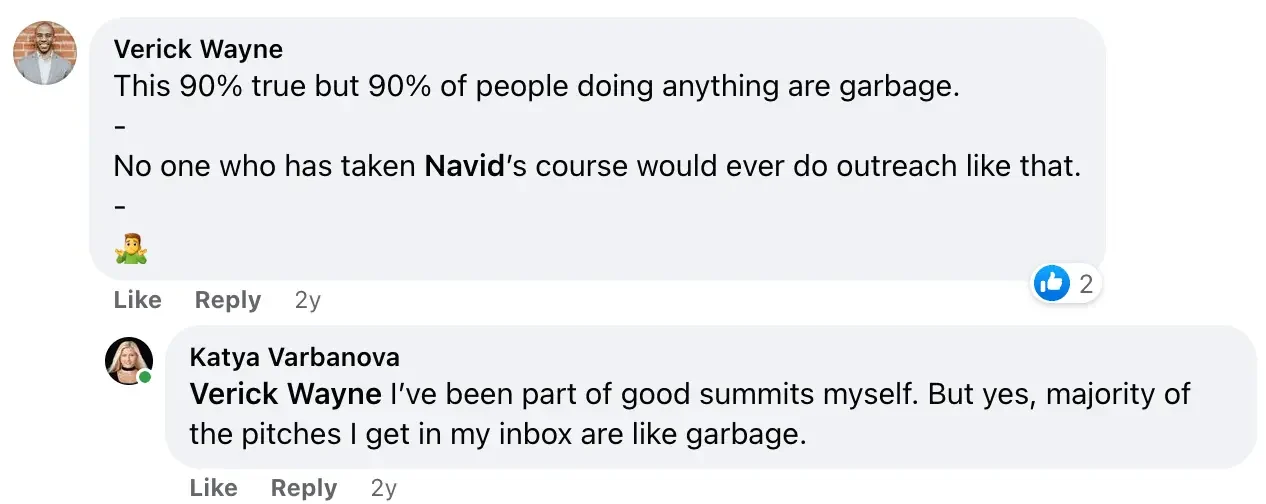
Do this instead: flip the message. Why would their audience love this? How does it help their goals? Why is it worth their time? If every sentence is about you, start over.
3. Leading with the ask, not value 🙏
You wouldn't walk up to a stranger at a party and say "promote my course". But that's what most first DMs do.
Do this instead: warm up first, like a normal person. Leave a thoughtful comment on their posts, not "🔥🔥🔥". Share their work with a note on why it helped you. Send a testimonial or a thank-you with no pitch. Let them see your name next to value before they ever see an ask.
4. Sounding like a robot (or like ChatGPT) 🤖
"Dear Sir or Madam, we would be honored to feature you in our esteemed program..."
Nobody talks like that. And a message that was obviously pasted from ChatGPT with no edits gets deleted just as fast.
Do this instead: write like a smart, friendly person. Use their first name, get to the point, speak to them as a peer. Read it out loud before you send it. If you wouldn't say it, rewrite it. Use AI to research and draft, then make every line sound like you.
5. Letting an assistant make first contact 📧
"Hello there, I'm [assistant's name], reaching out on behalf of [a guru] who's launching a massive summit. Here are the requirements..."
A stranger, writing for someone else you don't know, with a list of demands. Mitch Asser, one of my students, shared an invite like this in my students' group, and the replies said it all:

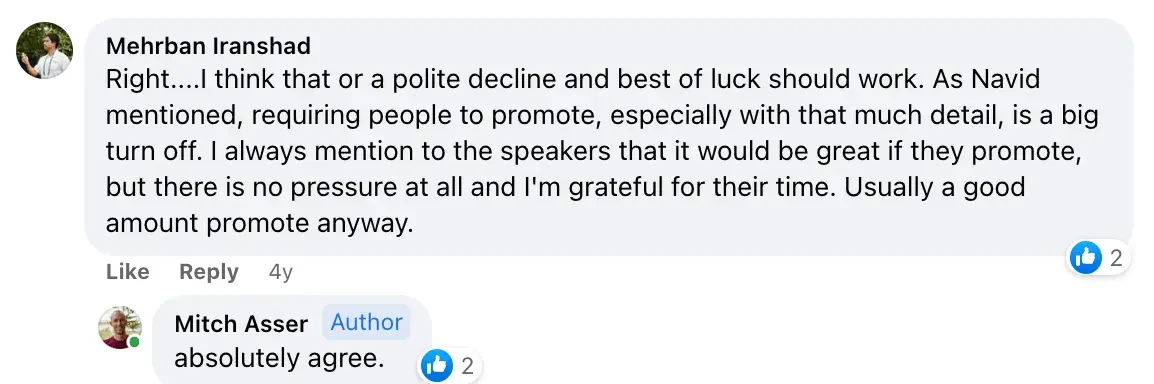
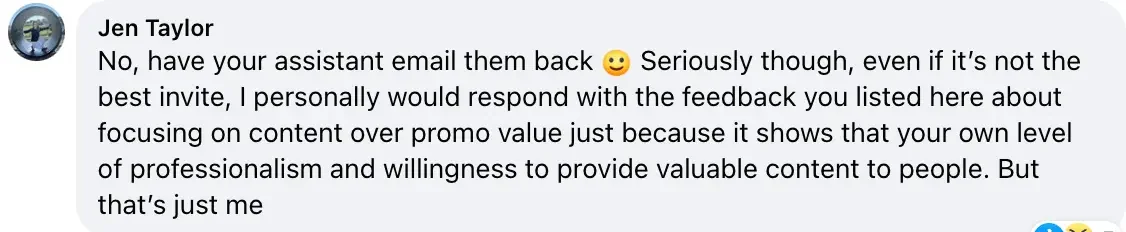
Do this instead: if it's the first time you're reaching out to someone, do it yourself. Your assistant can build the list, research each person and prepare notes. You hit send.
6. Chasing status over substance ⭐
100k followers or a big conference on their bio doesn't make someone the right partner. Some of my best collaborators have been creators nobody else was paying attention to yet. They showed up, delivered and cared.
Do this instead: look for alignment and shared values first. Judge the quality of their audience, not just its size.
7. Overhyping big names 💎
"Past speakers include BIG names... and others."
Translation: if you're not famous, you're filler. Rising creators feel like second-class guests, and they're often the ones who would promote hardest.
Do this instead: mention names only where they help, and make every creator feel like a valued part of the event. Invest in people early. Those relationships compound.
8. Reaching out cold 🥶
You have your offer, your launch date and your list of influencers, so you start messaging. But none of them has heard of you.
Do this instead: show up in their comments and replies, share their work and send a message with no ask, a week or two before you pitch anything. You don't need months. You need to not be a stranger.
9. No clear reason to say yes ❓
"You'd be a great fit. Want in?" Why? Influencers get dozens of vague asks every week.
Do this instead: lead with a specific, concrete benefit. "Your session goes to 5,000 new creators in your niche." "Our top affiliates earned $3,000+ last time." "You'll be alongside [2 people they know and respect]."
10. Forcing one way to collaborate 🚫
Some creators love email promotions. Others prefer a podcast swap, a live session or a social post. Push everyone into your one format and you lose the people who would have said yes to something else.
Do this instead: offer 2 or 3 ways to work together, from low effort to high, and ask what they prefer. I've had partners say yes to big collaborations only because they had options.
11. Not following up 📬
One email and done means you're invisible. Their inbox is full, and your message got buried.
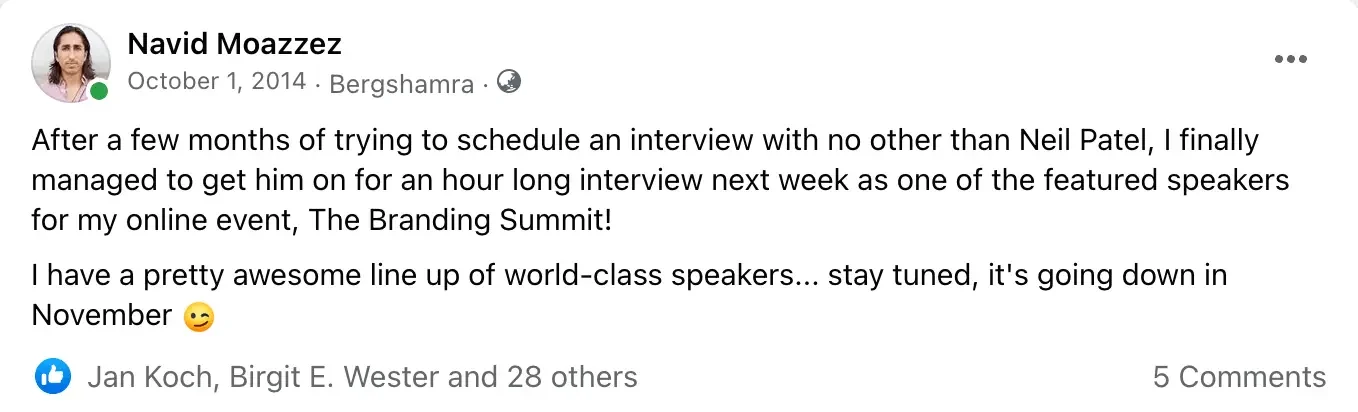
In 2014, I spent months trying to schedule an interview with Neil Patel. I kept following up, and he finally said yes to an hour-long interview for The Branding Summit:
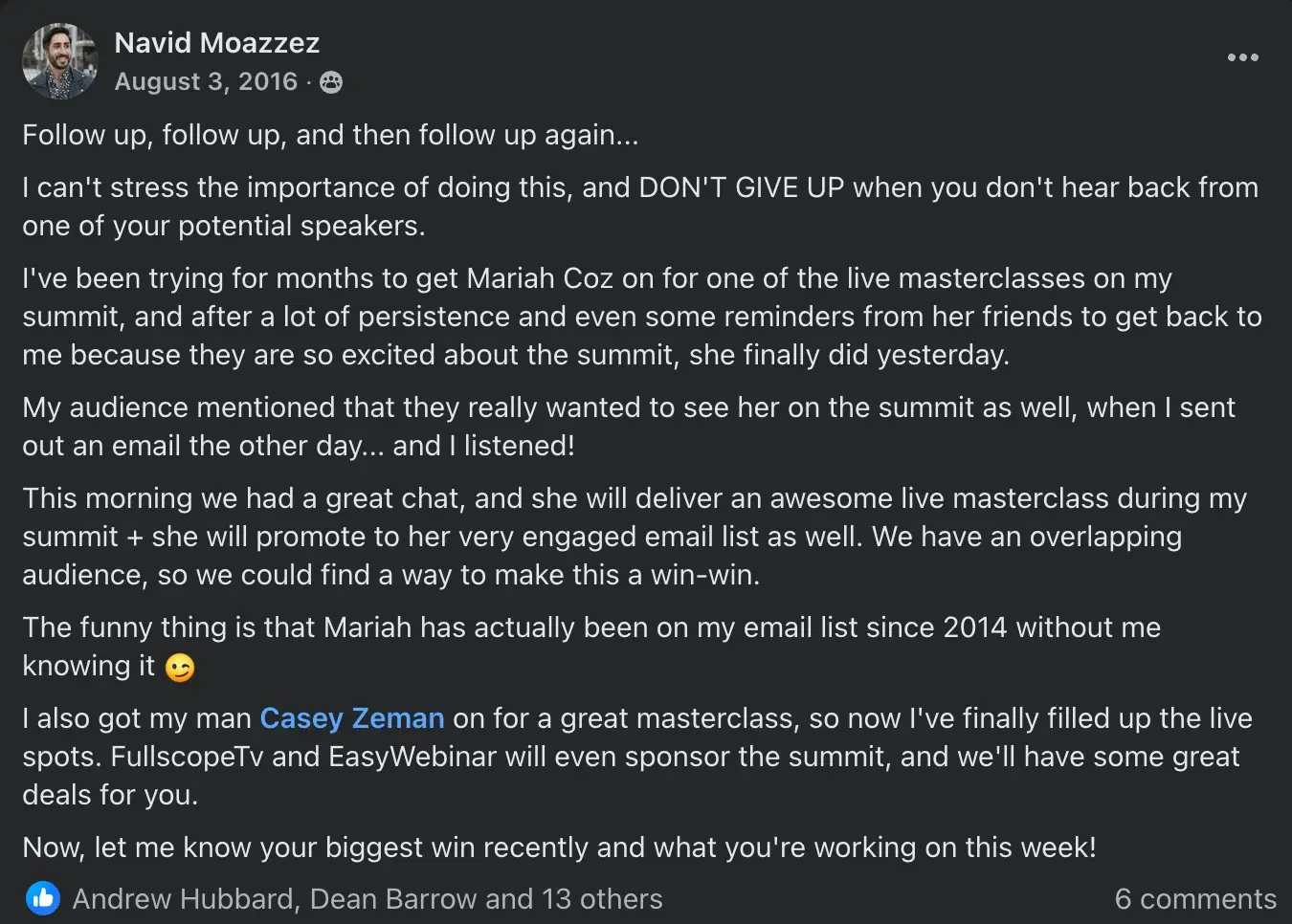
In 2016, the same thing happened with Mariah Coz for my next summit. I'd been following up for months:
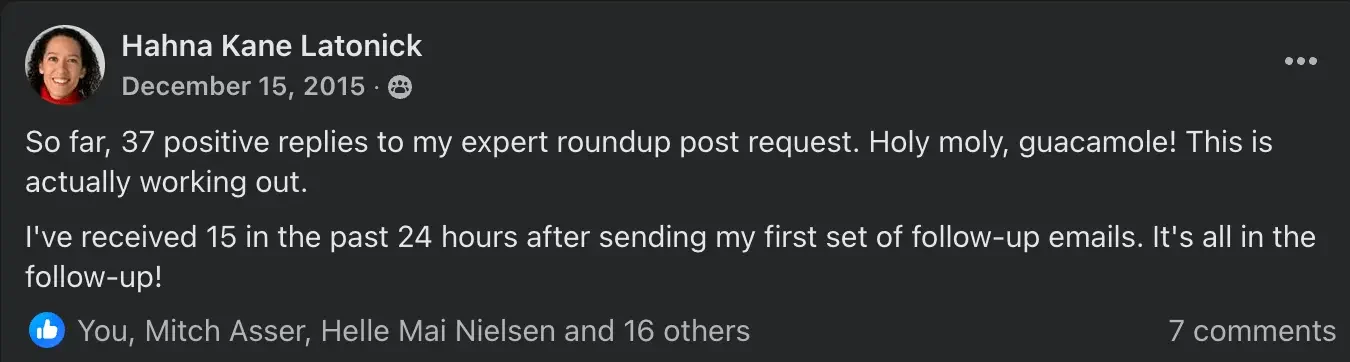
My students see the same thing:
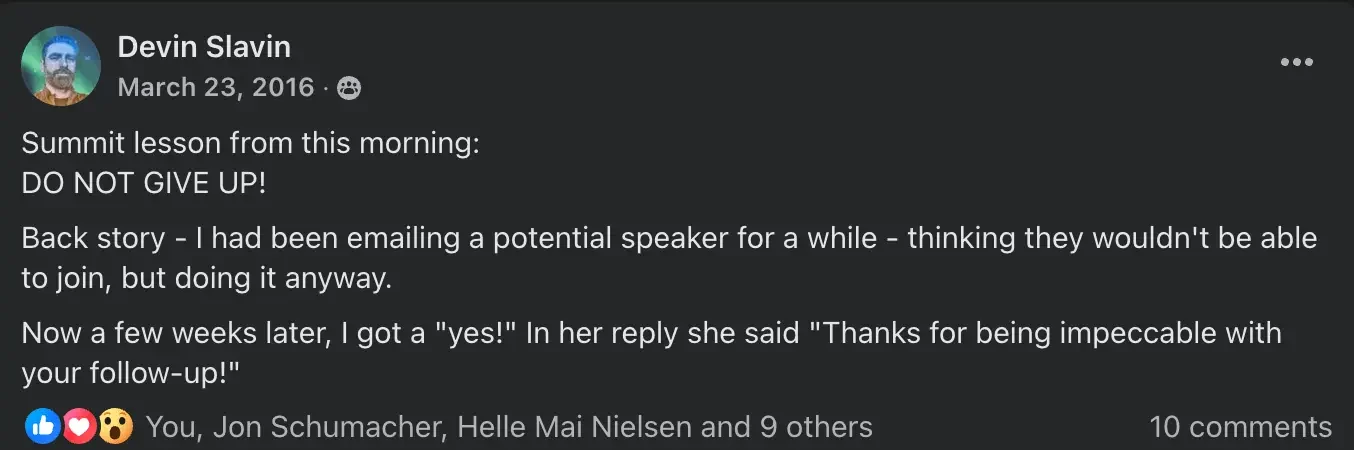
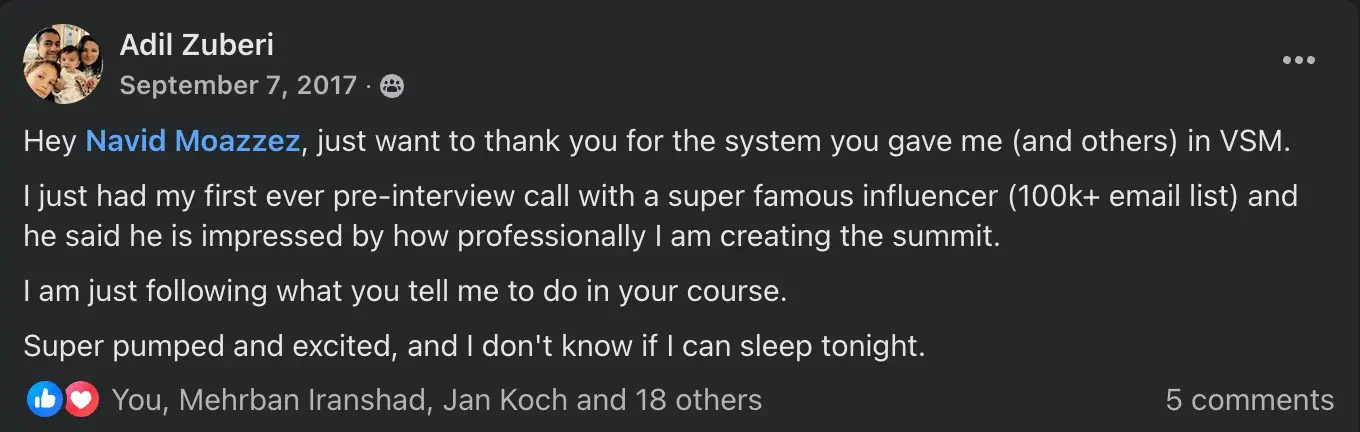
Do this instead: follow up with value, not "just checking in". Share an update, add something helpful, give them a reason to reply. Wait about a week between follow-ups, and track every conversation in a simple CRM or spreadsheet.
12. Not doing your research 🔍
Pitching a vegan creator on your steak course, or asking someone to speak on a topic they stopped talking about 2 years ago, tells them you never looked.
Do this instead: read or watch their last 10 pieces of content. Know what they care about now, what they already promote and who their audience is. Use AI to summarize their recent work, then look at it yourself. I explain how in how to identify influencers.
13. Judging by follower count 📊
Followers can be bought. Engagement can't be faked for long.
Do this instead: look at comments, replies and how people talk to them. A creator with 8,000 followers and real conversations under every post can do more for you than one with 800,000 and silence.
14. Not tracking results 📈
If you don't know which partner brought in which subscribers and sales, you can't thank the right people, pay them fairly or know who to work with again.
Do this instead: give every partner their own tracking link, and look at registrations and sales by partner after every campaign.
15. Skipping disclosure ⚖️
In the US, the FTC requires influencers to clearly disclose paid or sponsored promotions. It's your job as the brand to make sure your partners do it.
Do this instead: tell every partner upfront that paid or affiliate promotions need a clear disclosure, like "ad", "sponsored" or "affiliate link". It protects them, you and the trust of their audience.
16. Micromanaging their content 🎬
A script written by your marketing team, read word for word, sounds like an ad. Because it is one.
Do this instead: give them the key points, the facts and the link, then let them say it their way. Their audience follows them for their voice, not yours.
17. Treating it as a one-off 🔗
One post, one payment, never speak again. You've bought an ad, not built a relationship.
Do this instead: stay in touch between campaigns. Promote their launches, send them results, invite them to your next event. Some of my summit speakers came back for the next one, and some became partners on later launches too.
18. Picking the wrong platform 📱
A great partner on the wrong platform is the wrong partner. If your buyers are on email and LinkedIn, a big TikTok creator might bring you views but no customers.
Do this instead: start where your audience already buys from you, and pick partners who are strongest there. For summits and courses, email partners still beat almost everything.
19. Expecting overnight results ⏳
The first partnership rarely changes everything. The tenth, built on the first 9, often does.
Do this instead: think in years. My relationships from 2013 and 2014 led to summit speakers, affiliate partnerships and friendships I still have today.
20. Not making it easy to promote 🧰
A partner who has to write their own email, find your link and make their own graphics probably won't.
Do this instead: send a promo kit: 2 or 3 ready emails, social posts, graphics and their tracking link. Chandler Bolt credits exactly this for his summit's results:
21. Forgetting to say thank you 🙌
A partner promotes you, and never hears back. Next time, they'll say no.
Do this instead: thank every partner personally, share their results with them, and thank the best ones publicly. It costs you nothing, and it's the reason people want to work with you again.
FAQs about influencer marketing mistakes
The questions people ask most about working with influencers.
Making it all about you.
A message full of your needs and demands, from someone the influencer doesn't know, gets ignored.
Build a relationship first, then lead with what's in it for their audience.
Keep it short, use their name and write the way you'd talk.
Follow up with value, about a week apart, until you get an answer.
Some of my best speakers said yes after months of follow-ups.
Less than engagement and fit.
A creator with a smaller, engaged audience that matches yours often brings better results than a bigger account.
Yes.
In the US, the FTC requires influencers to clearly disclose paid, sponsored and affiliate promotions, and it's the brand's job to make sure partners do it.
Not the first time.
Your assistant can research and prepare, but the first message should come from you.
Final thoughts on influencer marketing mistakes
Almost every influencer marketing mistake comes from the same place: treating people like an advertising channel instead of people.
Flip that, and most of these mistakes disappear. Get clear on what you want, lead with value, make it easy to say yes and easy to promote, follow up, and keep the relationship going after the campaign ends.
Start with the next person on your list. Then read how to reach out to influencers for the exact emails I use, and what are influencer partnerships for turning one collaboration into many.
Navid Moazzez
AI business strategist & AI OS builder
Navid Moazzez helps creators and founders master AI and build their own AI Operating System (AI OS) to automate their business and life.
Navid.me is reader-supported. When you buy through links on this site, I may earn an affiliate commission. Learn more.
Similar articles
How to build relationships with influencers: 33 proven ways
How to identify influencers (and find the right ones)
How to reach out to influencers (and get them to say yes)
Influencer marketing: The ultimate guide to connecting & partnering with influencers
Influencer marketing benefits and disadvantages (the truth)
21 types of social media influencers you need to know (2026)
What are influencer partnerships? Types, examples and how to build them
 Free AI newsletter
The most actionable AI newsletter for founders
Every week, get proven AI strategies, curated tools, and step-by-step systems to grow your audience, create better content, and build a profitable creator business.
No fluff, no filler, no BS. Just five minutes each week that might level up your online business and life.
P.S. Sign up now to get free access to my ultimate AI tools guide for creators.