


A free compound interest calculator that grows your money live on a chart, with monthly deposits, inflation, milestones and a plan B.
See what your money grows into with compound interest: a start, a monthly deposit, a return and the years, with the chart moving as you type.
Your numbers
Drag the sliders and watch the chart move. Inflation turns the end balance into today's money; adding more each year raises your monthly deposit by that much every year.
Your result
Enter a starting amount or a monthly deposit to see it grow.
Embed this tool on your site
Paste the code into any page: WordPress, Webflow, Squarespace, Ghost or plain HTML. It's free with the credit under it, which links back to navid.me.
This free compound interest calculator shows what your money grows into from a starting amount, a monthly deposit, a yearly return and the years.
The balance moves as you type or drag the sliders, on a chart that splits what you put in from the interest it earned.
I built it because a bank's calculator never shows the moment compounding takes over. This one marks the year your interest out-earns your deposits, the round numbers on the way and what the end balance could pay you a month.
Here's what compound interest is, how to read every part of the result, and the few choices that change it the most.
 TL;DR
TL;DRKey takeaways
What is a compound interest calculator?
A compound interest calculator works out how a balance grows when each period's interest is added to it and starts earning interest too.
The textbook formula is A = P(1 + r/n)^(nt), where P is what you start with, r the yearly rate, n how often it compounds a year and t the years.
Deposits make it harder to do by hand, since each one starts compounding from the month it goes in. The calculator does that month by month, so a plan with a starting amount and monthly deposits comes out exact.
How to use the compound interest calculator
You only need two numbers to start, and everything else has a sensible default you can change.
Your numbers stay in this browser, and nothing is sent anywhere.
What the calculator shows you
The result is more than the end balance, and each part answers a different question.
| Part | What it tells you |
|---|---|
| Final balance | What you'd have at the end |
| You put in | Your starting amount plus every deposit |
| Interest earned | What the money made on its own |
| In today's money | The end balance with inflation taken out |
| Doubling time | How long money takes to double at your rate, with the Rule of 72 beside it |
| The crossover | The year your interest out-earns your deposits |
| Milestones | The year you pass $100,000, $250,000, $500,000 and $1 million |
| What it pays | What the end balance could pay a month at a 4% withdrawal |
The chart stacks your deposits under the interest, year by year, so you can see the interest band take over.
A worked example
Here's the example the calculator loads when you press Try an example, worked out in October 2026.
You start with $10,000, add $500 a month and earn 7% a year, compounded monthly, for 30 years.
- Balance
- $106,639
- Put in so far
- $70,000
- Balance
- $300,851
- Put in so far
- $130,000
- Balance
- $691,150
- Put in so far
- $190,000
After 30 years you'd have $691,150. You put in $190,000, so $501,150 is interest.
In year 9, the interest earned that year is bigger than the $6,000 you add that year. That's the crossover, and from there your money works harder than you do.
At 3% inflation a year, the $691,150 buys what about $284,745 buys today. That's why the calculator shows both, so a big number never fools you.
What changes the result the most
Four inputs move the end balance, and they don't move it equally.
The years
Time is the biggest lever, because the interest compounds on itself every month you stay in.
- $300 a month until 65
- $787,444
- Years
- 40
- $300 a month until 65
- $365,991
- Years
- 30
- $300 a month until 65
- $156,278
- Years
- 20
Starting 10 years later costs more than half the end balance, even with the same deposit. So the best year to start is this one.
The return
The rate you earn changes the end balance a lot over 30 years. Here's the same $10,000 plus $500 a month at different returns.
| Yearly return | After 30 years |
|---|---|
| 4% | $380,160 |
| 5% | $460,807 |
| 6% | $562,483 |
| 7% | $691,150 |
| 8% | $854,537 |
| 10% | $1,328,618 |
No return is promised, and a higher one usually means more ups and downs on the way. So run your plan at a lower rate too, and plan on that one.
How often it compounds
Compounding more often helps, but less than banks make it sound. Here's $10,000 at 7% for 10 years.
| Compounded | After 10 years |
|---|---|
| Yearly | $19,671.51 |
| Quarterly | $20,015.97 |
| Monthly | $20,096.61 |
| Daily | $20,136.18 |
Daily beats yearly by $464.67 over 10 years. That's worth taking when two accounts are otherwise the same, but it never beats a higher rate or more years.
What you add each month
Your deposit is the one input you control every month. Drag it up in the calculator and watch the crossover year move closer.
Mistakes to avoid
A few habits make a compound interest plan look better on paper than it turns out.
- Planning on the best year's return instead of a long-run average
- Forgetting inflation, so a future balance feels bigger than it is
- Leaving out fees: a 1% yearly fee comes off your return every year
- Stopping deposits in a bad year, which is when they buy the most
- Pulling money out early and resetting the compounding
Run your plan with a lower return and your real fees, and anything above that is a bonus.
The quiet power of starting early
Compounding rewards patience more than brilliance, and the math in the tables above shows it.
All returns in life, whether in wealth, relationships, or knowledge come from compound interest.
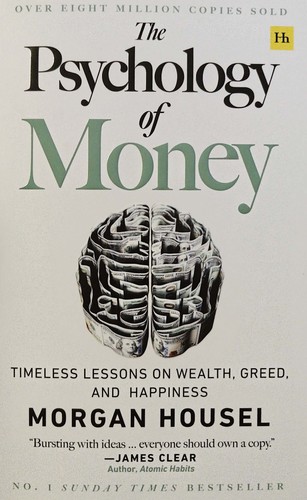
Morgan Housel makes the same point with Warren Buffett in The Psychology of Money: most of Buffett's fortune came after his mid-60s, because he started early and never stopped.
The Psychology of Money
by Morgan Housel
The Psychology of Money by Morgan Housel explores how emotions, biases, and behavior shape financial decisions, offering timeless lessons on wealth.
I may earn a commission if you make a purchase, at no additional cost to you.
For me, this is the math behind freedom. I wrote about the life it pays for in what is a global citizen.
Who is the compound interest calculator for?
It's for anyone saving or investing for something years away, and each of these tools takes a plan further.
- Retirement calculator – for checking if your plan carries the life after work
- CAGR calculator – for finding the real yearly growth of something you already own
- Inflation calculator – for seeing what your future balance buys in today's money
- Net worth calculator – for adding up where you stand today
- Side hustle quiz – for finding the extra income that raises your monthly deposit
Start with the compound interest calculator, then take the number into whichever of these fits your next question.
More money calculators
These calculators share the same stage, music and save options, so your plan moves from one to the next.
| Calculator | What it answers |
|---|---|
| Retirement calculator | Will my savings last? |
| Net worth calculator | Where do I stand today? |
| Inflation calculator | What's my money really worth? |
| CAGR calculator | How fast did it really grow? |
| Debt payoff calculator | When am I debt-free? |
Pick the one that answers your next question, and your currency and scene come with you.
Plan your money with your AI
Take your numbers further in





Compound Interest Calculator FAQs
Questions about the compound interest calculator? Here's what to know.
A compound interest calculator shows how a balance grows when its interest is added back and earns interest too.
This free one adds monthly deposits, inflation and a chart of every year.
Use A = P(1 + r/n)^(nt), where P is the starting amount, r the yearly rate, n how often it compounds and t the years.
With monthly deposits, each deposit compounds from the month it goes in, which the calculator does for you.
It grows to $691,150 when compounded monthly.
You put in $190,000, so $501,150 is interest.
The Rule of 72 says money doubles in about 72 divided by the yearly rate in years.
At 8%, that's about 9 years, and the exact answer is 9.01 years.
No, it makes a small one.
At 7% for 10 years, $10,000 ends at $20,136.18 compounded daily and $19,671.51 compounded yearly.
Use a long-run average for what you invest in, then run a lower one too.
No return is promised, so plan on the lower result.
It's the first year your interest earns more than you add that year.
From then on, your money does more of the work than your deposits.
Prices rise over 30 years, so a future balance buys less than the same number today.
At 3% inflation, $691,150 in 30 years buys about what $284,745 buys now.
It raises your monthly deposit by that percentage every year, like putting part of each raise into savings.
It's one of the easiest ways to move the end balance.
Yes.
Add a plan B with another monthly deposit or return, and the calculator shows both end balances and the difference.
Yes.
Download every year as a CSV, save the plan as a page or a PDF, or copy a link that opens the same numbers.
It's 4% of the end balance a year, divided by 12.
The 4% comes from William Bengen's 1994 study of how much retirees could withdraw from a mix of stocks and bonds.
Yes, it's free with no login.
Your numbers stay in this browser.
I did.
I'm Navid Moazzez, and I made the compound interest calculator as one of my free tools on navid.me.
More about me.
Navid Moazzez
AI business strategist & AI OS builder
Navid Moazzez helps creators and founders master AI and build their own AI Operating System (AI OS) to automate their business and life.
Navid.me is reader-supported. When you buy through links on this site, I may earn an affiliate commission. Learn more.
Related calculators


More free tools

 X
X Bluesky
 LinkedIn
 Threads

 Mastodon
 Instagram
 TikTok
 Pinterest
 YouTube


Related MCP servers & CLIs


 Substack


 Apple Podcasts
 Free AI newsletter
The most actionable AI newsletter for founders
Every week, get proven AI strategies, curated tools, and step-by-step systems to grow your audience, create better content, and build a profitable creator business.
No fluff, no filler, no BS. Just five minutes each week that might level up your online business and life.
P.S. Sign up now to get free access to my ultimate AI tools guide for creators.