How to build a recurring revenue business that earns $10,000/month
Discover 11 proven recurring revenue business ideas, from memberships and monthly workshops to retainers and AI-powered libraries, and how to start.

Have you ever thought about creating a recurring revenue stream?
Well, you’re in luck!
The revolution is upon us, the recurring revenue revolution, that is.
It began when Blockbuster went extinct at the hands of Netflix, and it hasn’t stopped since.
Today, businesses of all kinds are leveraging monthly and annual recurring revenue models to create consistent, scalable income.
This guide is an introduction to the vast applications of recurring revenue.
You’ll discover why recurring revenue can work in almost any industry, and why you’re business will probably get left in the dust if you don’t incorporate it into your current model.
So…what the heck is recurring revenue anyway?
What is recurring revenue? (And what it isn’t!)
Recurring revenue is any product or service that customers purchase on a predictable basis.
Think of subscription-based services where customers pay monthly or annually for an on-going service.
This system makes it easy for companies to calculate accurate ROI projections and to reduce the amount of time spent hustling up new clients.
Creating a membership site is one of the most effective ways to add recurring revenue to almost any business.
Some well-known examples of recurring revenue include:
- Streaming services (Netflix)
- Shopping memberships (Amazon Prime)
- SaaS (software-as-a-service, like Canva or Notion)
Recurring vs. non-recurring revenue
Businesses love recurring revenue because it’s stable and easier to scale, and customers love it because they get more bang for their buck.
Non-recurring revenue, on the other hand, depends on one-off sales with no promise that customers will return.
This type of revenue usually depends on a proactive marketing strategy to make sure that new customers keep coming in.
Examples of non-recurring revenue:
- Grocery store (Whole Foods)
- One-off ticket sales (Ticketmaster)
- Short-term housing (AirBnB)
Spotify’s impact on the music industry is a perfect example of the epic battle between recurring vs. non-recurring revenue, and recurring revenue keeps coming out on top.
There was a time when music used to be sold one album (or song) at a time.
Even after music went digital, Apple was still selling songs and albums individually rather as a subscription.
Spotify, however, had more creative plans.
They cut a deal so that they could rent unlimited songs to their subscribers for a recurring monthly fee.
As long as customers keep paying, the songs keep playing, and music lovers around the world subscribe in the millions.
But monthly recurring revenue isn’t just for big companies like Spotify, local businesses are getting in on the action too.
Recurring revenue businesses are all around you
Believe it or not, the recurring revenue revolution has already gobbled up most of the world, and if you haven’t noticed, it’s probably because you’ve been living in the belly of the beast for so long.
Your everyday life is already full of recurring revenue businesses.
Amazon Prime is yet another “prime” example, but recurring revenue is just as common with small local businesses.
Your local juice bar
Even traditional brick-and-mortar stores are getting in on the recurring revenue action.
When I interviewed membership expert Stu McLaren, he told me a story of a juice bar he visited in San Francisco.
He was walking through the mall and popped in for a drink.
Off to the right, there was a little section of the menu that read “membership pricing,” and the way it works is that members pay $10 a month for two free green juices, and then every drink thereafter is at the member price of $5 instead of $6.50.
It’s a great deal for members and an even better deal for the juice bar because it almost guarantees loyal return customers.
Your local massage studio
Massage studios have been picking up the baton, like Mary-Claire Fredette, who went through Stu’s TRIBE program.
Her massage business was suffering from sporadic cash flow, and she needed a way to increase her average monthly income, so she decided to launch a membership site.
Mary-Claire got 17 people to sign up for her launch with just a small email list.
That’s at least 17 people coming in every single month for a massage, and many of them were upgrading to 90-minute massages.
Your local car wash
Stu also shared a story about a car wash across from his office that uses a membership program.
You can either go through the car wash once for $11 or get an unlimited number of car washes for $12 a month.
Sounds like a no-brainer to me.
Stu has a membership for his and his wife’s car, and now that one car wash has his family’s business indefinitely.
While most car washes around the city hope and pray for customers to come back, Stu’s car wash is worry-free.
The benefits of recurring revenue
The time is ripe to start a recurring revenue business.
Membership businesses are all over the place, and people are already accustomed to paying on a monthly basis for the products and services they love.
For instance, if you take a look at your credit card bill, most of the charges on there will probably be recurring services.
By adding your business to that list, you’ll enjoy some pretty awesome benefits:
How recurring revenue benefits your business
Here’s what you and your business have to look forward to when you adopt the membership model:
1. Predictable income
The people paying for your service this month are more likely to continue paying next month.
It’s always easier to sell to your existing customers than it is to convert new ones.
2. Higher customer LTV (lifetime value)
You’ll make more money off of each customer over their lifetime.
This gives you a higher ROI on the money you spend on advertising and marketing.
Plus, you’ll have more time to focus on customer retention.
3. Stable metrics
Future income will be easier to predict, making it easier to calculate the value of your business.
4. Scalable income
Many recurring revenue businesses, like membership sites, make it possible to stop trading your time directly for money, and that means you can scale your business a whole lot faster.
5. Impact more people
Recurring revenue allows you to take on more customers.
No matter which industry you’re in, you can have a bigger impact.
6. Low stress
Recurring revenue takes away the stress of revenue woes.
Memberships can guarantee that you’ll stay profitable from one month to the next with predictable monthly payments.
7. More time to improve your business
With one-time revenue, you have to put a ton of time into marketing and promotions every month.
But with monthly recurring revenue, you can just keep selling to the same customers and have more time to spend improving your product.
8. More time to do the things you love
Let’s face it, you have better things to do than constantly figuring out how to drive more sales.
The extra time you gain from recurring revenue can be used anyway you like.
Spend more time with your family and enjoy life.
How recurring revenue benefits your customers
Here’s what your customers have to look forward to when you adopt the membership model:
1. More bang for their buck
CD’s used to cost $15 a pop, and monthly subscriptions to a magazine weren’t any cheaper.
Today, you can enjoy unlimited listening from Spotify for less than $10 a month, and for the same price, you can get access to over 300 popular magazines and newspapers with Apple News+.
My how times have changed.
2. Higher quality products
Thanks to recurring revenue, businesses get to spend more time developing high-quality products at a lower price point, and customers reap the rewards.
3. Customer feedback that actually gets listened to
Most companies have a some system in place for taking in customer feedback, but how much of it actually gets listened to?
Recurring revenue businesses, like membership sites, thrive on customer feedback.
In fact, membership sites that don’t actively seek customer feedback and make rapid improvements usually don’t last long.
4. Belonging to a tribe
Membership programs give customers the feeling that they belong to a tribe of like-minded people.
Leveraging the tribe-mind is a powerful psychology tactic that seriously helps with customer retention.
With a yoga studio membership, for example, members develop a bond with the classes, the instructors, each other.
The sense of camaraderie is great for retention.
The 5 biggest misconceptions about making recurring revenue online
My guess is that recurring revenue is starting to look pretty darn good, but if you still have some doubts, I understand.
The good news is that the biggest misconceptions about recurring revenue have simplest solutions.
Here’s the truth about the challenges of building a recurring revenue stream online:
1. Not an expert
A common misconception is that you have to be at the top of your industry to start a membership service, but think again!
You can always leverage the knowledge of industry experts by hosting virtual events.
So you don’t have a Ph.D. on intermittent fasting…big deal.
Mitch Asser didn’t either, and that’s why he repurposes his virtual summit interviews for the core content of his membership site.
Mitch was a personal trainer before he started Fast Way To Health, but he wanted to beef-up the credibility factor, and hosting online summits was the perfect solution.
He’s able to deliver great results by packaging the interviews so that the content feels like an online course.

2. You’ll need to make a ton of content
Wrong!
One of the biggest misconceptions about offering value online is that you need a ton of content, when the truth is that people prefer bite-sized pieces of actionable advice.
Now, what if I told you that you could produce 6-8 months of content in less than a week?
This is exactly what best-selling New York Times author Michael Hyatt did for his Platform University membership site, a joint project with Stu.
Michael’s a busy guy, and at the time he was speaking on the road 100 days out of the year, writing weekly content for his blog, and making money podcasting.
So he and Stu decided to batch-produce video content in three 2-day sessions, enough to last 6-8 months.
Today AI makes this even easier. It drafts lessons from your outlines, and turns 1 live session into a replay, a summary, an action guide and a week of posts.
3. Too much free content in my market
What if there’s a ton of free content in your market?
Does that mean that nobody will be willing to pay for your knowledge-based service?
Nope, it actually means the opposite.
When there’s plenty of free content on a subject, it means that the industry is thriving.
It also means that people are most likely overwhelmed with information, and that’s where you and you membership service come to the rescue.
The thing is, people are willing to pay for speed and convenience.
If you can deliver real results and save your members from the hassle of hunting down trustworthy content, they’ll keep coming back month after month.
4. Small following
And then there’s the age-old misconception that you need to build a huge email list before a membership site launch.
Are you worried that a recurring revenue business only works if you already have a big following?
Well, don’t be.
The truth is that you can crush it with a small email list.
In fact, small targeted lists tend to have higher conversion rates than larger ones.
Stu’s TRIBE program is full of students who’ve launched membership businesses with small email lists, like Marianne Kane.
She was pregnant and in a rush to launch MyOMy Fitness, a kettlebell membership site for women.
So she decided to launch to an email list of only 250 and welcomed 52 members on the day of her launch.
That’s a sign-up rate of 20%!
Then there’s Anna Saucier.
She launched a membership site on extremely short notice to a list of only 326 people.
In just 24 hours, Anna was able to raise $5,024 for a membership site that wasn’t even live, and it’s been growing ever since.
Anna was in Stu’s TRIBE program as well, and she actually did her 24-hour fundraising sprint while attending one of his live events.
5. No following
What if I told you that you didn’t need any following at all before starting on your journey to building recurring revenue online?
A single online summit can grow an email list of up to 5,000 or more targeted people.
Augustus Kligys grew his list from zero to 4,500 with his Summit for Amazon Sellers and generated $58k in revenue.
Recurring revenue vs. One-time fees: Two ways to make money online
Before we dive into some proven ways to make recurring revenue online, it’s important to make a clear distinction between selling one-off info products/services and getting people to subscribe to repeat charges.
This is the difference between building a path towards lifestyle entrepreneurship or continuing to trade your time for money.
The same content that you sell as a one-off product can be turned into recurring revenue, it’s how you package and distribute it that makes the difference.
Here’s how to package your content in a way that retains customers and sets you up for monthly memberships:
- Drip content on a weekly or monthly basis. This gives members a reason to stick around.
- Build a community that members get attached to. It’s perfect for customer retention.
- You’ll also want to create new content to upsell to long-time members.
Now let’s dig into some recurring revenue ideas and find out which ones might be a good fit for your online business.
11 proven recurring revenue business ideas
Now that you know why recurring revenue streams have taken over the world, let’s take a look at how you can implement it.
My buddy Stu makes a pretty strong case that with the right strategy, memberships can be used to uplift any business.
He’s helped thousands of entrepreneurs elevate their businesses with recurring revenue.
And here’s the thing, it works with brick-and-mortar businesses, online stores, consultants, coaches, info products, and everything in between.
Here are 11 ways to add recurring revenue to your business, including 2 I use today.
1. Recurring membership sites
Membership sites, and knowledge-based businesses in general, are on the come up, and there really hasn’t been a better time to get in on the action.
The self-improvement industry is booming, and over the last several years, subscriptions to membership sites have tripled.
The time is ripe for membership sites.
People are crushing the membership site game in darn near every industry, and they’re doing it with less work, lower stress, and minimal content creation.
Offer more value with less content (say what?!)
WARNING!
What I’m about to say may shock the pants off you.
With membership sites, it’s actually better to publish less content.
This is one of the main secrets to success that Stu teaches, and yes, I know, it couldn’t be more counter intuitive, but bear with me.
The truth is that too much content overwhelms members, and overwhelm is the #1 reason why people leave.
Once they feel like they can’t keep up, they bail.
Here are a few insider tips to efficiently create killer content:
- Advice should be actionable and easy-to-implement today.
- Make easy-to-digest, bite-sized lessons.
- Only release one piece of content a week.
- Content should never take longer than an hour to consume.
When you start a blog, it’s easy to get stuck in the loop of cranking out a never-ending stream of content, which can be exhausting, time consuming, and expensive.
Membership sites, on the other hand, operate according to a different rule:
It’s not about the volume of content, it’s about how fast your members get results, and that happens best in small batches of well-crafted content.
A less-is-more case study
Paul Evans, one of Stu’s TRIBE graduates, runs a membership site called Teen Life Ministries.
His mission is to help youth ministers, and when he first launched his site, he had a whole bunch of different content in the members area, content that took a lot of work to create.
But when he surveyed his members, he found that they weren’t using most of it.
As it turned out, what they valued most took very little time to produce: the weekly bible lesson.
You see, most of his audience juggles pastoring part-time with a full-time job, and the weekly bible lesson offered massive value by saving them a ton of prep time.
Paul was able to strip away 75% of his content and focus on delivering the bible lesson, and plenty of other membership site owners share a similar story.
Skip to the end of this guide for a whole bunch of examples of people succeeding in every niche from dog training to guitar lessons.
2. Recurring coaching program
A recurring coaching program is another great way to build recurring revenue online, especially if you combine it with virtual content that you host on a membership site.
As part of a membership site, your one-on-one coaching can be an upsell to your core info-content.
Plus, you can create scalable income by hosting pre-recorded group training sessions.
The key is to get people to renew with an ongoing coaching plan that offers consistent value.
Lock them into recurring monthly payments and let the predictable income flow!
It can be a major lifestyle upgrade compared to making one-off sales and give you the opportunity to design your ideal lifestyle.
I’ve met more than a few digital nomads who make their living as virtual coaches, and they don’t even necessarily have a website.
Instead, they rely solely on influencer marketing and other social media-based strategies.
3. Recurring mastermind program
A mastermind is essentially a membership site where the main attraction is the other members.
People are joining to connect with other like-minded thinkers that can help them solve their problems.
The key to a building a high-level mastermind is to be selective about who you accept, because the members themselves are the product.
The more value that each member contributes to the group, the more you can charge for membership.
Benefits of recurring mastermind programs
Masterminds have several major benefits:
- They tap into the “hive mind” where everyone benefits from the collective problem solving of the group.
- It’s easier to retain customers because members develop a bond with the group.
- Members get their questions answered faster.
And then of course there’s my favorite benefit of all, and that’s that masterminds generate significant revenue.
High-level masterminds, like James Wedmore’s Inner Circle, charge up to $40K a year and beyond.
Will a mastermind work in your niche?
The real question is, “Does your audience regularly have questions that only the collective power of a group can best solve?”
In other words, if a mastermind is the best way to solve your audience’s problems, then yes, a mastermind can work in your niche.
4. Earn recurring income from affiliate marketing
Affiliate programs are a great way to add additional revenue streams to your business, whether you run a membership site, work as a personal coach, or make money blogging.
Help companies make sales, and they’ll be more than willing to share the profits.
There are affiliate programs in every niche, and some of the most profitable are info products and SaaS tools.
Benefits of becoming an affiliate
For years I made over six figures a year from affiliate sales, and much of it was paid out as monthly recurring revenue.
But increasing revenue and diversifying your income are just two benefits of becoming an affiliate.
Affiliate programs are also a great way to network with other players in your industry.
By becoming an affiliate, you offer immense value by boosting their sales, and this can be the start of a meaningful professional relationship.
For instance, most of the $40K+ I made in the month after my first virtual summit, The Branding Summit, came from affiliate sales of Ramit Sethi’s flagship course.
I actually did so well that I won an award for being his top affiliate.
Choosing the right affiliate programs
Be choosy about the products and services you become an affiliate for.
Here’s a cheat sheet for deciding whether or not an affiliate program is right for you:
- Offer value to your readers.
- Relevant to the rest of your content.
- Pay you well for the effort you put into promotion.
- High-quality that you can stand behind.
Not all affiliate programs are going to be a good fit, and promoting low-quality products can damage your reputation and burn bridges with your audience.
But as long as the product helps your audience and pays well, it’s worth considering.
Where recurring affiliate income comes from today
The best recurring commissions come from software people pay for every month: AI tools, email and course platforms, and the other SaaS products creators run their business on.
I share the AI tools I actually use in my AI Tools Library, and many of them pay a commission every month for as long as the customer stays.
Whichever products you promote, only recommend what you use and trust. Your audience's trust is worth more than any commission.
5. SaaS, software as a service subscription
SaaS (software-as-a-service) is any software that’s sold as a subscription.
This includes all email service providers, membership site platforms, online course platforms, webinar platforms, web hosting and podcast hosting providers.
While it takes a lot more startup money to create an SaaS product, if it provides a much needed solution to specific problem, the payoff can be huge.
Try to diversify your recurring revenue stream with upsells like set up fees, extra storage, data, speed boosts, API’s, and white label licensing.
6. Create service plans or retainers
Many online businesses offer products and services that require regular renewal.
It makes good sense then to set them up with an automatically recurring subscription rather than trying to make another sale at the end of each month.
Offer recurring stand-alone services and packages that automatically renew every month.
One Click Influence is a great example of a recurring revenue service plan.
They’re a link building and SEO company that sells everything from monthly link rentals to all-inclusive SEO packages built from the ground up.
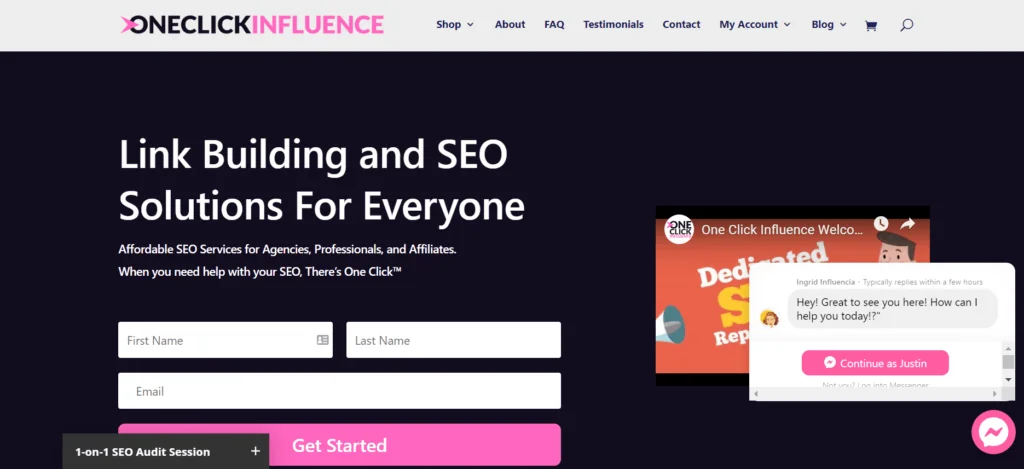
What’s key is to have services to upsell to loyal customers, like One Click does with their dedicated SEO Rep package, where you can have a dedicated SEO consultant assigned to your project.
Copywriting services are another booming industry, where companies like Presto Media provide recurring content management and content production solutions to larger businesses.
To encourage customer retention, consider rewarding loyal customers with special deals and discounts.
As an SEO specialist, web developer, copywriter or AI consultant, service plans can be the perfect recurring revenue model because they reduce the hassle of having to track down new clients every month.
7. Online membership + physical product delivery
Online membership sites that deliver physical products are another recurring revenue business model that’s really taken off recently.
One of the most famous companies to kick off the trend was the Dollar Shave Club, which in 2016 sold out to Unilever for a whopping (drum roll please) one billion dollars.
Dog toy membership sites
If you have a dog, you may already have heard of the many dog membership sites like Perrobox, BarkBox, and PupJoy.
With these sites, members pay a monthly fee of as low as $20 and receive a customizable box of treats and toys delivered to their door.
Even smells are for sale
Companies like ScentBird, ScentBox, and Urban Taste Bud saw a hole in the market: most people want to try out a variety of perfumes and colognes without having to buy gigantic bottles of the stuff.
With ScentBird, members get to try fragrances from companies like Versace and Tom Ford in small quantities for only $14.95 a month.
8. Evergreen virtual summits
Hosting virtual events can supercharge your recurring revenue business by…
- Rapidly building a focused email list.
- Establishing yourself as an authority in the niche.
- Make meaningful connections in your industry.
- Generating significant revenue with all-access passes and affiliate sales.
Mitch Asser, is one of several Virtual Summit Mastery students who’ve leveraged virtual summits to launch a membership site.
In fact, he went from zero to 30k email subscribers by hosting virtual conferences.
As I mentioned before, Mitch also used his summit interviews as part of the evergreen content of his membership site.
By offering monthly access to your summit recordings, you can leverage them to offer massive value to your members.
Similarly, with a strong sales funnel of ads or content, a webinar and a simple sales page, you can sell your virtual summit as a stand-alone info product and use it as a front-end hook into your membership site.
Virtual summits can also be used to grow already successful online businesses, a technique that Chandler Bolt of Self Publishing School used to explode his email list by an extra 60K+ subscribers and generate over $700K in revenue over the course of two summits.
9. Set up your online courses as evergreen
Just as you can turn your virtual summit into an evergreen sales funnel, you can do the same with an online course.
Your funnel can consist of ads or content, a webinar and a simple sales page. You can also drive traffic to your evergreen courses using virtual summits and affiliate partnerships.
The key here, though, is to incorporate your funnel into a broader recurring revenue game plan, so your evergreen funnel should feed into an upsell that’s based on a subscription service, like a membership site, service plan, or physical product delivery.
10. Monthly live workshops
A monthly live workshop gives members a new hands-on session every month, on a new topic, with the replays in one place.
It's how I'm rebuilding my own membership, AI Creator OS: a new practical, hands-on live AI workshop every month, taught by people who use AI in their own business.
It works because members pay for showing up live together, not for a library they'll never finish. And with AI turning every session into a replay, a summary and an action guide, one live hour a month becomes a full month of content.
11. AI-powered libraries and assistants
Members pay monthly for tools they use every week: templates, prompts, AI skills and swipe files, kept up to date as the tools change.
You can go one step further with an AI assistant built on your own frameworks, like a Claude project or a custom GPT, so members get answers in your method at any hour.
It's one of the easiest recurring offers to keep fresh, because you add to it instead of starting over.
What are the best ways for you to make recurring revenue in your business?
The first step to deciding how to make recurring revenue in your business is to which type of business you’re working with.
What’s your business’s bread and butter?
- Is it a service like web design, graphic design, or SEO?
- Do you offer coaching that you want to sell as a monthly membership?
- Do you have skills or knowledge that you want to share on a larger scale?
If you provide a service like SEO or copywriting, then selling them as a monthly subscription is an easy first step towards recurring income, and coaches and consultants can offer their one-on-one services on a monthly retainer.
If you have knowledge that can be packaged as an info product, then you might as well make it into a membership, a monthly workshop or an AI-powered library, and sell it as a recurring subscription.
But the truth is, nearly any type of business can incorporate a membership site into their business model, all you have to do is organize your knowledge into easy-to-digest, actionable advice.
How to get started with recurring revenue
Start with the offer that fits what you already do:
For the full step-by-step on memberships, read how to create a membership site. To learn from Stu McLaren directly, find his programs on his Creator Directory profile.
Examples of real-world people making recurring revenue from membership sites
Here are a few case studies of successful TRIBE students who added recurring revenue to their business by creating a successful membership site:
Wendy Batten: Helping paint store retailers
Wendy’s story is another great example of a membership site taking off with a small email list.
She launched her site for paint store retailers with only 460 people on her list.
And we’re talking about a tiny, tiny niche.
Out of those 460 people, 59 of them signed up, generating $2,800 a month right off the bat.
Over the course of 12 months, Wendy’s site grew to over 100 members.
Levi Kujala: Guitar niche
Levi is absolutely crushing it in the music niche with his guitar website.
His site was already bringing in $30k a month in revenue, but after taking Stu’s TRIBE Course, that number quickly ballooned up to over $100k.
Levi’s site is now a multi-million dollar membership with over 6k members.
Susan Garrett: Dog niche
Susan is a great example of escaping the info-product rat race and transitioning to a recurring membership program.
She was exhausted with the stress of juggling product launches while traveling the country as a high-level dog trainer, so she packaged her knowledge into a membership site and did a beta launch to 1,600 of her best clients.
1,100 of them signed up.
FAQs about recurring revenue
Here are answers to the questions people ask most about building a recurring revenue business.
Recurring revenue is any product or service that customers buy on a predictable basis, like a subscription they pay for monthly or yearly.
Recurring revenue is stable and easier to scale, because the same customers keep paying. Non-recurring revenue depends on one-off sales with no promise that customers come back, so you have to keep finding new ones.
The people paying you this month are likely to keep paying next month, and it’s always easier to sell to existing customers than to find new ones.
No. You can bring in the knowledge of industry experts by hosting virtual events, and build your membership around what they teach.
No. People prefer bite-sized, actionable advice over huge libraries, and you can produce 6 to 8 months of content in less than a week.
No. A single virtual summit can grow an email list of 5,000 or more targeted people. Augustus Kligys grew his list from 0 to 4,500 with his summit for Amazon sellers and made $58K in revenue.
This guide covers 11: membership sites, coaching programs, mastermind programs, affiliate marketing, software subscriptions, service plans and retainers, memberships with physical products, evergreen virtual summits, evergreen online courses, monthly live workshops, and AI-powered libraries and assistants.
A mastermind is a membership where the main attraction is the other members. Be selective about who you accept, because the members themselves are the product.
AI takes over most of the content work and admin: it drafts lessons, turns each live session into a replay, a summary and an action guide, and handles onboarding and reminders. You can also sell access to an AI assistant built on your own frameworks.
Final thoughts on building a recurring revenue business
Recurring revenue, from memberships and monthly workshops to retainers and subscriptions, can take you to the $10,000 a month mark and beyond.
It may not be the fastest route to financial freedom, but it has a high ceiling, both in revenue and in the life it gives you.
Pick 1 model from this guide, test it with a founding group, and show up for them every month.
How are you going to add recurring revenue to your business? DM me on X or Instagram and let me know.
Navid Moazzez
AI business strategist & AI OS builder
Navid Moazzez helps creators and founders master AI and build their own AI Operating System (AI OS) to automate their business and life.
Navid.me is reader-supported. When you buy through links on this site, I may earn an affiliate commission. Learn more.
Similar articles

How to create an online course in 2026 (step-by-step guide)

How to make money blogging: 10 steps to actually monetize your blog quickly in 2026

How to create a membership site in 2026 (step-by-step guide)

How to make money with AI as a creator: 15 real ways (2026)

How to make money podcasting: 18 ways to monetize a podcast

How to make money online as a content creator in 2026

10 biggest AI lessons to 10x your creator business (2026)

How to start a blog in 2026: Your step-by-step guide for the AI era

1000 true fans: How to build your fan base fast
 Free AI newsletter
The most actionable AI newsletter for founders
Every week, get proven AI strategies, curated tools, and step-by-step systems to grow your audience, create better content, and build a profitable creator business.
No fluff, no filler, no BS. Just five minutes each week that might level up your online business and life.
P.S. Sign up now to get free access to my ultimate AI tools guide for creators.