How to host a virtual summit that converts (2026 guide)
Discover how to host a virtual summit that grows your audience, builds authority, and drives revenue even if you’re starting from scratch.
Hosting a virtual summit is one of the fastest ways to grow your email list, build authority and generate sales online.
I've been hosting virtual summits for 12 years. My first one, The Branding Summit, was in 2014, when I had no product and no audience. It changed everything for me: that same year I quit my job and moved abroad.
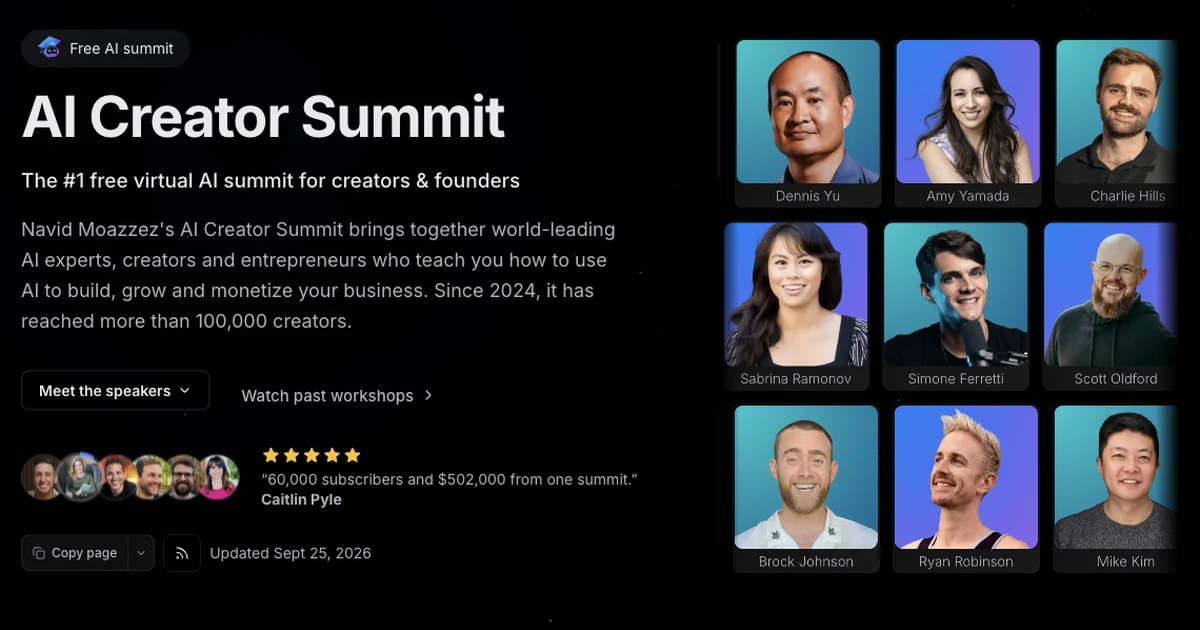
Since then I've hosted summits like List Building School and the AI Creator Summit, which 100,000+ creators tuned in to across 2024 and 2025. My students and I have generated tens of millions in sales and millions of email subscribers with summits, in over 100 different markets, from harp music and play therapy to tennis coaching, SEO and self-publishing.
In this guide, you'll learn how to host a profitable virtual summit step by step, from choosing your topic and landing speakers to launching and monetizing your event. And I'll show you how I host my summits today, with AI doing a lot of the work.
Let's dive in.
What is a virtual summit?
A virtual summit is an online event where people sign up to watch sessions with experts, usually for free. It can be a 1-day intensive or a multi-day event, depending on your goals.
Most hosts release a few sessions each day and keep each one open for a limited time. Then they offer a smart way to keep access, like an all-access pass, a bundle, a membership or a course.
If you want the full breakdown of how it works, read what is a virtual summit.
You don't need to be famous to lead. A summit lets you create the stage, invite the experts, and build real authority in your niche.
Why host a virtual summit?
Here are the reasons I keep coming back to summits, 12 years in:
- Rapid email list growth: Thousands of targeted subscribers in weeks instead of years
- Authority: You stand next to the experts in your niche, and their credibility rubs off on you
- Relationships with your heroes: Your speakers can become long-term partners and friends
- Your first product: The recordings become an all-access pass, even if you have nothing to sell yet
- Multiple revenue streams: Passes, backend offers, sponsorships and affiliate income
- Location freedom: You can host it from anywhere in the world with an internet connection
They help you grow your audience, establish authority and generate revenue without relying on ads or social media.
How to host a virtual summit in 7 steps
Here's my 7-step process:
- Plan your profitable summit
- Get your speakers
- Build your summit funnel
- Record your summit sessions
- Deliver your summit
- Promote and launch your summit
- Monetize and scale
Let's go through each one.
1. Plan your profitable summit 🎯
Your summit foundation will make or break your summit. Even if you think you already know your topic, don't skip this step.
When you get the topic and positioning right, launching and selling your summit is a piece of cake.
Choose a profitable topic
When choosing your topic, think about your:
- Passions, interests and hobbies
- Current skills and experience
- Audience, and their willingness to pay for the solution your summit brings
Also think about what you want to be known as the go-to expert in. A summit is a perfect way to establish yourself in a new field, so look toward where you want to go, not where you've come from.
Once you have a few ideas, check them against my 7 criteria for a great summit niche:
- Do you love it, or have a big interest in it?
- Are other people selling in that space?
- Are there other popular publications in that niche?
- Does it meet your personal moral and ethical standards?
- Can you think of at least 3 things to sell?
- Can you think of sub-niches of the larger niche?
- Are there loyal and passionate customers?
Narrow down your niche until it hurts
One of the biggest mistakes I see is going too broad. A summit for everyone is really for no one.
A specific niche lets you target specific needs and pain points, and there's less competition, so it's much easier to become the go-to authority.
Instead of an "Online Business Summit", I hosted List Building School. Instead of a "Parenting Summit", think "Positive Parenting Conference" or "Parenting Teens Summit".
One of my students, Steph Gaudreau, felt the health niche was already saturated with summits. So she narrowed it down to exactly who she wanted to attract and hosted the Women's Strength Summit. She went from 62 email subscribers to 19,560 new ones.
Research your niche
Validate your idea first. Research properly now to avoid stress later.
- Search Google for "your niche + summit". Look for clues from other summits: the name, the hook, the number of speakers, the design, the copy, sponsorships and pricing.
- Ask real people. Ask people in your target market if your summit is something they need and would pay for. If you have an audience, send a survey. If you don't, message people you know who fit your audience.
Position your summit to stand out
Get inside the mind of your ideal attendee: their wants, needs, pains and desires, in their own words. If you get it right, they'll land on your page and think: "WOW, they're reading my mind. This is EXACTLY what I need."
Even in a crowded market, your summit will stand out with a unique hook. Your hook is usually more important than your summit's name. You can stand out by doing something that hasn't been done before, choosing unique speakers, covering a new angle, mixing formats (like live Q&As and panels) or including a charity element.
Avoid these 3 rookie naming mistakes:
- Too clever or cute: Puns and confusing acronyms that people won't understand
- Too long: The name should be memorable, descriptive and easy to spell
- Already trademarked: Check you can legally use the words before you launch
Plan how you'll profit
Think about how you'll profit from your summit from the very start. You can generate revenue before, during and after your summit with all-access pass sales, backend offers, affiliate commissions, sponsorships, software deals, repurposed content and paid speaking gigs.
I go through 21 ways in how to monetize virtual events.
For 50 summit topics that have already worked, see my list of virtual event ideas.
2. Get your speakers 🎤
You can't host a virtual summit without experts sharing their knowledge. Speakers are the most important part of the summit model: they bring the content, the credibility and, when they share the summit, the audience.
I've written a full series on this, so here's the summit version.
Build your Dream 100 list. Look at podcast hosts and guests, speakers on other summits, product creators, bloggers and authors in your niche. Aim for 50 to 100 names. Then narrow it down to the people whose audience, message and values fit your summit. Here's my full process for how to identify influencers.
Give before you ask. Start building relationships 3 to 6 months before your summit if you can. Share their content, leave reviews, send them a case study, introduce them to someone they want to meet. I cover 33 ways in how to build relationships with influencers.
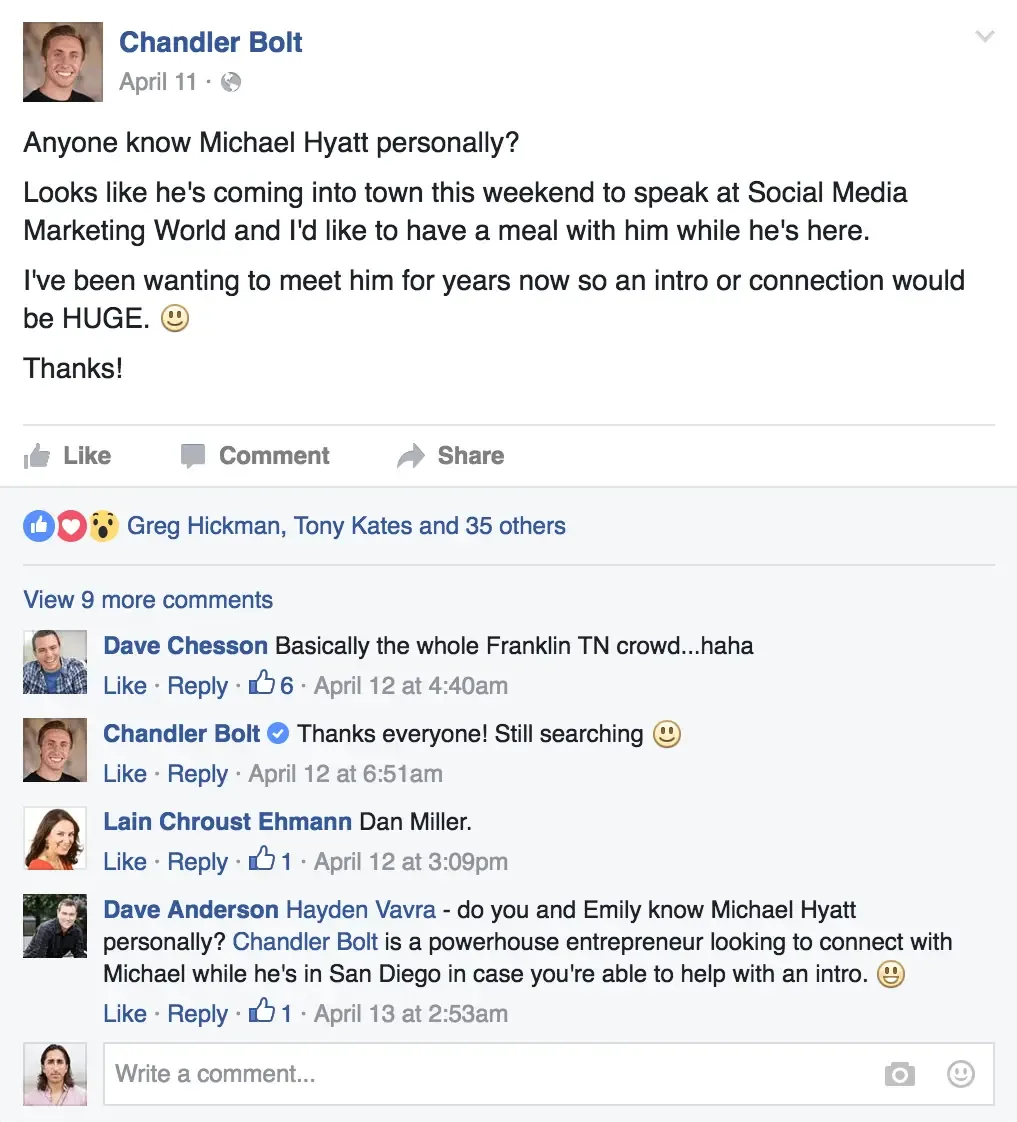
It's also important to tell people what you're looking for. When Chandler Bolt wanted to meet Michael Hyatt for his Self-Publishing Success Summit, he asked his network for an introduction:
Use the ladder strategy. Sort your list into up-and-comers (small but engaged audiences, eager to grow), trusted authorities (known experts with solid followings) and A-listers (big names, hard to get). Start at the bottom with the people you know, and use every yes as social proof for the next invite. Trusted authorities often have the most responsive audiences.
Make the ask short and easy. Personalize it, keep it brief, and make it a win for them. For big names, a quick personal video invitation stands out. Here's my step-by-step process for how to reach out to influencers, including the exact invite I send for the AI Creator Summit today.
Make it a win-win-win. One of my students, Caitlin Pyle, focused on helping her speakers grow their own lists while she grew hers. She got 60,000 new email subscribers and $500k+ in sales in 2 weeks with her Work-At-Home School summit.
Follow up. Some will say yes right away, some will say no (for now, not forever), and some won't answer at all. Follow up until you hear yes or no.
How many speakers? I had 88 speakers for my first summit. For the AI Creator Summit 2026, I had 30+ world-class experts, including people who charge $1,000s if not $10,000+ to speak and rarely speak in public.
3. Build your summit funnel 🧩
Now it's time for the tech side: your summit website. It's not as hard as it looks.
The summit funnel
Here's the journey your attendees take:
- They land on your registration page and sign up for free access to the sessions.
- They're taken to an offer page, which welcomes them and gives them a limited-time offer on your all-access pass (or whatever you're offering).
- If they don't buy yet, they can upgrade on your regular sales page throughout the summit.
Every other page on your site has 1 goal besides giving value: to bring people back to that sales page.
Your registration page
Your registration page gets the most traffic, and it can make or break your summit. Include:
- Your summit name, a catchy hook, the dates and a clear button to register, above the fold
- What the event is about, and why it's different from all the noise out there
- What people will learn and how they'll benefit
- Who's speaking, and what they'll cover
- The schedule, so people can mark their calendar
- Testimonials for social proof
- Who you are, and why you're hosting it
- Several chances to register throughout the page
For the AI Creator Summit, everyone who registers gets a welcome gift right away: my AI tools guide, with 100+ of the best AI tools for creators, organized by category.
Your offer page, sales page and checkout
The offer page and sales page communicate the value of your offer. The difference: the offer page has a special price people only see once, right after they register. That real urgency drives up your conversions.
Include what's in the offer, testimonials, how it helps them, who's speaking, a guarantee, who you are, and several clear buttons to buy. Then a simple checkout page that shows exactly what they're getting.
The rest of your site
You'll also need a sessions page, a page for each session, a thank you page, a page for your live Q&As, a support page, an affiliate page, and your privacy policy, terms and disclaimer. Plus a members area where buyers can watch everything.
Today I don't build any of this from scratch. I host my AI Creator and AI Agents Summits on AI Summit OS, my set of Next.js summit templates, from registration to replay vault. Claude builds from them, so a summit site comes together fast.
4. Record your summit sessions 🎙️
Prepare for each session
Research your speakers so you can bring out their best answers. They also appreciate it, and they're more likely to share your summit when you've done your homework.
I spend 30 minutes to 4 hours researching each speaker, depending on how well I know them:
- Read their website (especially their About page)
- Sign up for their email list
- Watch or listen to other interviews they've done
- Look at what they're working on right now
- Check their social media profiles
Then set a clear goal for what your audience should achieve from the session, and write a short outline of the topics and questions you want to cover.
How I record sessions today
Every session is pre-recorded with me on Riverside, like an in-depth video podcast. Speakers can share their screen and demo, and my audience likes that a lot more than a plain interview. Sessions usually run 45 to 90 minutes.
You don't need top-of-the-line gear for your first summit. A decent webcam, a good microphone and some light go a long way. You can work your way up as you grow.
Tips for epic interviews
Be ready for speakers to reschedule. It happens. Stay flexible and have backup times.
Editing
Editing is still the hardest part to hand off. Descript's Underlord has some potential, but it still eats credits too fast and misses too many things. What I really want is a video editor that connects perfectly to Claude Code. Until then, keep it simple: there's no need to over-edit.
Before you record, prepare with my 100 best questions to ask guest speakers.
5. Deliver your summit 📅
You've done most of the hard work. Now it's about giving your attendees a brilliant experience.
How my summits run today
The AI Creator Summit 2026 ran for 7 days, with about 5 new sessions a day:
- Every day, attendees get an email with that day's speakers and topics.
- Each session closes 24 hours after it goes live, which gives people a real reason to watch now.
- Every day at 7pm ET, I host a live Q&A where I share the biggest lessons from that day's sessions and answer questions.
- After the last day, an encore reopens the sessions for a short time, so people can catch up and binge everything on 1 page.
In the daily emails, I give attendees 3 action steps:
Your summit emails
Write every email ahead of time. There are 3 phases:
- Before the summit: Keep your list involved while you build it (confirmed speakers, progress updates, questions), then send a short welcome sequence of 3 to 5 emails to everyone who registers, with a push to upgrade. Add 2 to 3 reminders before any live kickoff.
- During the summit: At least 1 email a day. The daily emails are the easiest to write, because they naturally have value: the links to that day's sessions. Test subject lines with big names or the most actionable topic.
- After the summit: Run your encore with 3 to 5 emails, give people a final chance to upgrade, and send a survey.
Make 2 surveys, 1 for buyers and 1 for non-buyers. Ask non-buyers why they didn't upgrade, and ask buyers what tipped them over. It's the most valuable feedback you'll get.
Then welcome your new customers with a nurture sequence. Once someone has bought from you once, they're far more likely to buy again.
6. Promote and launch your summit 🚀
Treat your summit like any other launch: build excitement and buzz in the lead-up.
Your launch timeline
- 3 to 4 weeks before: Start promoting to your own audience
- 2 weeks before: Your speakers and affiliate partners start promoting
Focus on a few channels and do them really well. The 80/20 rule applies: 80% of your results come from 20% of your efforts. One of my students, Jared DeCamp, knew his audience for the Learn Microsoft OneNote Conference hung out on Twitter, so that's where he focused.
Promote to your own audience
Even if you think you don't have an audience, you do. Message people you know who'd want to attend: that can get you your first 100+ registrations. Then email your list, post on social media, mention it on your podcast, and update your cover images and bio links.
Run an affiliate launch with your speakers
A summit is perfect for an affiliate launch: your speakers already know the event, and you can invite non-speaker partners too.
Make it easy for them to share: swipe copy for emails and social posts, and a promo graphic for each speaker. Then keep in touch through the launch.
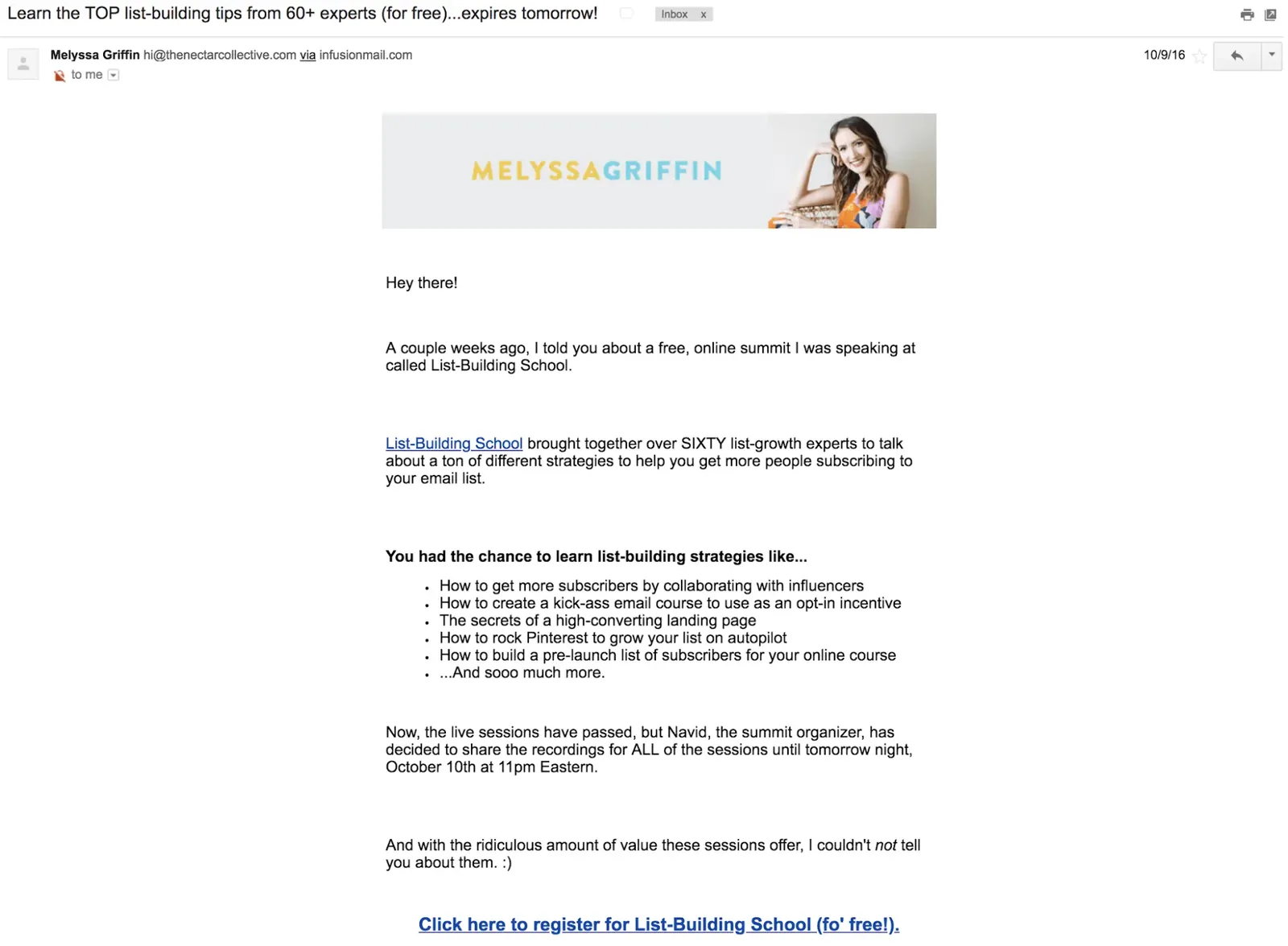
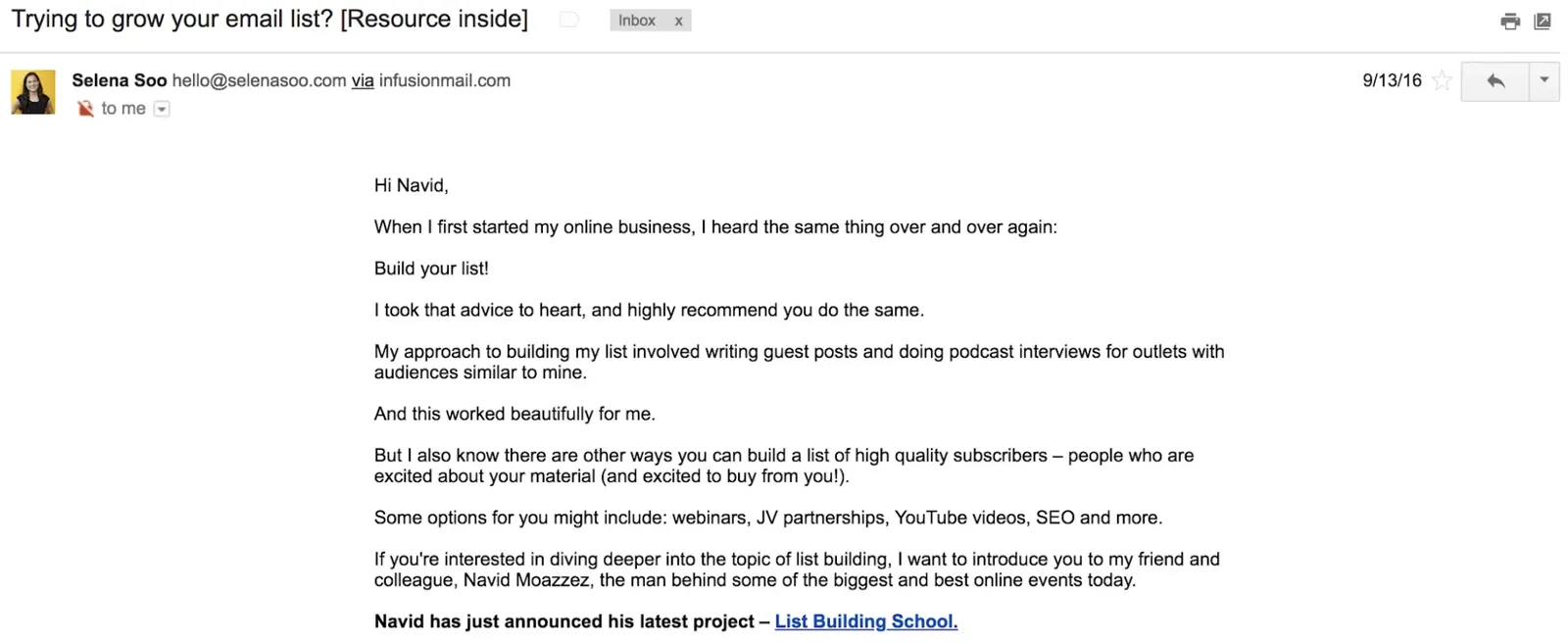
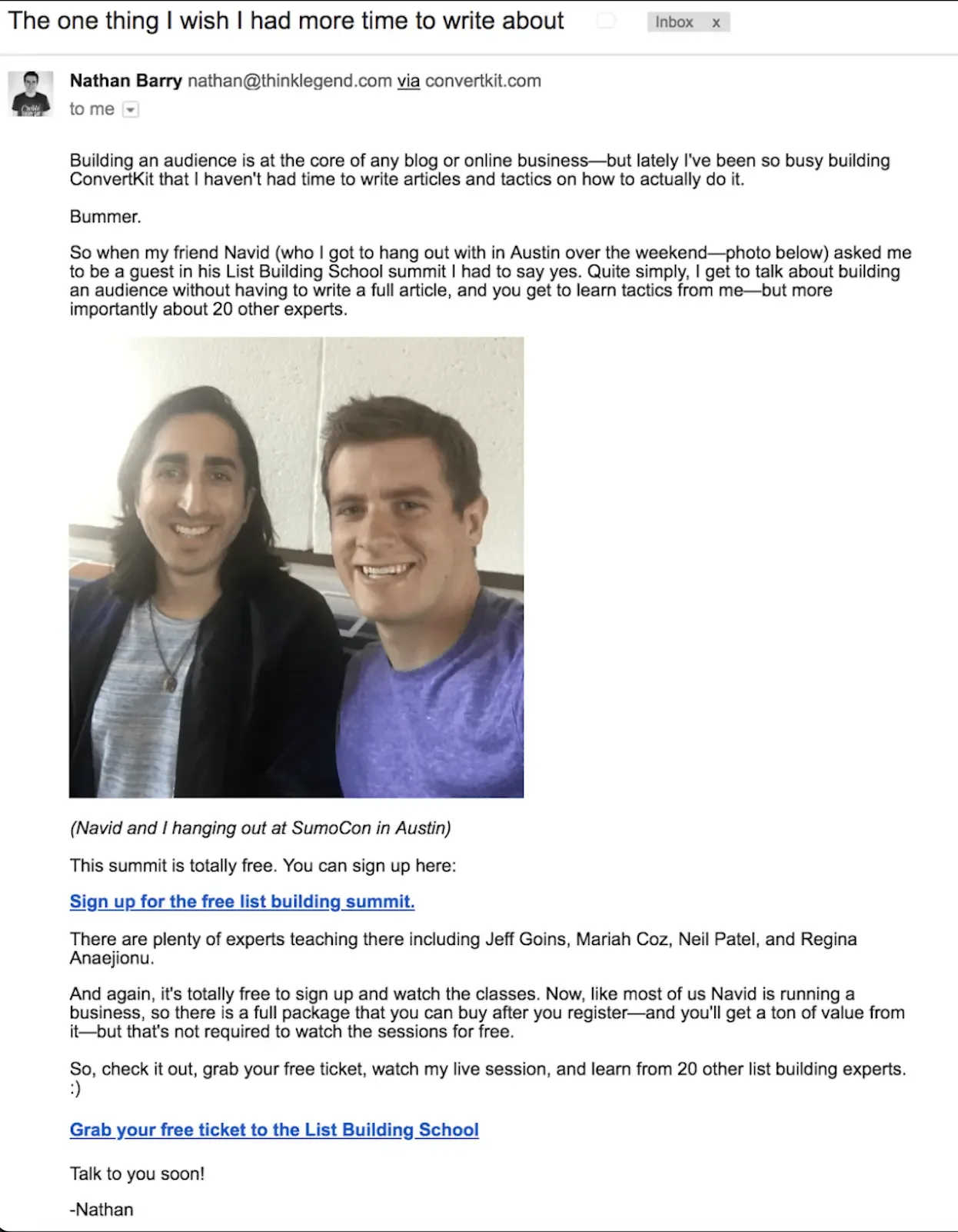
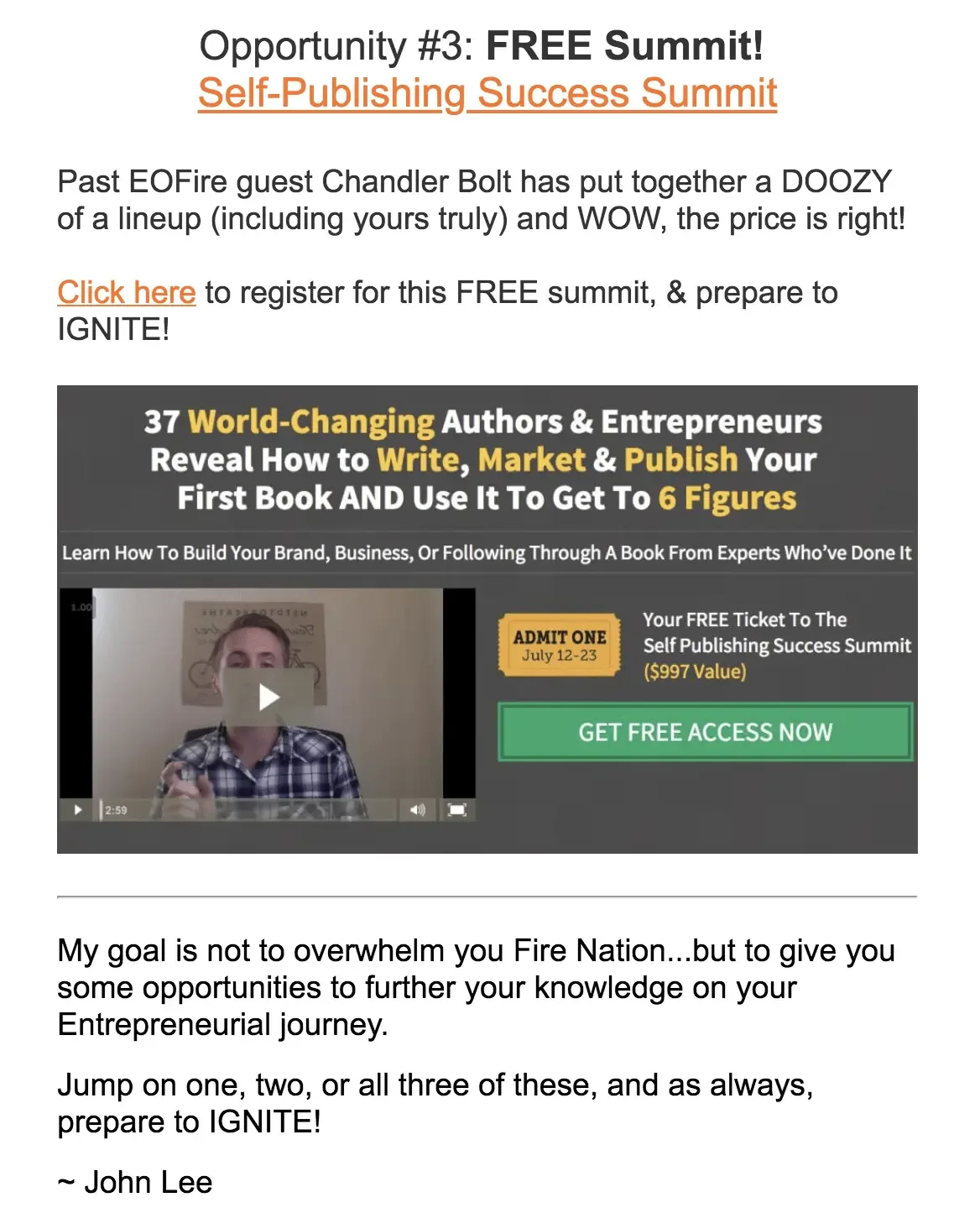
This is how some of the biggest names in my industry shared my summits. Melyssa Griffin and Ryan Levesque shared List Building School with well over 100,000 people between them, and Nathan Barry shared it with his personal list:
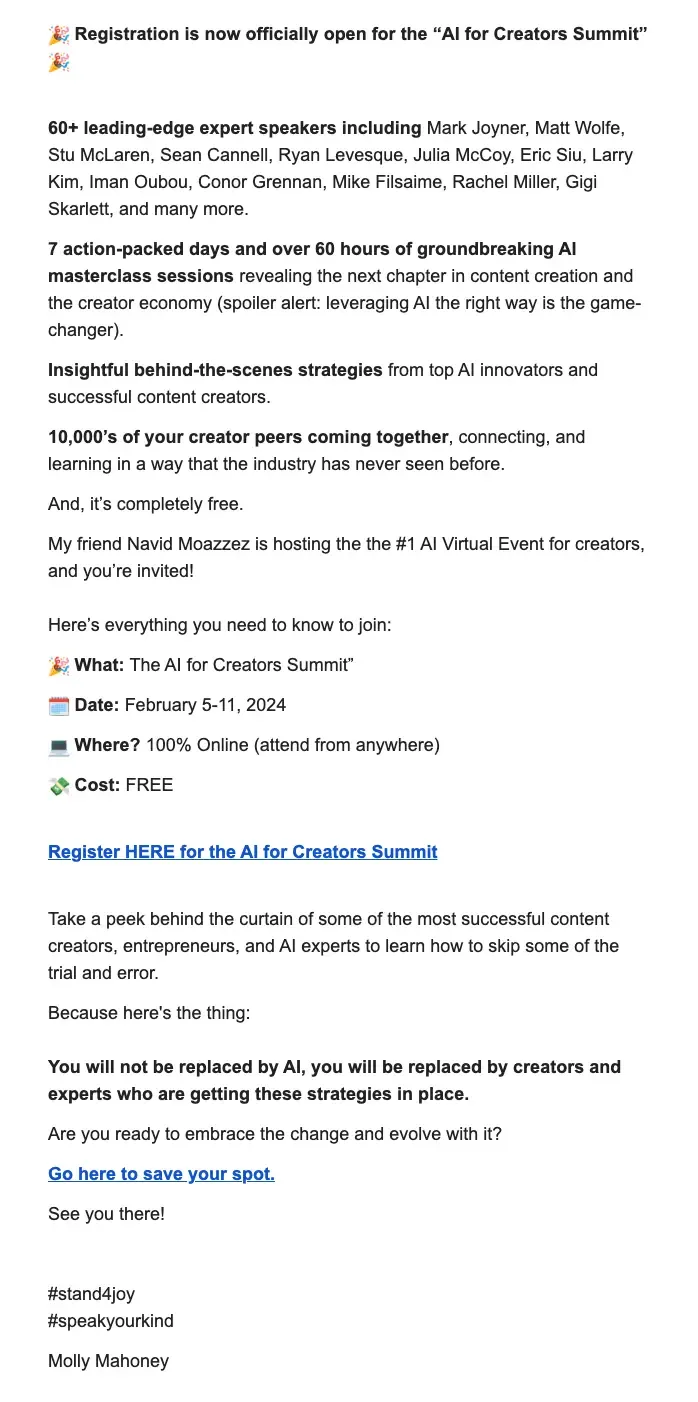
And the same thing happens with my AI summits, like the AI for Creators Summit in 2024:
Reward your attendees for sharing
For the AI Creator Summit 2026, every attendee could share a free ticket and unlock up to 6 rewards, from a VIP Backstage Pass at 3 referrals to my Claude Skills Library and a 1-on-1 strategy call at 100. Your attendees become your promoters.
Get publicity and test paid ads
Pitch blogs, podcasts and YouTube channels in your niche with a newsworthy angle, the same way you reach out to speakers. And if you run ads, start at around $10 a day, split test your text and images, give each ad 1 clear call to action, and scale what works.
For the full plan, read 21 online event marketing strategies, and use the 6-week timeline in how to promote a virtual event.
7. Monetize and scale 💰
After all that work, take a moment to enjoy it, and personally thank your speakers and partners. Then use the momentum.
Overdeliver to your customers
Your new customers can become lifelong customers. Surprise them with bonuses they didn't expect: a private community, extra live Q&As, special offers, and outstanding support.
Set up your backend
Pass sales are great, but the real money is in your backend. During the AI Creator Summit 2026, I launched AI Creator OS with a super early bird price, and my partners could earn 30 to 50% on every customer they referred.
If you don't have a product yet, pilot a course, coaching program or membership with your new audience. For all the options, see how to monetize virtual events.
Repurpose, go evergreen and relaunch
1 summit session can become podcast episodes, YouTube videos, blog posts, emails, social posts and even a book. You can turn the summit into an evergreen lead and revenue machine.
And you don't have to start from scratch next time. I've relaunched the AI Creator Summit every year since 2024, with new speakers each time. Every relaunch builds more relationships and more value for your offer.
Keep the relationships going
The relationships you build are the most valuable part of a summit. A while after Regina Anaejionu spoke on my first summit, we teamed up on a free workshop for her audience:
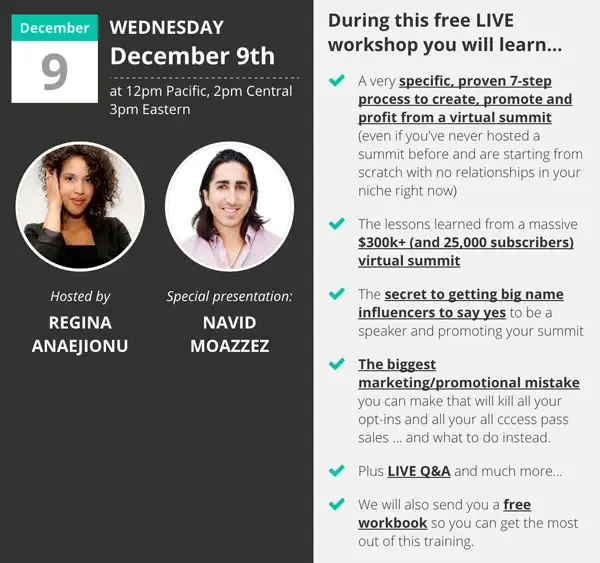
By Regina's count, over 1,000 people signed up, and it turned into a great opportunity for both of us. More on this in how to build relationships with influencers.
How I use AI to host a summit now
The method hasn't changed since 2014. The work has.
Summit site
I build every summit on AI Summit OS, my Next.js templates. Claude builds the site from them.
Speaker invites
A Claude skill drafts my invites in my voice, after researching what each speaker is doing right now.
Recording
Sessions are pre-recorded on Riverside, like a video podcast, with screen sharing and demos.
Thumbnails
My YouTube thumbnail skill pulls the video and transcript, grabs each face, and writes the text from what was actually said.
Rewards
The referral rewards are AI assets too, like my Claude Skills Library and AI Lead Magnet OS.
I'm putting the full method, rebuilt so AI does most of the work, into my upcoming book Virtual Summit OS.
10 virtual summit mistakes (and how to avoid them)
Most people who try virtual summits and struggle make at least 1 of these:
- The wrong topic: Too broad. Narrow your niche until it hurts.
- The wrong positioning: No clear hook, or a name that's too clever, too long or trademarked.
- The wrong speakers: Big names who don't fit your audience, instead of the right mix of up-and-comers, trusted authorities and A-listers.
- Asking before giving: Cold invites with no relationship and nothing in it for them.
- The wrong offer: Nothing to buy, or an offer that isn't clear on the page right after people register.
- No launch plan: Promoting everywhere at once, instead of doing a few channels really well.
- The wrong timing: Starting promotion too late, or dragging it out until everyone loses interest.
- Sessions that stay open forever: Without a deadline, people put off watching and never buy.
- No follow-up: Skipping the encore, the survey and the nurture sequence.
- Stopping after 1 summit: The relationships, the backend and the relaunch are where the long-term value is.
I go through 21 of them, with the fix for each, in virtual event mistakes and how to avoid them.
Real virtual summit results
My students have hosted successful summits in every kind of niche. A few of them:
- Caitlin Pyle: 60,000 email subscribers and $500k+ in sales in 2 weeks
- Steph Gaudreau: From 62 subscribers to 19,560 new ones with the Women's Strength Summit
- Jesse Krieger: 15,000 new email subscribers and 500+ customers
- Eric Yang: From 0 to 15,000 email subscribers and $170K+
- Devin Slavin: 4,000 new email subscribers and $80K+ in revenue
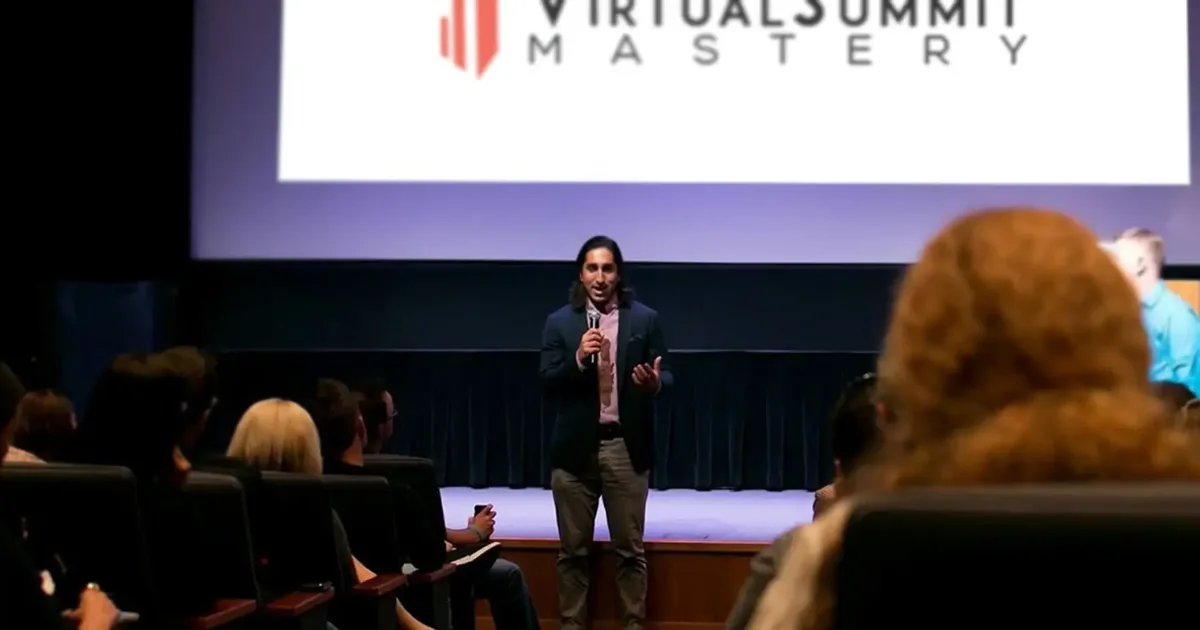
And the Self-Publishing Success Summit I did with Chandler Bolt brought in 25,000+ opt-ins. You can read what 1,000+ students said on the Virtual Summit Mastery page.
FAQs about hosting a virtual summit
Below you’ll find answers to a few questions people ask about how to host profitable online summits.
A virtual summit is an online event where experts share insights through interviews or presentations. People sign up to attend and can usually watch for free. Some summits run for a single day, while others span several days, it depends on your strategy. Many hosts offer an optional upgrade or product to monetize the event.
Most successful summits take 60 to 90 days to plan, especially if it’s your first one. That gives you time to choose a topic, invite speakers, create your offer, and promote the event. Some hosts launch faster in 30 to 45 days using a proven system.
Start with your ideal audience. What do they need help with right now? A great summit topic solves a real problem and ties into your backend offer. Bonus if it feels timely or taps into a growing trend in your niche.
Not at all. Your summit can become your first product, either as an all-access pass, a bundle, or something you launch right after. Many of my students started with no product and used the summit to build one along the way.
Make a list of experts your audience would love to hear from. Start with people you know or follow, then expand. When reaching out, highlight what’s in it for them, exposure, affiliate commissions, and being part of a high-quality event.
No. One of the best parts of a virtual summit is that it builds your audience *as you launch it.* Even if you’re starting from zero, you can grow fast with the help of speakers, affiliates, and partners.
No. Most summits are pre-recorded and released on a schedule (like 3 to 7 days). This gives you more control, less stress and better content. I pre-record every session, then host a live Q&A each day of the summit to make it interactive.
You only need a few essentials: A remote recording software for high-quality video interviews, a page builder, an email platform, a sales / checkout system, and somewhere to host your sessions. The setup doesn’t need to be complicated, many summit hosts start with simple, creator-friendly tools and upgrade later.
Your marketing plan should focus on email, affiliates, and organic content. Most successful summits use a mix of speaker promotions, your own list (if you have one), social media, and partnerships. Paid ads can work too, but they’re optional when your offer and positioning are strong.
Focus on a compelling topic, strong speaker lineup, and an irresistible free offer. You can also include bonuses for early registration or referral rewards. The more clear and valuable it feels, the more people will sign up and share.
You don’t need a fancy studio to record great-looking summit interviews. A solid mic, a decent camera (even your smartphone can work if it’s set up right) and good lighting go a long way. I record every session remotely on Riverside.
Summits can be 1 day or several days. The sweet spot for most creators is 3 to 7 days. That gives you enough time to feature speakers and promote the event, without overwhelming yourself or your audience.
Share daily updates by email, encourage people to comment, and if possible, create a private community or chat for attendees. You can also livestream a kickoff or host a Q&A to make it feel more interactive, even if most sessions are pre-recorded.
Send a thank-you email to attendees and speakers, recap the highlights, and offer a next step (like a related digital product or coaching). You can also ask for feedback or testimonials and invite them to join your list or community for future offers.
You don’t need a big budget to host a successful summit. Many creators launch their first one for just a few hundred dollars, or even less, depending on your setup.
It’s not uncommon to see big platforms claim it costs $10,000 or more, but that’s usually because they want you to pay for their all-in-one service. The truth is, you can do it yourself with lean tools and keep costs low, especially if you already have a mic, a camera and a basic website.
Focus on value, not expensive software. That’s what gets results.
Final thoughts on hosting a virtual summit
You don't need a big audience, a product or ads to launch a successful summit.
I've done it. So have my students... in markets you wouldn't believe.
All you need is the right topic, a few experts, and a proven summit strategy.
If you want to go deeper, my upcoming book Virtual Summit OS teaches the method behind the summits I've hosted since 2014, rebuilt so AI does most of the work.
Got questions or want to share your summit idea? DM me on X or Instagram. I'd love to hear from you.
Navid Moazzez
AI business strategist & AI OS builder
Navid Moazzez helps creators and founders master AI and build their own AI Operating System (AI OS) to automate their business and life.
Navid.me is reader-supported. When you buy through links on this site, I may earn an affiliate commission. Learn more.
Similar articles
21 virtual event mistakes and how to avoid them
21 online event marketing strategies that work in 2026
What is a virtual event? The complete guide for 2026
How to monetize virtual events: 21 proven strategies (2026)
100 best virtual event examples to model in 2026
21 benefits of virtual events for creators in 2026
100 best questions to ask guest speakers at a virtual event
50 top virtual event ideas that actually work in 2026
19 types of virtual events for creators & marketers in 2026
How to promote a virtual event: 17 tips and a 6-week plan

What is a telesummit? And why video summits replaced them
What is a virtual summit? The complete guide (2026)
 Free AI newsletter
The most actionable AI newsletter for founders
Every week, get proven AI strategies, curated tools, and step-by-step systems to grow your audience, create better content, and build a profitable creator business.
No fluff, no filler, no BS. Just five minutes each week that might level up your online business and life.
P.S. Sign up now to get free access to my ultimate AI tools guide for creators.