

21 virtual event mistakes and how to avoid them
The 21 virtual event mistakes I see most, from the wrong topic to the wrong follow-up, and how to fix each one.
 by Navid Moazzez·Updated Sept 27, 2026·6 min read·Navid.me is reader-supported. When you buy through links on this site, I may earn an affiliate commission. Learn more.




A virtual event can add thousands of subscribers and pay for itself before it starts.
Or it can eat 3 months of your time and end with 50 registrations.
I've hosted virtual summits since 2014 and taught hundreds of people to host their own. The ones that flop almost never flop because of bad luck. They flop because of the same few mistakes, made again and again.
Here are the 21 virtual event mistakes I see most, and exactly how to avoid each one.
Why most virtual events struggle
Most hosts treat their event as a project: book speakers, record interviews, press publish.
The events that work are treated as a system instead: a clear promise, the right partners, a funnel that makes money, and a plan for what happens after.
Every mistake below is a gap in that system.
21 virtual event mistakes and how to avoid them
1. The wrong process 🧭
Making it up as you go is the most expensive way to host an event. You skip the planning, and the problems show up later as a weak offer or a hook that doesn't land.
Jan Koch, who has hosted many summits, put it best in a post in my students' group:
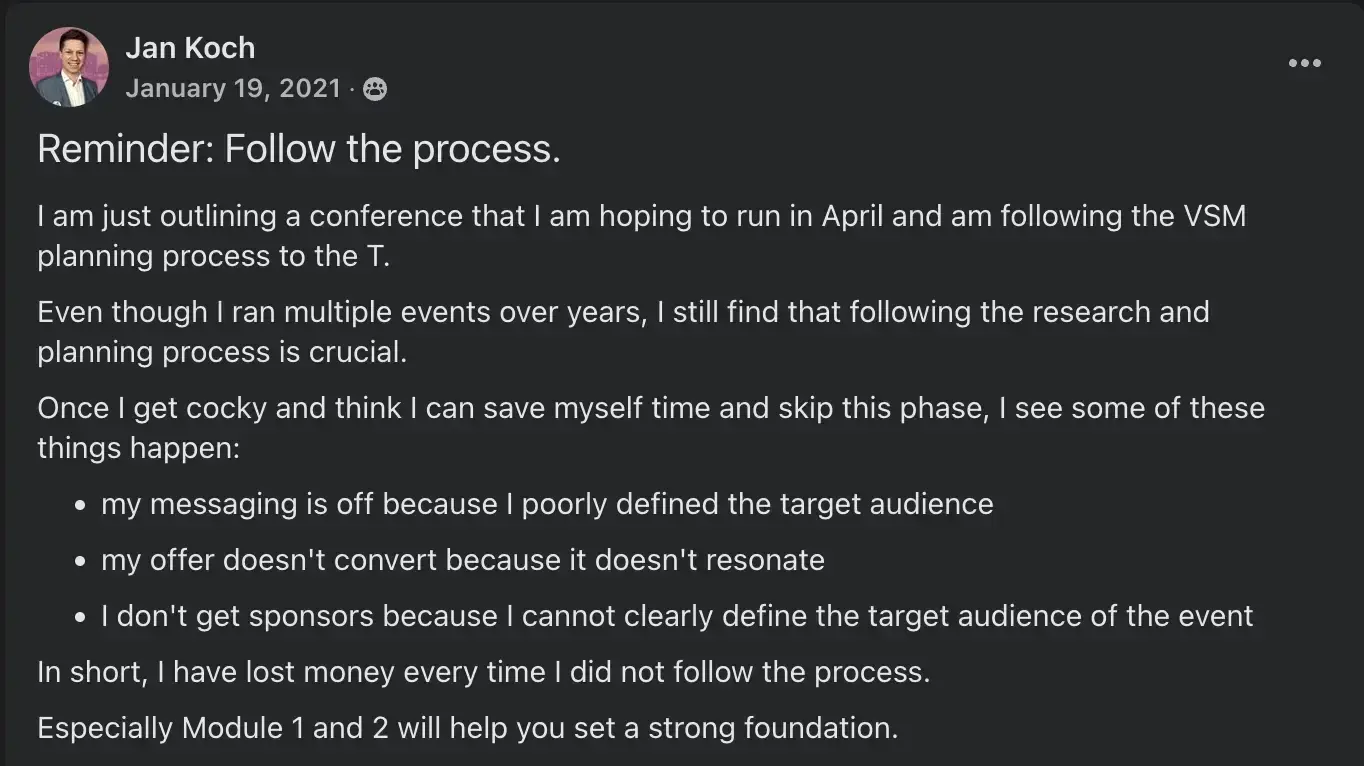
The fix: follow a proven plan from start to finish, especially the planning steps you're tempted to skip. How to host a virtual summit walks you through mine.
2. The wrong topic 🎯
A summit for everyone is a summit for nobody. "Online marketing summit" or "health summit" is too broad to stand out.
The fix: niche down until it feels uncomfortable. Instead of a marketing summit, host a list building summit. Instead of a health summit, a strength summit for women, like Steph Gaudreau did. She went from 62 email subscribers to 19,560 new ones.
Need a starting point? Here are 50 virtual event ideas that have already worked.
3. The wrong hook 🪝
Even with the right topic, a bland angle gets ignored. "Experts share their best tips" isn't a reason to sign up.
The fix: lead with one bold, specific outcome. List Building School promised exactly what it said: learn to build your list. The name was the hook.
4. The wrong offer 💰
No all-access pass, or a pass that's just the recordings, leaves money on the table and makes the event hard to pay for.
The fix: offer the recordings plus bonuses that make them easier to use: transcripts, workbooks, templates, a speaker bonus or two. Price it so it's an easy yes for the people who got value.
5. The wrong speakers 🎤
Chasing the biggest names is tempting. But a famous speaker who never shares your event does less for you than a mid-sized creator who emails their list twice.
The fix: pick for alignment first: their audience matches yours, their content is actionable, and they're excited to be part of it.
6. The wrong launch plan 🚀
Posting the registration page a week before the event isn't a launch. It's a hope.
The fix: plan your promotion 4 to 6 weeks out, in phases, with partners doing a big part of it. Here's a 6-week plan for promoting a virtual event.
7. The wrong tools 🧰
Too many tools, or tools that don't talk to each other, turn a simple event into a tech project.
The fix: keep the stack small: one recording tool, one page builder, one email platform, one checkout. Today I host my summits on AI Summit OS, my set of summit templates from registration to replay vault. Claude builds from them, so a summit site comes together fast.
8. The wrong content 📼
Generic interviews where every speaker gives the same 5 tips. Attendees stop watching after day 1.
The fix: give each speaker one specific topic, and ask questions that pull out stories and step-by-step detail. Use my 100 best questions to ask guest speakers.
9. The wrong funnel 🔀
A registration page that goes straight to "thanks, see you soon" wastes the moment someone is most excited.
The fix: registration page, then a thank-you page that offers the all-access pass at an early bird price, then a welcome email. That's how List Building School had $104,811 in pass sales before it started.
10. The wrong agenda 🗂️
8 sessions a day for 10 days is too much for anyone to watch. People fall behind, then give up.
The fix: 3 to 5 sessions a day, grouped by theme, so each day has one clear takeaway.
11. The wrong promotion strategy 📣
Relying only on your own list keeps your event exactly as big as your audience already is.
The fix: make your speakers and affiliates your main channel, with a promo kit, tracking links and a contest. See 21 online event marketing strategies.
12. The wrong communication 📭
Registrants who hear nothing between signing up and the kickoff forget they signed up.
The fix: a welcome email, a few value emails before the event, and one short email every morning of the event with that day's sessions.
13. The wrong delivery ⚠️
Live sessions that crash, links that don't work, videos that won't play. Tech problems during the event cost you trust and sales.
The fix: pre-record the interviews, test every page and link the day before, and keep a backup plan for anything live.
14. The wrong recording setup 🎧
Bad audio makes people leave faster than a bad camera. A great interview with echo and noise is hard to finish.
The fix: a good USB microphone, a quiet room and a recording tool that captures each person locally, like Riverside. My video gear guide has the setup I use.
15. The wrong timing 📅
Launching over a holiday, or the same week as a big launch in your niche, splits the attention you need.
The fix: check your niche's calendar before you pick dates, and avoid big holidays and school breaks for your audience.
16. The wrong length ⏳
Too long, and people burn out. Too short, and you don't have enough time to build trust and sell the pass.
The fix: 3 to 7 days works for most summits. Start there, then adjust based on how many people keep watching to the end.
17. The wrong bonuses 🎁
Bonuses that nobody wants, or so many that the pass looks like a pile of stuff, don't help sales.
The fix: 2 or 3 bonuses that help people use what they learned: a workbook, a template pack, a live Q&A. Quality over quantity.
18. The wrong tracking 📊
Without tracking links, you don't know which partners brought people in, and you can't pay affiliates fairly.
The fix: give every partner and every channel its own link, and check the numbers daily during the launch.
19. The wrong follow-up 📬
The event ends and the host goes quiet. Thousands of warm subscribers go cold.
The fix: a replay weekend, a last call for the pass, then a clear next offer: a course, coaching, a membership or your next event.
20. The wrong goals 🏁
"Get as many signups as possible" isn't a plan. And a goal that's only about you forgets the people who make the event work.
The fix: set 3 numbers before you start: registrations, pass sales and new subscribers for your speakers. Include your attendees' results in what you call success.
21. The wrong value proposition 💡
If you can't say why someone should spend 5 days with your event instead of watching YouTube, neither can they.
The fix: promise a transformation, not information. "Build your first 1,000 subscribers" beats "learn from 30 experts".
A quick checklist before you launch
- A broad topic nobody can picture
- Speakers chosen for fame, not fit
- No pass, or a pass with no bonuses
- Promotion that starts a week before
- No tracking links for partners
- No plan for after the event
If you can say "not me" to all 6, you're ahead of most hosts.
FAQs about virtual event mistakes
The questions I hear most from people planning their first virtual event.
Picking a topic that's too broad.
A summit for everyone is a summit for nobody, so niche down until it feels uncomfortable.
Most fail because of a weak promise, speakers who don't share the event, promotion that starts too late, or no offer.
Very few fail because of the content itself.
3 to 7 days works for most virtual summits.
A single webinar or workshop usually runs 60 to 90 minutes.
Pre-record the interviews, test every page and link the day before, and keep a backup plan for anything live.
Keep your tool stack small so there's less that can break.
No.
My first summit had 88 speakers and I had almost no audience, and it still brought in over $20,000 in sales.
Run a replay weekend, send a last call for the all-access pass, then follow up with your next offer.
You can also turn the event evergreen so it keeps selling.
Final thoughts on virtual event mistakes
My first virtual summit, The Branding Summit, wasn't perfect. It still brought in over $20,000 in sales and close to 3,000 attendees, because I got the big things right: a clear topic, the right speakers and a real offer.
Your first event doesn't need to be perfect either. It needs to avoid the mistakes that sink most events before they start.
Pick the 3 mistakes on this list you're most likely to make, and fix those first. Then go build your event with how to host a virtual summit.
My upcoming book Virtual Summit OS goes deeper on every step, rebuilt so AI does most of the work.

Navid Moazzez
AI business strategist
Navid Moazzez helps creators and founders master AI and build their own AI Operating System (AI OS) to automate their business and life.

Navid.me is reader-supported. When you buy through links on this site, I may earn an affiliate commission. Read the affiliate disclaimer.
On this page
Similar articles
The 14 best live streaming software in 2026 (free and paid)
What is a virtual event? The complete guide for 2026
How to promote a virtual event: 17 tips and a 6-week plan
What is a telesummit? And why video summits replaced them
21 online event marketing strategies that work in 2026
100 best questions to ask guest speakers at a virtual event
19 types of virtual events for creators & marketers in 2026
21 benefits of virtual events for creators in 2026
50 top virtual event ideas that actually work in 2026
100 best virtual event examples to model in 2026
How to monetize virtual events: 21 proven strategies (2026)
What is a virtual summit? The complete guide (2026)
Related free tools


 Bluesky
 Instagram
 LinkedIn
 Threads

 Mastodon

 TikTok
 Pinterest
 YouTube
 Free AI newsletter
The most actionable AI newsletter for founders
Every week, get proven AI strategies, curated tools, and step-by-step systems to grow your audience, create better content, and build a profitable creator business.
No fluff, no filler, no BS. Just five minutes each week that might level up your online business and life.
P.S. Sign up now to get free access to my ultimate AI tools guide for creators.
