




Management Tip of the Day takes one idea from HBR's back catalogue and states it in a paragraph.
The brevity is the point: it is a prompt to think about how you manage, not a course.
Free, with HBR membership behind the full articles it draws from.
A single practical management tip each morning, pulled from HBR's research and writing.
 Curated by Navid Moazzez·Updated Aug 15, 2026·1 min read·Navid.me is reader-supported. When you buy through links on this site, I may earn an affiliate commission. Learn more.
Management Tip of the Day takes one idea from HBR's back catalogue and states it in a paragraph.
The brevity is the point: it is a prompt to think about how you manage, not a course.
Free, with HBR membership behind the full articles it draws from.
Navid Moazzez
AI business strategist
Navid Moazzez helps creators and founders master AI and build their own AI Operating System (AI OS) to automate their business and life.
Navid.me is reader-supported. When you buy through links on this site, I may earn an affiliate commission. Read the affiliate disclaimer.

Navid Moazzez on the AI OS, discipline and health, written for people building something of their own.
Small compounding improvements, one short issue at a time.
Five things Tim Ferriss found interesting this week: tools, books, experiments.
AI research and industry news, covered in more depth than the daily roundups manage.
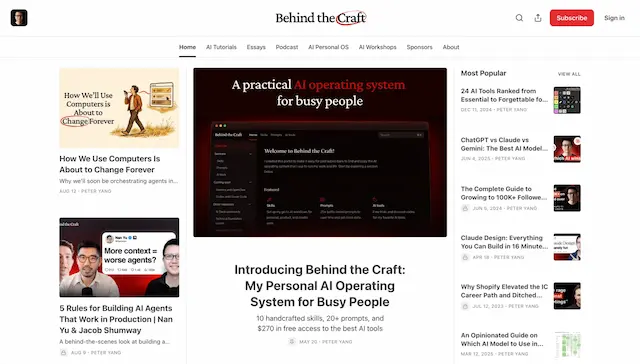
Practical AI tutorials and interviews for busy people, from a product leader who left the job to write full time.
Property investing strategy, deal analysis and market data from the largest real estate community online.
The mindset shifts and systems behind scaling a consumer brand to a billion-dollar exit.
Mental models and decision-making frameworks, drawn from history, philosophy and cognitive science.

Buying boring businesses as a path to wealth, argued against the conventional advice.
Marketing for handmade and product businesses, from someone running one.
Big ideas on growth, wealth and decision-making, broken into usable pieces.

A carefully made weekly of apps, articles, and ideas for a saner digital life.

by Navid Moazzez
Navid Insider is the personal one. It covers the AI operating system I run my own work on, plus the parts most business newsletters leave out: discipline, health, and the decisions underneath the tactics.
The filter is what is actually working, not what is trending. That means fewer tool announcements and more on the systems that survive contact with a real week.
If you want the tactical creator and AI material instead, AI Creator Insider is the other one.
by Colby Kultgen
1% Better is built on compounding. Each issue offers a small, specific change rather than a programme, on the argument that sustainable beats dramatic.
The format is short enough that it never becomes the newsletter you mean to read later.
Good entry point if longer self-help writing tends to lose you.
by Tim Ferriss
5-Bullet Friday is a curation, not an essay. Five items, usually a mix of books, tools, quotes and whatever experiment he is running.
The value is the filter. Ferriss has spent two decades finding what works through self-experimentation, and this is the residue of that.
One of the earliest newsletters of this shape, and still one of the better ones.
AI Breakfast sits a level deeper than the daily AI roundups. It covers research, funding and industry moves with enough context to understand why each one matters.
Three issues a week rather than daily, which suits material that does not need same-day turnaround.
Free to read, with a paid tier for the fuller analysis.
by Peter Yang
Behind the Craft is practical AI writing rather than AI news. Tutorials you can follow, and interviews with people actually building the tools.
Peter Yang led products at Roblox, Reddit, Amazon and Meta for over a decade before leaving Roblox in June 2026 to do this full time, so the product judgement behind the AI material is real rather than borrowed.
It was called Creator Economy by Peter Yang until 2025 and kept the same domain through the rename, so older links still work. There is a paid membership at behindthecraft.com, which is a separate property from the newsletter.
BiggerPockets is the biggest real estate investing community in the US, and the newsletter is its distilled output: deal analysis, financing strategy and market data.
The strength is volume of real cases. Very little of it is theoretical.
Free, with paid membership tools behind it.
by Tom Bilyeu
Billion Dollar Principles leans more on mindset than tactics. Bilyeu's argument is that the constraint on most founders is how they think about scale, not what they know about operations.
That makes it a different read from a growth newsletter. You get frameworks for decision-making and risk rather than channel breakdowns.
Works best as a complement to something more tactical. On its own it is philosophy with a business application.
by Shane Parrish
Brain Food is about the quality of your thinking rather than the quantity of your output. Each issue works through mental models, decision frameworks, and where judgement usually goes wrong.
Parrish draws on history and cognitive science rather than business anecdote, which gives it a longer shelf life than most.
There is a paid membership with deeper material. The free issue alone is worth the subscription if decisions are the expensive part of your work.

by Codie Sanchez
Contrarian Thinking is built on a single premise: the reliable route to financial independence is buying an existing profitable business, not launching a startup.
The newsletter works that thesis through real deals — laundromats, car washes, service businesses — with the mechanics of how they were financed and what they return.
It is opinionated by design, and the framing is deliberately against the grain. Read it for the deal breakdowns; the wealth-building rhetoric is the wrapper, not the substance.
by Mei Pak
Creative Hive is aimed at makers and product sellers rather than at digital creators, which makes it unusual in this list.
Mei Pak runs a handmade jewellery business alongside it, so the advice is tested against real inventory and real margins.
Free, with paid courses behind it.
by Sahil Bloom
Curiosity Chronicle takes a large idea and reduces it without hollowing it out. Topics run across personal growth, wealth building and mental models.
The framing is that curiosity compounds, and the issues are built to leave you with one thing you did not know how to articulate before.
Broad by design, which is the appeal if you do not want a newsletter locked to a single subject.
by Kai Brach
Dense Discovery is one of the best-crafted newsletters going. Each issue collects apps, articles, and ideas, presented with real attention to design.
Kai Brach writes from a position that is thoughtful about technology rather than uncritically enthusiastic, and the recurring theme is using less of it more deliberately.
Worth subscribing to for the quality of assembly alone, independent of any given issue's contents.
Free AI newsletterEvery week, get proven AI strategies, curated tools, and step-by-step systems to grow your audience, create better content, and build a profitable creator business.
No fluff, no filler, no BS. Just five minutes each week that might level up your online business and life.
P.S. Sign up now to get free access to my ultimate AI tools guide for creators.