21 online event marketing strategies that work in 2026
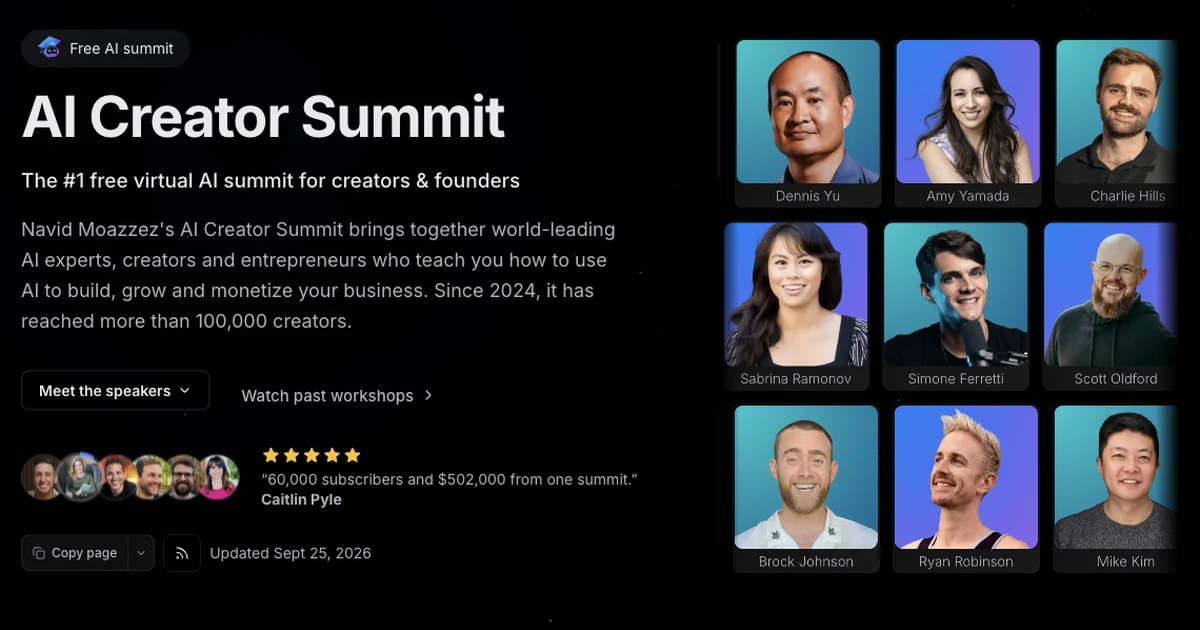
The 21 online event marketing strategies I use before, during and after every summit, with real examples from List Building School and the AI Creator Summit.
Most people market their online events the wrong way.
They build the event for months, then post the registration page a week before it starts, send 2 emails and hope people show up.
I've hosted virtual summits since 2014, from The Branding Summit to the AI Creator Summit. My List Building School summit added over 26,000 subscribers in 2 weeks, and $104,811 in pass sales came in before it even started. None of that came from one launch post.
It came from a marketing plan that starts weeks before the event and keeps working long after it ends.
Here are the 21 online event marketing strategies I use, split into what to do before, during and after your event.
What is online event marketing?
Online event marketing is everything you do to get the right people to register for your event, show up, and buy what you offer.
It covers summits, webinars, workshops, challenges and live launches. The format changes. The job doesn't: turn attention into registrations, registrations into attendees, and attendees into customers.
The difference between an event that fills up and one that flops is almost never the content. It's the plan around it.
Virtual event marketing isn't about going viral. It's about positioning your offer so the right people say yes.
Why online events still work so well
Attention is harder to get every year. Ads cost more, organic reach swings up and down, and a short video is forgotten in a day.
An online event does something a post can't. It gets people to block out time for you, learn from you and the experts around you for several days, and trust you before you ever make an offer.
That's why events still convert. The offer is part of the experience, not an interruption at the end.
And now AI does most of the production work, from the registration page to the replay clips. So the marketing is where your time should go.
More on why in 21 benefits of virtual events.
Before you market anything: lock these in
Get these 3 right first, or no promotion will save the event.
- One clear promise. People don't sign up for "a summit". They sign up for an outcome, like building an email list or learning Claude Code.
- A name that sells itself. List Building School and the AI Creator Summit tell you what you'll get before you read another word.
- A reason for partners to care. Your speakers and affiliates are your biggest channel. Decide early what's in it for them.
Online event marketing strategies before your event
Most of the results are decided here, in the 3 to 6 weeks before the doors open.
1. Start earlier than you think 🗓️
Start promoting to your own audience 3 to 4 weeks before the event. Get your speakers and partners ready 2 to 3 weeks out, with everything they need to share it.
Plan every touchpoint on a calendar: announcement, speaker reveals, early bird deadline, the kickoff, the last call.
2. Build a registration page that converts 📝
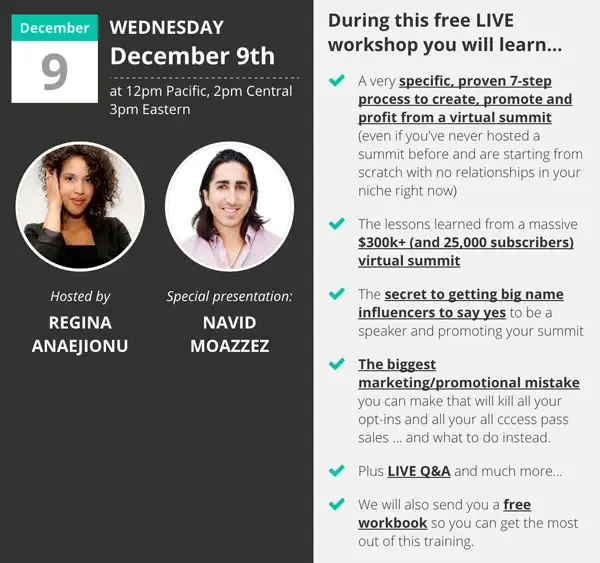
The registration page does one job: get the email. Keep it to one promise, the speakers' faces, a few lines of proof and one button.
Here's the page for a workshop I did with Regina Anaejionu in 2015, before one of my summits:
Make sure it works on a phone. That's where most people will see it first.
3. Turn your speakers into promotion partners 🤝
Your speakers are the biggest marketing channel you have. Their audiences already trust them.
Most hosts send a swipe file and hope. Instead, give every speaker a promo kit: 2 or 3 short emails, social posts, graphics and their own tracking link. Then make sharing their session the easiest thing they do all week.
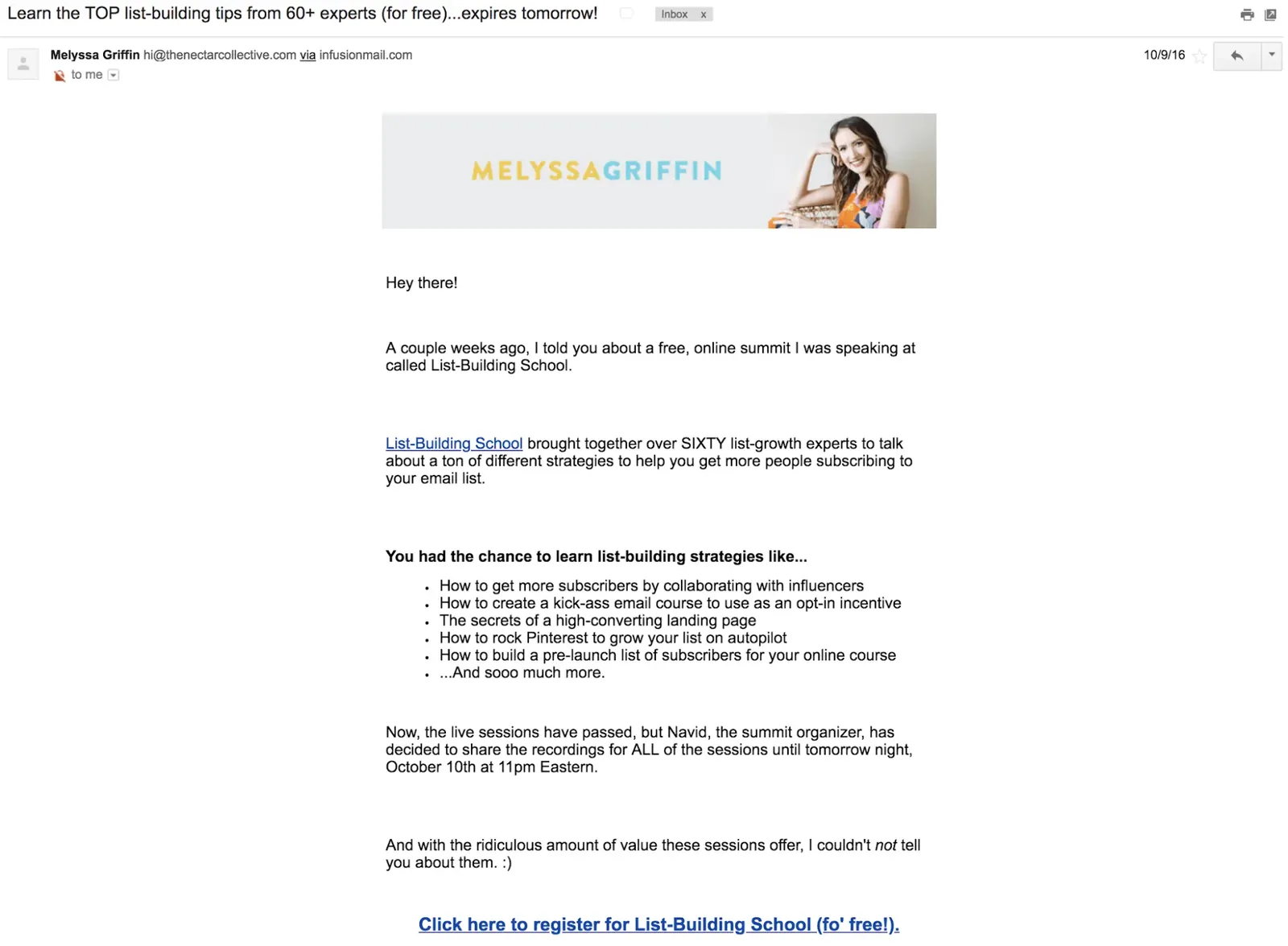
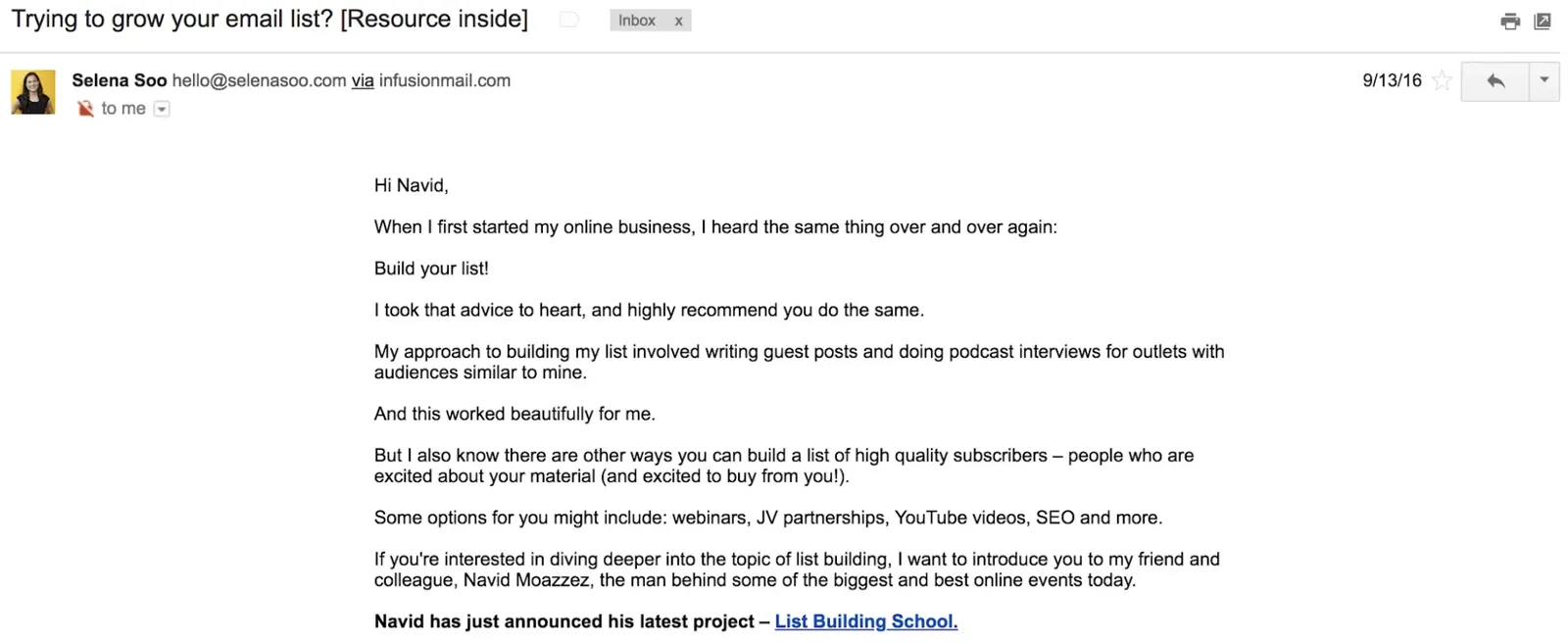
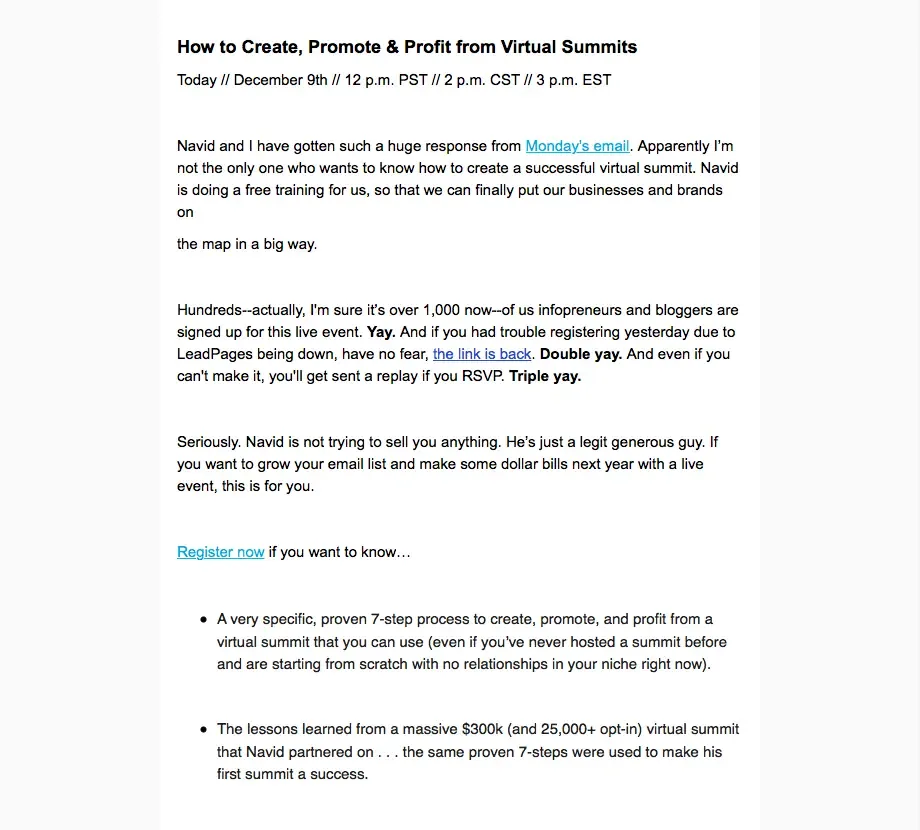
This is what that looks like when it works. Melyssa Griffin, Selena Soo and Nathan Barry all emailed their lists about List Building School:
4. Run an affiliate contest 🏆
Give partners a real reason to promote hard: a commission on every pass they sell, and prizes for the top of the leaderboard.
I've seen both sides of this. In 2015 I became the #1 affiliate for Ramit Sethi's Zero to Launch and made around $40,000 in a month. That's when I learned how much a good contest motivates people.
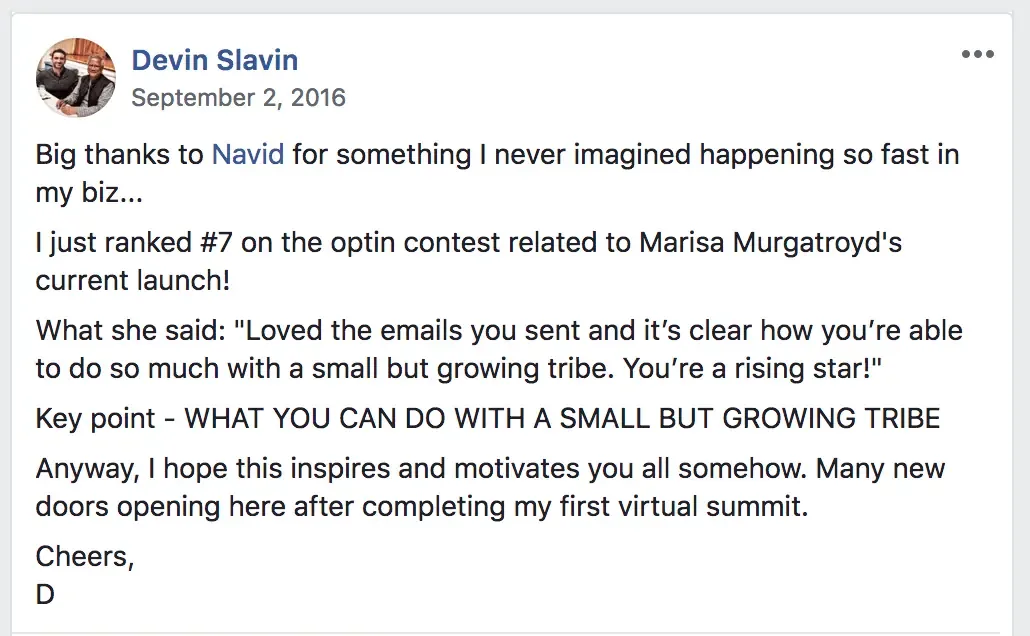
Devin Slavin, one of my students, thanked his partners publicly after his contest:
5. Pre-sell the all-access pass 🎟️
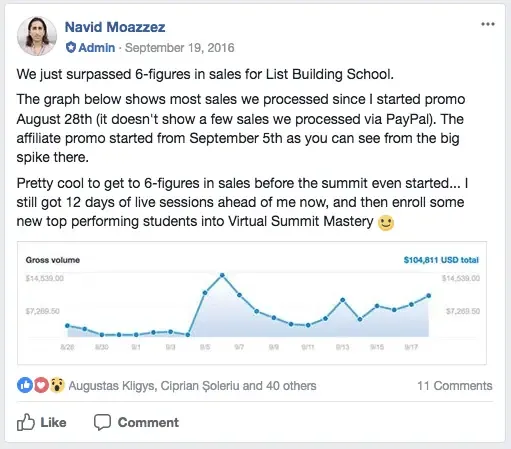
Don't wait for the event to start selling. Open the all-access pass on the thank-you page, right after someone registers, at an early bird price.
That's how List Building School had $104,811 in sales before the summit started:
6. Write an email sequence that sells the event 📧
Your emails should sell the outcome of the event, not the topic.
A simple sequence:
Segment it. People who opened but didn't register get a different email from people who already signed up.
7. Build anticipation on social media 📱
Post short clips from the speaker interviews, quotes, behind-the-scenes and a countdown. Each one is a small preview of the value.
With AI, one interview becomes 10 clips in minutes. Tools like Descript find the best moments for you.
8. Host partner webinars before the event 🎤
A joint workshop with a partner puts you in front of their audience, live, before the summit.
In December 2015, I ran workshops with Chandler Bolt and Regina Anaejionu. They grew my list by close to 2,000 subscribers in a few days.
9. Get press and podcast interviews 📰
A story about you in the right place can bring in more people than a month of posts.
In February 2015, Business Insider featured my summit story. It went viral, and I got almost 2,000 email subscribers overnight. Pitch podcasts and journalists on your story, not your event.
10. Use paid ads only on warm audiences 🎯
Ads to cold audiences are expensive for a free event. Use them to retarget people who visited your registration page, your email list and people who watched your videos.
Start small, and only scale what already works organically.
11. Publish a search-friendly post before launch 🔎
Write a guide on your event's topic a few weeks before launch, and link it to the registration page.
It brings in people searching for that topic now, and keeps doing it for the next event.
12. Offer a real early bird 🐦
A lower price that ends on a specific date gives people a reason to decide now. Keep it real: when the deadline passes, the price goes up.
Online event marketing strategies during your event
The event itself is your best marketing. Treat every day like a launch day.
13. Send a "today's sessions" email every morning ☀️
One short email a day: who's speaking today, the one takeaway to watch for, and the link. It's the single biggest lever for attendance.
14. Go live and build a community 💬
Open with a live kickoff, and run a live Q&A or wrap-up each day. Give attendees a place to talk to each other.
Caitlin Pyle's Facebook group for her Work-At-Home Summit grew from 0 to 28,000 members in a month. The community became part of the event.
15. Make every speaker share their own day 📣
Remind each speaker the day before their session goes live. A speaker sharing "my session is live today" is the easiest promotion you'll get all week.
16. Collect wins and testimonials live 🙌
Ask attendees to post their biggest takeaway. Share the best ones in your emails and on social. Real people getting value is the strongest proof for everyone still on the fence.
17. Sell the pass with a real deadline ⏰
Remind people what the all-access pass includes, and when the price goes up. Most sales come in the last 48 hours, so plan your strongest emails for the end.
Online event marketing strategies after it ends
This is where most hosts stop, and where a lot of the money is.
18. Run a replay weekend 🔁
Open all the sessions for 48 hours after the event. It catches everyone who missed a day, and it's your last chance to sell the pass at the event price.
19. Follow up with your next offer 🚀
Your event just built trust with thousands of people. Follow up with the offer that naturally comes next: a course, coaching, a membership or a live cohort.
20. Turn the event evergreen ♾️
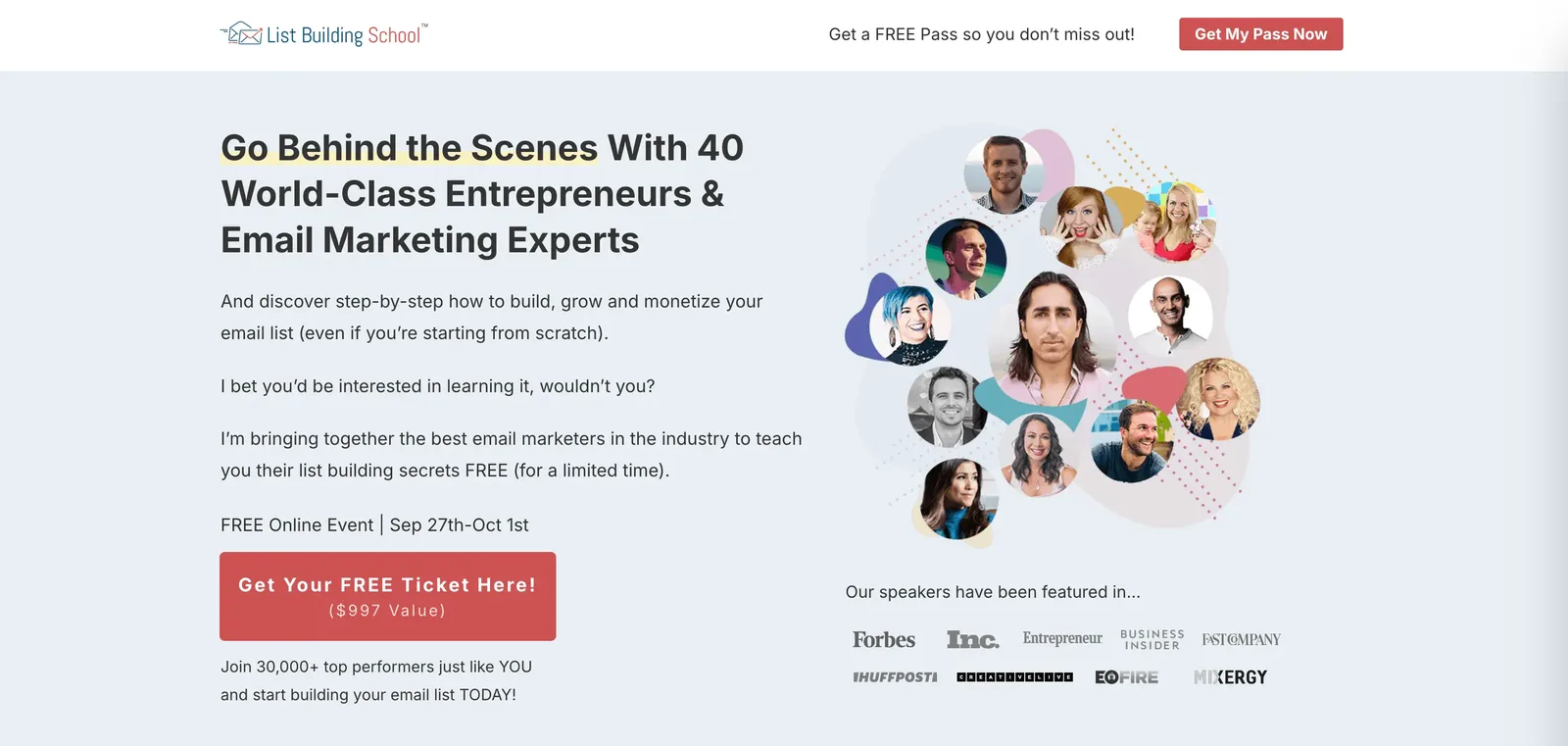
Package the summit so new people can register and buy it all year. Here's List Building School running as an evergreen summit:
21. Repurpose everything with AI ✂️
Every interview is a stack of content: clips, posts, newsletter issues, a lead magnet, even a book. AI turns a recorded summit into months of content in an afternoon.
How to measure your online event marketing
Track these numbers after every event, and compare them next time.
| Metric | What it tells you |
|---|---|
| Registrations by source | Which partners and channels actually bring people in |
| Registration page conversion | How strong your promise and page are |
| Attendance rate | Whether your emails and reminders are working |
| All-access pass conversion | How strong your offer is |
| Affiliate sales by partner | Who to invite back, and who to thank |
| Backend sales | The long-term value of the event |
Use a tracking link for every partner and every channel. Without it, you're guessing.
Online event marketing mistakes to avoid
- Starting too late. A week isn't enough to build momentum.
- Leaving partners on their own. Make it easy for them, or they won't share.
- No hook. If your event sounds like every other one, nobody cares.
- No offer. Without a pass and a backend, you've built an audience and made nothing.
- Stopping when the event ends. The replay, the follow-up and the evergreen version are half the result.
I cover the rest in 21 virtual event mistakes and how to avoid them.
FAQs about online event marketing
The questions I get most about marketing online events, answered from my own summits.
Online event marketing is everything you do to get the right people to register for your online event, show up and buy what you offer.
It covers the time before the event, the event itself and the follow-up after it ends.
Start promoting to your own audience 3 to 4 weeks before the event.
Get your speakers and partners ready 2 to 3 weeks out, with a promo kit and their own tracking links.
Partners are the best channel for most events.
When your speakers and affiliates share your event with their audiences, you reach people who already trust them.
Send a short email every morning of the event with that day's sessions and the link.
Add a live kickoff and a place for attendees to talk, and remind speakers to share their own session day.
Track registrations by source, your registration page conversion, attendance, pass sales and sales by partner.
Give every partner and channel its own tracking link, so you know what actually worked.
Yes.
AI can draft your emails and posts, cut clips from interviews and repurpose the recordings, but your promise, partners and voice still decide the results.
Final thoughts on online event marketing
Great online events aren't marketed in a week. They're marketed before, during and after, with partners doing a big part of the work.
Start with the before: a clear promise, a name that sells, and speakers who want to share it. Then treat every day of the event like a launch day. And when it ends, keep going.
If you're planning your first event, start with how to host a virtual summit. My upcoming book Virtual Summit OS teaches the full method behind my summits, rebuilt so AI does most of the work.
Got questions about marketing your event? DM me on X or Instagram.
Navid Moazzez
AI business strategist & AI OS builder
Navid Moazzez helps creators and founders master AI and build their own AI Operating System (AI OS) to automate their business and life.
Navid.me is reader-supported. When you buy through links on this site, I may earn an affiliate commission. Learn more.
Similar articles
21 virtual event mistakes and how to avoid them
What is a virtual event? The complete guide for 2026
How to host a virtual summit that converts (2026 guide)
How to monetize virtual events: 21 proven strategies (2026)
100 best virtual event examples to model in 2026
21 benefits of virtual events for creators in 2026
100 best questions to ask guest speakers at a virtual event
50 top virtual event ideas that actually work in 2026
19 types of virtual events for creators & marketers in 2026
How to promote a virtual event: 17 tips and a 6-week plan

What is a telesummit? And why video summits replaced them
What is a virtual summit? The complete guide (2026)
 Free AI newsletter
The most actionable AI newsletter for founders
Every week, get proven AI strategies, curated tools, and step-by-step systems to grow your audience, create better content, and build a profitable creator business.
No fluff, no filler, no BS. Just five minutes each week that might level up your online business and life.
P.S. Sign up now to get free access to my ultimate AI tools guide for creators.