Grow faster with virtual events
My first virtual summit made over $5,000 on the day I quit my bank job, in November 2014.
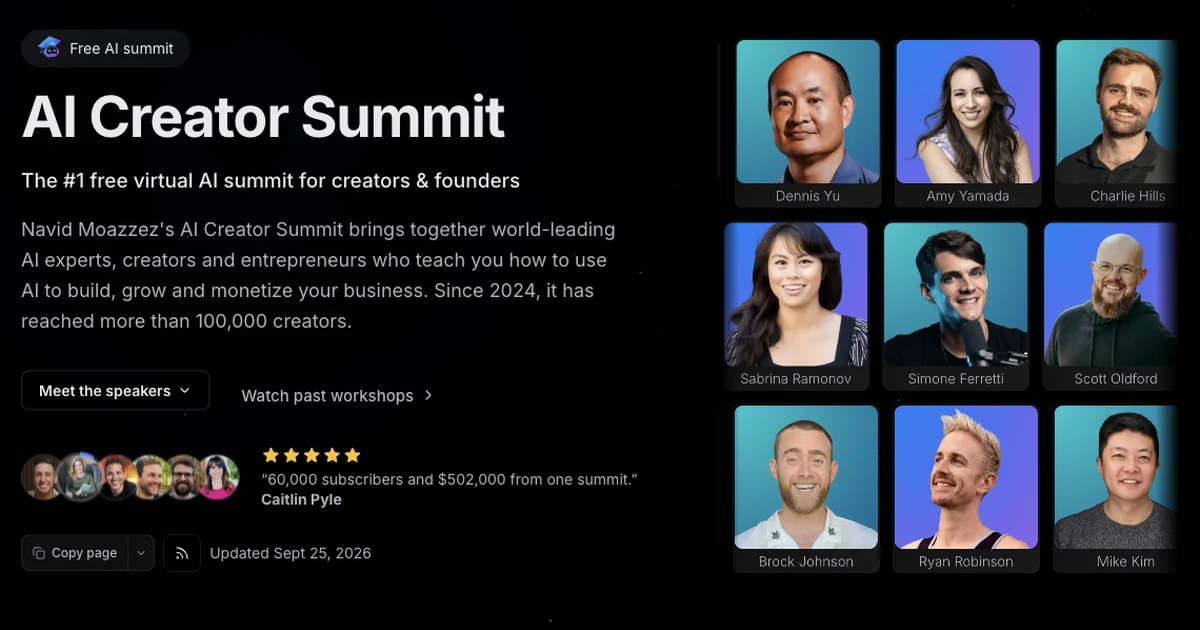
Since then I've interviewed hundreds of experts at my virtual events, and my AI Creator Summit has been watched by 100,000+ creators across 2024 and 2025.
Here's everything I've learned about virtual events: what they are, how to host one, how to promote it and how to make money from it. Start with how to host a virtual summit.
Every article on virtual events

FAQs about virtual events

A virtual event is an organized event that happens online instead of in a physical place.
People register, then watch, learn and interact from wherever they are.
Virtual events let you build an email list fast, make money while you grow your audience, position yourself as an authority, and reach a global audience from your laptop.
A webinar is one type of virtual event: usually one presenter and one session.
A virtual event can also be a multi-day summit with many experts, a workshop or a conference.
A virtual summit is an expert-led online event where people register to watch interviews or sessions, usually for free.
Most run for 1 to 7 days, and the host offers an optional upgrade, like an All Access Pass to the recordings.
Most summits are pre-recorded and released on a schedule, which gives you more control and less stress.
I pre-record every session on Riverside, then host a live Q&A each day of the summit to make it interactive.
Most successful summits take 60 to 90 days to plan, especially if it’s your first one.
That gives you time to choose a topic, invite speakers, create your offer, and promote the event.
Some hosts launch faster in 30 to 45 days using a proven system.
Start with your ideal audience.
What do they need help with right now?
A great summit topic solves a real problem and ties into your backend offer.
Bonus if it feels timely or taps into a growing trend in your niche.
Make a list of experts your audience would love to hear from.
Start with people you know or follow, then expand.
When reaching out, highlight what’s in it for them, exposure, affiliate commissions, and being part of a high-quality event.
Most virtual summits run for 1 to 7 days.
When you're starting out, 5 to 7 days works well: enough time to feature your speakers and build momentum, without overwhelming you or your audience.
The AI Creator Summit 2026 ran for 7 days.
No.
You don't need a list, product, or audience to launch a virtual summit.
All you need is a topic people care about and a few experts to guide the way.
Partner with people who already have one.
Invite speakers whose audience matches yours, make it a win for them, and give them everything they need to share it.
Put up a waitlist page about 6 weeks before the event.
Announce it to your list about 4 weeks out, and have your partners start sharing about 3 weeks out.
Plan an announcement, a few speaker spotlight emails, an early bird deadline, a countdown and one email every morning of the event.
Each phase gives you a new reason to write.
The most profitable approach combines multiple revenue streams, like premium passes, sponsorships, digital products and backend offers, rather than relying on ticket sales alone.
A premium pass, also called an all-access pass, gives attendees lifetime access to all sessions, bonus content and exclusive materials after the free viewing period ends.
Sponsors pay to reach your audience through logo placement, speaking opportunities or promotional mentions.
Sponsorship rates typically range from $500 to $10,000+ depending on audience size and engagement, and some summits land much bigger deals, like Eric Yang’s $50K platinum sponsor.
Yes.
Most of my students didn't start with a big audience, a product or connections.
The summit builds your email list, your product and your relationships at the same time.
Find your idea with the virtual event idea generator, and name it with the event name generator.
Prepare your interviews with the interview questions generator, and count down to it in every email with the email countdown timer.
Use the free time zone converter: it shows one time in every city, and gives you a link that opens in each guest's own time zone.
My first virtual summit was The Branding Summit, in November 2014, with 88 speakers and almost no audience of my own.
It brought in over $20,000 in sales and close to 3,000 attendees.
Yes.
My AI Creator Summit is the one I host now.
The 2026 edition ran for 7 days, June 22 to 28, with 30+ AI experts and creators.
100,000+ creators tuned in across 2024 and 2025.
 Free AI newsletter
The most actionable AI newsletter for founders
Every week, get proven AI strategies, curated tools, and step-by-step systems to grow your audience, create better content, and build a profitable creator business.
No fluff, no filler, no BS. Just five minutes each week that might level up your online business and life.
P.S. Sign up now to get free access to my ultimate AI tools guide for creators.