



Email marketing statistics 2026





Explore the top email marketing statistics for 2026: open and click rates, the email apps people read in, the best time to send, what readers pay and how the top 100,000 websites protect their email.
0.0(0 ratings) by Navid Moazzez·Updated Oct 3, 2026·10 min read·Navid.me is reader-supported. When you buy through links on this site, I may earn an affiliate commission. Learn more.
How the top 100,000 websites that take email protect it (DMARC policy)
| Item | Count | Share |
|---|---|---|
| Reject: failing mail is refused | 17,934 | 25% |
| Quarantine: failing mail goes to spam | 16,259 | 22% |
| None: only reported | 20,299 | 28% |
| No DMARC record | 17,896 | 25% |
Source: the public email records of the top 100,000 websites on the Tranco list (N2PGW), read September 29, 2026


Here are the email marketing statistics that matter in 2026.
Email still reaches people in a way a social feed can't. The newsletters on beehiiv alone sent 28 billion emails in 2025 and reached more than 255 million readers (beehiiv).
How many of those emails get opened? When should you send yours? And how many readers will pay for one?
The answers come from Klaviyo, Litmus, beehiiv, Substack, the Reuters Institute, Google and Microsoft, plus the public email records of the top {{dm\_top}} websites.
In this post, you'll find:
- The average open and click rates, and the best day and time to send
- How often newsletters go out, and which subject lines get opened
- How many readers pay, and what paid newsletters charge
- How the top {{dm\_top}} websites handle and protect their email
- The email platforms to act on it
Every number names its source, and every chart says how many emails, newsletters or websites it comes from.
TL;DRTop email marketing statistics (Navid's picks)
What is the average email open rate?
Newsletters averaged a 41.24% open rate in 2025, up from 37.98% in 2024 (beehiiv).
Newsletters averaged a 41.24% open rate in 2025
beehiiv, The State of Newsletters 2026 · 28 billion emails
That's across 28 billion emails. More newsletters launched in 2025, and readers opened them more often.
Online stores see lower opens. Klaviyo, looking at over 183,000 of its customers, puts a good campaign open rate at 31% in 2026, and 45.1% for the top 10% (Klaviyo).
What is a good click rate?
About 3%. The average click rate fell to 3.23% in 2025, from 4.74% in 2024 (beehiiv).
beehiiv puts the drop down to more competition in the inbox, and to readers reading the newsletter itself instead of clicking out.
So anything above 3% is doing well today. Watch clicks more than opens: they show what readers actually do.
Do automated emails beat one-off campaigns?
Yes, by far. Automated emails, the ones a signup, a browse or an abandoned cart sends, got a 5.58% click rate in 2026, more than 3 times a campaign's 1.69% (Klaviyo).
That's from over 183,000 Klaviyo customers, mostly online stores. Campaigns are 94.7% of what they send, but automated emails bring in nearly 41% of the revenue.
Set up a welcome email first. It reaches every new subscriber at the moment they're most interested.
Do people read newsletters on their phone?
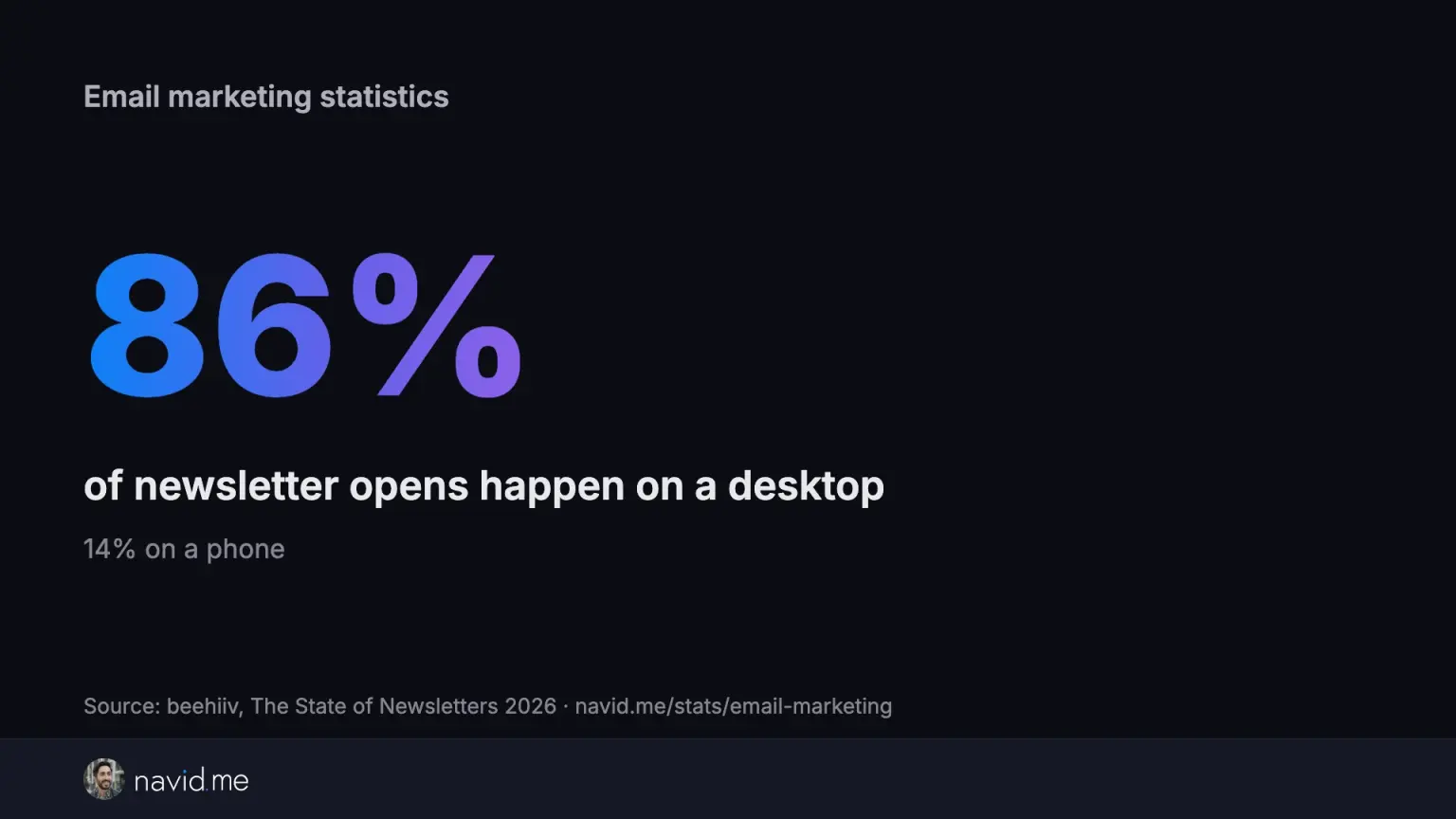
The counts disagree. beehiiv counted 86% of 2025 newsletter opens on a desktop and 14% on a phone (beehiiv).
Litmus, which tracks over {{lt\_opens}} opens a month, says phones are still where most subscribers read (Litmus).
So design for both: a layout that reads well on a big screen, and links big enough to tap.
Which email apps do people read emails in?
Apple Mail and Gmail. Apple Mail had {{lt\_c1\_pct}} of email opens in {{lt\_month}}, and Gmail {{lt\_c2\_pct}}: together, {{lt\_top2\_pct}} (Litmus).
Share of email opens by email app (%)
Litmus, Email Client Market Share · over 1 billion opens in July 2026
Apple's count includes Mail Privacy Protection, which downloads an email's images in the background whether it's read or not (Apple). Litmus puts the share of opens it affects at roughly 55% to 60%.
That's why open rates run high, and why clicks tell you more.
What is the best day to send a newsletter?
Monday wins, but only just. Every weekday lands close to 40% (beehiiv).
Monday is the best day to send a newsletter, at a 40.45% open rate
beehiiv, The State of Newsletters 2026 · 28 billion emails in 2025
Saturday is the only real dip, at 39.41%. Pick the day your readers expect you, and keep it.
What is the best time to send a newsletter?
5am US Eastern time, with a 44.46% open rate. A second peak comes at 3pm Eastern, at 43.5% (beehiiv).
Newsletter open rate by hour (US Eastern) (%)
beehiiv, The State of Newsletters 2026 · 28 billion emails in 2025
Late at night is the worst time. Open rates drop to 28.61% around 10pm Eastern, almost 16 points below the 5am peak.
How often do newsletters go out?
Weekly, by far. 46.67% of newsletters on beehiiv go out every week, 27.15% every month and 1.37% every day (beehiiv).
46.67% of newsletters go out weekly
beehiiv, The State of Newsletters 2026 · newsletters on beehiiv in 2025
The rest send on other schedules. Daily newsletters are rare: fewer than 1 in 50.
Do short subject lines get more opens?
Yes. Short subject lines win the open, and long ones win the click (beehiiv).
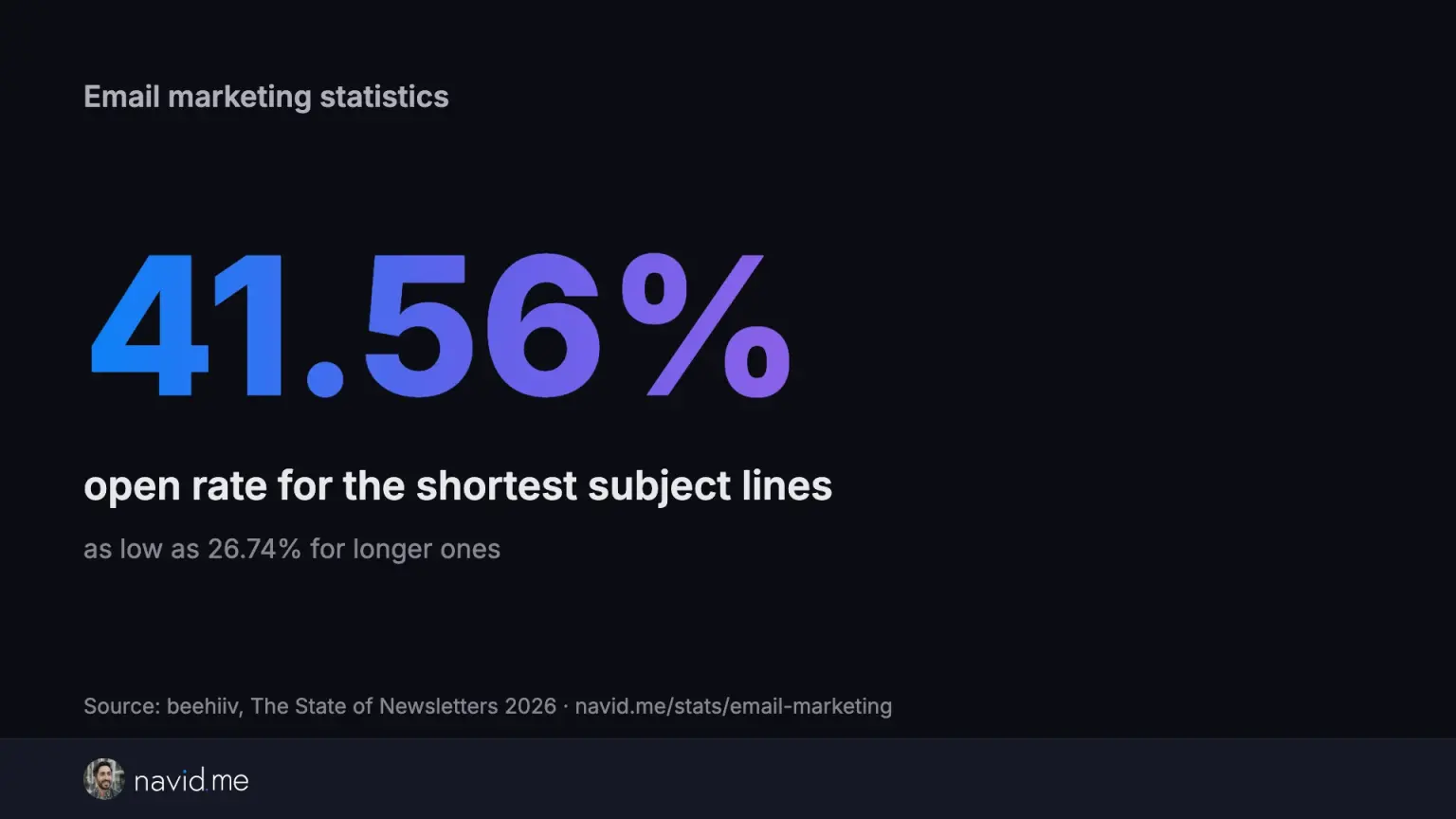
The shortest subject lines opened at 41.56% (beehiiv)
Opens fell to between 26.74% and 34.03% as subject lines got longer.
The longest subject lines got a 7.78% click rate (beehiiv)
That's more than 2.5 times the average click rate.
13.89% of subject lines include an emoji (beehiiv)
Emoji didn't raise or lower opens in beehiiv's data. Use them for your voice, not for the numbers.
You can test yours with my free subject line tester and subject line length checker.
How many readers pay for newsletters?
Paid newsletters are a real business, but most readers still don't pay.
Substack has 5 million paid subscriptions (Substack)
More than 30% of them come from within Substack's own network.
The median paid newsletter converts 0.62% of its readers (beehiiv)
That's about 6 in every 1,000 readers. Sports newsletters convert best, at a median of 1.93%.
Readers who pay, median paid newsletter by niche (%)
beehiiv, The State of Paid Newsletters 2026 · thousands of paid newsletters
The best do far better. The top 10% of finance newsletters convert 20% of their readers, and the top 10% in investing 18.69%.
17% of people pay for online news (Reuters Institute)
That's across the 20 countries the Reuters Institute tracks. Norway leads at 40%, and in most markets it's 10% to 20%.
What do paid newsletters charge?
$10 a month and $100 a year is the median, and it hasn't moved since early 2024 (beehiiv).
A paid newsletter charges a median of $10 a month
beehiiv, The State of Paid Newsletters 2026 · thousands of paid newsletters
Your niche sets the price more than your list size does. A yearly investing newsletter charges a median of $292, and a yearly travel newsletter $80.
If you're launching a paid tier, beehiiv has paid subscriptions built in, and so does Substack.
Which niches keep their paid subscribers longest?
Food and drink, and news. Here's the share of paid subscribers who cancel each month (beehiiv):
Paid subscribers who cancel each month, by niche (%)
beehiiv, The State of Paid Newsletters 2026 · thousands of paid newsletters
The gap adds up fast. At 5% a month, about 54% of subscribers are still paying after a year. At 17%, about 11% are.
AI newsletters lose 13.33% a month, one of the highest rates of any niche.
How fast is paid newsletter revenue growing?
Fast. Paid subscription revenue on beehiiv grew 138% in 2025, from $8 million to $19 million (beehiiv).
The typical creator adds a paid tier 45 days after starting their newsletter.
Which email platform should you use?
It depends on what you send. Here are the main platforms, and what each one is built for:
| Platform | Built for |
|---|---|
 beehiiv | Growing a newsletter and earning from it, with paid subscriptions and an ad network |
 Kit | Creators, with automations and landing pages |
 Substack | Writers who start free and earn from paid subscriptions |
 Flodesk | Emails where the design matters most |
 MailerLite | Growing an audience with email, landing pages and automations |
 Mailchimp | Email and SMS marketing for businesses |
 AWeber | Email marketing with AI writing, landing pages and sign-up forms |
 Ghost | Open source publishing for blogs and newsletters, with paid memberships |
See what each one costs at your list size with my free email marketing pricing comparison.
How do the top websites protect their email?
Most have the basics, but fewer than half block fake mail. These numbers come from the public email records of the top {{dm\_top}} websites on the Tranco list, a research ranking of the most visited sites.
{{dm\_answered}} of them answered every lookup, and {{dm\_mail}} of those take email. Every share below is out of those {{dm\_mail}}.
It matters for every newsletter. Since February 1, 2024, Gmail requires anyone who sends more than 5,000 emails a day to Gmail accounts to set up SPF, DKIM and DMARC (Google).
Outlook followed on May 5, 2025: it rejects mail from domains that send more than 5,000 emails a day and fail SPF, DKIM or DMARC (Microsoft).
{{dm\_missing\_pct}} of the {{dm\_mail}} top websites that take email have no DMARC record at all, so anyone can send mail that looks like theirs.
The biggest brands do better. Among the top 1,000 websites that take email, {{dm\_top1000\_enforced\_pct}} block or quarantine fake mail.
You can check your own domain with my free DMARC checker, SPF record checker and DKIM checker, and make a record with the DMARC record generator.
Which email providers do the top websites use?
Google, then Microsoft. Google handles email for {{dm\_mx1\_pct}} of the top websites that take email, and Microsoft for {{dm\_mx2\_pct}}, going by the mail servers each site lists in its public records (Tranco top 100,000 websites).
Who handles the top websites' email (%)
Tranco top 100,000 websites, public email records read September 29, 2026 · 72,402 websites that take email
Security gateways like Proofpoint and Mimecast count as their own provider here, since they're what the site's mail servers point to. Another {{dm\_other\_mx\_pct}} use a provider outside this list.
Which email platforms do the top websites send with?
Amazon SES and Mailchimp lead. These are the email sending and marketing services the top websites name in their SPF record, the list of who may send their mail (Tranco top 100,000 websites).
Email sending services named in the top websites' SPF records (%)
Tranco top 100,000 websites, public email records read September 29, 2026 · 72,402 websites that take email
This counts a service only when the record names it directly, so it undercounts the platforms that send from their own domain.
Few brands show their logo in the inbox yet. Only {{dm\_bimi\_pct}} of the top websites that take email have a BIMI record, the standard that puts a verified logo next to your emails in Gmail and Apple Mail. My free email deliverability checker checks yours.
How to use these numbers
Before your next send:
- Aim for a 3% click rate, and watch clicks more than opens
- Send in the early morning of your readers' time zone
- Keep subject lines short when the open is what you need
- Launch a paid tier around 6 weeks in, at about $10 a month
- Set up SPF, DKIM and DMARC before you pass 5,000 emails a day
- Compare what email platforms cost with my free email marketing pricing comparison
Send weekly, on the day your readers expect you, and give them a reason to click.
FAQs about email marketing statistics
Questions about email marketing statistics? Here's what to know.
They're the numbers that show how email performs: open and click rates, when people read, how often newsletters send and what readers pay.
This page gathers them from beehiiv's 2026 reports, Substack, the Reuters Institute and Google, plus the public email records of the top 100,000 websites.
They show you what normal looks like, so you know whether your own open or click rate is good.
They also show what to change first: when you send, how long your subject line is, what to charge and whether your domain is set up so your emails land.
About 41% for a newsletter: newsletters on beehiiv averaged 41.24% in 2025.
For an online store, Klaviyo puts a good campaign open rate at 31% in 2026.
About 3%: beehiiv's newsletters averaged 3.23% in 2025, down from 4.74% in 2024.
Monday, by a small margin, with a 40.45% open rate.
Every weekday lands close to 40%, and Saturday is the lowest at 39.41%.
5am US Eastern time, with a 44.46% open rate in beehiiv's data.
A second peak comes at 3pm Eastern, at 43.5%.
The median paid newsletter on beehiiv converts 0.62% of its readers, about 6 in 1,000.
The top 10% of finance newsletters convert 20%.
$10 a month or $100 a year is the median on beehiiv, unchanged since early 2024.
Investing newsletters charge the most, at a median of $27 a month.
Yes, once you send more than 5,000 emails a day to Gmail accounts: Google has required SPF, DKIM and DMARC since February 1, 2024.
Only 47% of the top websites that take email block or quarantine fake mail.
Apple Mail: it had 62.26% of email opens in July 2026, and Gmail 27.03%, in Litmus's count of over 1 billion opens.
Apple's share includes opens from Mail Privacy Protection, which loads emails whether they're read or not.
They come from beehiiv's State of Newsletters 2026 and State of Paid Newsletters 2026, Klaviyo's 2026 benchmarks, Litmus, Substack, the Reuters Institute, Google and Microsoft.
The email security numbers come from the public email records of the top 100,000 websites on the Tranco list, read on September 29, 2026.
Key takeaways
Here's what the email marketing statistics say:
- Opens are up – newsletters averaged a 41.24% open rate in 2025, up from 37.98% in 2024.
- Clicks are harder to earn – the average click rate fell to 3.23%, from 4.74%.
- Early mornings win – 5am US Eastern opened best, at 44.46%, and Monday was the best day.
- Short subject lines get opened – the shortest opened at 41.56%.
- Few readers pay – the median paid newsletter converts 0.62% of its readers, at a median $10 a month.
- Most top websites don't block fake mail – only 47% of the top 100,000 websites that take email block or quarantine it.
- Google and Microsoft run much of business email – together they handle email for nearly half of the top websites that take email.
Email is still the channel you own. For more, see my social media statistics and podcast statistics, and check your own setup with my free email deliverability checker.
Sources (10)
- beehiiv, The State of Newsletters 2026 (January 5, 2026; 28 billion emails sent on beehiiv in 2025), checked Sept 29, 2026
- beehiiv, The State of Paid Newsletters 2026 (June 22, 2026; thousands of paid newsletters), checked Sept 29, 2026
- Substack, About Substack, checked Sept 29, 2026
- Reuters Institute, Digital News Report 2026 (June 16, 2026), checked Sept 29, 2026
- Klaviyo, 2026 Email Marketing Benchmarks by Industry (over 183,000 Klaviyo customers), checked Sept 29, 2026
- Litmus, Email Client Market Share (July 2026; over 1 billion opens), checked Sept 29, 2026
- Apple, Mail Privacy Protection and privacy, checked Sept 29, 2026
- Google, Email sender guidelines, checked Sept 29, 2026
- Microsoft, Outlook's new requirements for high-volume senders (April 2, 2025, updated April 30, 2025), checked Sept 29, 2026
- Tranco list (N2PGW): the public MX, SPF, DMARC and BIMI records of its top 100,000 websites, checked Sept 29, 2026

Navid Moazzez
AI business strategist
Navid Moazzez helps creators and founders master AI and build their own AI Operating System (AI OS) to automate their business and life.

Navid.me is reader-supported. When you buy through links on this site, I may earn an affiliate commission. Read the affiliate disclaimer.
On this page
Related stats
Similar articles

21 influencer marketing mistakes to avoid in 2026

What are influencer partnerships? Types, examples and how to build them

21 types of social media influencers you need to know (2026)

Influencer marketing benefits and disadvantages (the truth)
Influencer marketing: The ultimate guide to connecting & partnering with influencers

How to identify influencers (and find the right ones)

How to reach out to influencers (and get them to say yes)

How to build relationships with influencers: 33 proven ways
Related free tools


 Bluesky
 Instagram

 LinkedIn

 Threads Free AI newsletter
The most actionable AI newsletter for founders
Every week, get proven AI strategies, curated tools, and step-by-step systems to grow your audience, create better content, and build a profitable creator business.
No fluff, no filler, no BS. Just five minutes each week that might level up your online business and life.
P.S. Sign up now to get free access to my ultimate AI tools guide for creators.
