



Free Deep Work Timer (+ Guide)



A free deep work timer that plans each session first, lets urges pass without breaking it, and keeps score in deep hours.
0.0(0 ratings) by Navid Moazzez·Updated Sept 30, 2026·11 min read·Navid.me is reader-supported. When you buy through links on this site, I may earn an affiliate commission. Learn more.
Embed this tool on your site
Paste the code into any page: WordPress, Webflow, Squarespace, Ghost or plain HTML. It's free with the credit under it, which links back to navid.me.
This free deep work timer plans your session before it starts, then gets out of the way while you work.
Most deep work timers are a countdown. This one asks what you'll make first, checks the plan, lets urges pass without breaking the session, and keeps score in deep hours per week.
Here's what deep work is, how 20 people who did great work set up their days, and how to run your first session today.
TL;DRKey takeaways
What is deep work?
Deep work is focused work on something hard, with no distractions, that pushes your skills to their limit. Cal Newport named it in his 2016 book Deep Work.
To produce at your peak level you need to work for extended periods with full concentration on a single task free from distraction.
His argument fits in 2 lines. The ability to focus deeply is getting rarer just as it's worth more.
So the few who build it learn hard things faster and make work that stands out. In 2024 he followed it with Slow Productivity: do fewer things, work at a natural pace, and obsess over quality.
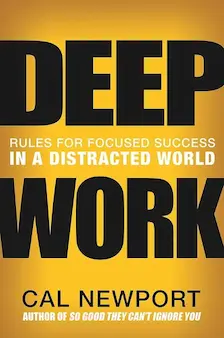
Deep Work

by Cal Newport
Deep Work by Cal Newport teaches how to focus without distraction, master your craft, and produce high-quality work in less time.
I may earn a commission if you make a purchase, at no additional cost to you.
Shallow work, and how to spot it
Shallow work is everything that doesn't need your full mind: email, meetings, admin and scheduling. It feels productive, and it's easy to fill a day with it.
Newport's test is 1 question. How many months would it take to train a smart college graduate, with no training in your field, to do this task?
The more months it would take, the deeper the work. The fewer, the more it belongs in a short block at the end of the day.
- Deep work
- Writing the essay, the script or the course
- Shallow work
- Posting, scheduling and replying
- Deep work
- Designing the offer or the feature
- Shallow work
- Updating the tools you run it on
- Deep work
- Planning the launch
- Shallow work
- Checking the numbers again
- Deep work
- Deciding what matters this quarter
- Shallow work
- Status meetings and chat
Multitasking is distraction dressed up as productivity.
Attention residue: why switching costs so much
Sophie Leroy's 2009 research found that switching tasks leaves part of your attention on the last one. She called it attention residue.
A quick look at your inbox in the middle of a session costs more than the minute it takes. That's why the timer plans 1 deliverable per session, and why you can park a stray thought in 2 seconds instead of acting on it.
How to use the deep work timer
The plan takes about a minute. The checks tell you what to fix before the clock starts.
- The deliverable names a thing that will exist, not an activity
- No email, meetings or admin as the target
- A first step small enough to start in 2 minutes
- 1 big project a day, and 3 active projects at most
- The block fits today's deep work ceiling
How many hours of deep work a day?
Newport cites Anders Ericsson's research: about 1 hour a day of intense focus for a beginner, and up to about 4 hours for experts, rarely more.
So the timer starts you near an hour a day, and adds 15 minutes after each week you use most of it, up to 4 hours. If you already work deeply, you can start higher.
How long should a deep work session be?
- What it suits
- A small deliverable on a low-energy day
- What the timer does
- Keeps the scope narrow
- What it suits
- 1 real deliverable
- What the timer does
- A midpoint note at 90
- What it suits
- A deeper piece of work
- What the timer does
- A midpoint note at 60
Pick the block that fits the minutes you really have without interruption. The plan checks that the deliverable fits it.
Deep work routines of 20 people who did great work
Deep work doesn't look the same in every life. Newport describes 4 ways to fit it in: monastic, bimodal, rhythmic and journalistic, and Slow Productivity adds seasons and doing fewer things.
Here are 20 real routines, each from a named source. Tap a style to load that routine in the timer above: it sets your block length, your level and your ritual.
- Their routine
- 9am to 1pm, phone on airplane mode, moving every hour
- Style
- Navid's own
- Source
- Navid's Longevity OS protocol
 Cal Newport
- Their routine
- Every minute in a time block, a weekly tally, a shutdown ritual
- Style
- Journalistic
- Source
- Deep Work
 Donald Knuth
- Their routine
- No email since 1990, mail answered in batches
- Style
- Monastic
- Source
- Deep Work
 Carl Jung
- Their routine
- A stone tower at Bollingen for deep work, the city for the rest
- Style
- Bimodal
- Source
- Deep Work
 Adam Grant
- Their routine
- Teaching in 1 semester, research in the rest
- Style
- Bimodal
- Source
- Deep Work
 Bill Gates
- Their routine
- Think Weeks: a week away to read and think
- Style
- Bimodal
- Source
- Deep Work
 Jerry Seinfeld
- Their routine
- Writes every day and keeps the chain of red X's going
- Style
- Rhythmic
- Source
- Deep Work
 Walter Isaacson
- Their routine
- Wrote his first book in the gaps of a busy job
- Style
- Journalistic
- Source
- Deep Work
 Theodore Roosevelt
- Their routine
- Studied in the gaps between classes, at full intensity
- Style
- Deadline dash
- Source
- Deep Work
 J.K. Rowling
- Their routine
- Checked into a hotel to finish the last Harry Potter book
- Style
- Grand gesture
- Source
- Deep Work
 Peter Shankman
- Their routine
- Wrote a book on a round trip to Tokyo
- Style
- Grand gesture
- Source
- Deep Work
 Maya Angelou
- Their routine
- A bare hotel room from 6:30am to about 12:30
- Style
- A place for the work
- Source
- The Paris Review
 Mark Twain
- Their routine
- A shed so far off his family blew a horn for meals
- Style
- A place for the work
- Source
- Deep Work
 Dan Brown
- Their routine
- A home by the sea with the secret rooms of his thrillers
- Style
- A place for the work
- Source
- Slow Productivity
 Paul Graham
- Their routine
- Half-day blocks, meetings only at the end of the day
- Style
- Founder
- Source
- Maker's Schedule
 Dan Koe
- Their routine
- 60 to 90 minute morning blocks, shallow work after
- Style
- Creator
 Justin Welsh
- Their routine
- Phone on Do Not Disturb, 1 hour a week to think on paper
- Style
- Creator
 Jane Austen
- Their routine
- Wrote her novels once her social obligations fell away
- Style
- Do fewer things
- Source
- Slow Productivity
 Basecamp
- Their routine
- 6 to 8 week cycles, then a 2-week cooldown
- Style
- Seasons
- Source
- Slow Productivity
 Ian Fleming
- Their routine
- 10 months at a job, 2 at Goldeneye writing Bond
- Style
- Seasons
- Source
- Slow Productivity
Cal Newport: every minute has a job
Newport plans his workday in time blocks, giving every minute a job, and redraws the plan when the day breaks it. He keeps a weekly tally of deep hours, the way a team keeps score.
Each evening he runs a shutdown ritual: check the inbox 1 last time, plan tomorrow, then say "Shutdown complete" and stop thinking about work.
Copy this tomorrow: block the first 90 minutes of your day on paper tonight, and give them 1 deliverable. Load Cal Newport's routine
Donald Knuth: no email since 1990
The computer scientist behind The Art of Computer Programming has had no email address since January 1, 1990. An assistant sorts his mail, and he answers what matters in 1 batch about every 3 months.
It's the monastic style: cut out almost everything that isn't the work. Few jobs allow it fully, but most allow more of it than we use.
Copy this tomorrow: pick 1 channel you check out of habit, and move it to a single batch at the end of the day. Load Donald Knuth's routine
Maya Angelou: a bare room from 6:30am
Maya Angelou rented a hotel room in every town she lived in, and had everything taken off its walls. She arrived by 6:30am and wrote until about 12:30, lying across the bed.
She brought a dictionary, a thesaurus and yellow pads. The room held nothing but the work.
Copy this tomorrow: give your deep work its own place, even if it's 1 corner of a room with nothing else on the desk. Load Maya Angelou's routine
Jerry Seinfeld: the chain
Seinfeld writes jokes every day, and crosses each day off on a wall calendar with a big red X. After a few days there's a chain, and the job is to keep it going.
It's the rhythmic style: the same block at the same time, so starting takes no decision. The timer's weekly tally works the same way, counted in deep hours.
Copy this tomorrow: pick 1 time of day for deep work and put it in your calendar for the next 5 days. Load Jerry Seinfeld's routine
Paul Graham: the maker's schedule
In his 2009 essay, Paul Graham split the world into managers, who work in hours, and makers, who need half a day at least. 1 meeting in the middle of a morning can break it in 2.
His fix was to put meetings at the end of the day, as office hours. The mornings stayed unbroken.
Copy this tomorrow: move 1 meeting from your morning to late afternoon, and guard the morning you get back. Load Paul Graham's routine
Navid Moazzez: 9am to 1pm, phone on airplane mode
Navid's deep work runs from 9am to 1pm, with his phone on airplane mode and no email, messages or browsing. The hardest work goes first, and every hour ends with a 5-minute movement break.

Probably his best desk ever: Waka Wena in Canaima, Venezuela, with the falls behind him. The routine travels, because it lives in the rules, not the room.
Real discipline removes the need for willpower.
Same wake-up time, same habits, fewer decisions.
Copy this tomorrow: put your phone on airplane mode for your first block, and stand up at the end of every hour. Load Navid's routine
Which routine fits you
- Style to try
- Journalistic
- What it looks like
- Deep work whenever a gap opens, 20 minutes or an hour
- Style to try
- Rhythmic
- What it looks like
- The same early block every day
- Style to try
- Bimodal
- What it looks like
- Full days, or full weeks, for deep work
- Style to try
- Grand gesture
- What it looks like
- A new place booked just for the work
- Style to try
- Monastic
- What it looks like
- Cut out everything that isn't the work
- Style to try
- Seasons
- What it looks like
- Cycles of 6 to 8 weeks, then a cooldown
Start with the style your week allows, not the one you admire. You can move toward a deeper one as you clear space.
Deep work vs pomodoro
A pomodoro is 25 minutes of work and a 5-minute break. It helps you start, but it can cut deep work off just as you settle in.
Deep work blocks run 45 to 120 minutes. Use a short block on a hard day, then build up.
Why the timer lets urges pass instead of blocking sites
Newport's advice is to take breaks from focus, not breaks from distraction. Each time you feel the pull and don't follow it, you train your attention.
So when you want to check something, press U. A bubble rises, the urge is counted, and you keep going.
Focus music, sound and scenes
The Sound tab plays instrumental focus music, sorted by mood: deep, calm, lo-fi beats, ambient, cinematic, nature, flow and more. Every track was checked for vocals, drops and sudden changes, and each one crossfades into the next.
Turn on the focus layer to add soft volume pulses, 16 a second, to the middle of the sound. It's the technique tested in a 2024 study by researchers at Brain.fm, where it helped people with more ADHD traits most.
Under the music sit 5 noises made live in your browser: brown, pink, white, rain and ocean. Then pick a scene for the session screen, like a real beach, snowy mountains or a city at night, and the sound can follow it.
Deep work prompts for any AI
The timer runs these prompts for you. Here they are to use in the AI you already have.
| When | Prompt |
|---|---|
| Before a session | Plan 1 deep work session |
| Stuck in the middle | Get unstuck without leaving the task |
| End of the day | Review the day and shut down |
Plan 1 deep work sessionYou are a world-class deep work coach. You know Cal Newport's Deep Work and Slow Productivity: a session has 1 deliverable, a first step small enough to start in 2 minutes, and a clear definition of done.
Think hard before you write. First pull out: what the person wants to exist at the end, how much of it fits in their minutes at their energy, and anything shallow hiding in the task (email, meetings, admin), which never becomes the deliverable.
Rules:
- 1 deliverable, named as a thing that will exist ("the first 400 words of", "3 hook options for"), never an activity ("work on").
- Fit the block: [minutes you have] minutes, at energy [1 to 10] out of 10. Low energy means a smaller scope.
- First step: 1 action, under 12 words, starting with a verb.
- Blockers: the 2 most likely, each with what to do if it happens.
- Flow triggers: 3, short, specific to this task.
- Use only what the person wrote. No hype words. No em dashes.
The shape, with an example:
Task: work on the deep work guide. 55 minutes, energy 8.
Deliverable: The first 400 words of the deep work guide, from the hook to the first heading.
Done: 400 words that read start to finish, ready to edit tomorrow.
First step: Write the hook in 1 sentence.
Before you answer, check: is the deliverable a thing that will exist? Does the first step fit 2 minutes? Does it fit the block?
Answer with: Deliverable, Done, First step, Blockers (2, each with what to do if it happens) and Flow triggers (3).
My task: [what you want to work on]
First step I had in mind: [optional]
Get unstuck without leaving the taskYou are a world-class deep work coach, and the person is in the middle of a session. They pressed "stuck". Keep them working on the same deliverable.
Answer in the check-in shape only: 1 sentence that names what's happening, 1 next step they can do right now (1 action, under 12 words, starting with a verb), and 1 question only if they can't move without answering it. No lecture, no new plan, no em dashes.
Before you answer, check: can they do the next step in under 5 minutes, without leaving the deliverable?
Answer with: What's happening, Next step, and a Question only if I need one.
Deliverable: [what I'm making in this session]
What's happening: [what's in the way]
Minutes left: [minutes]
Review the day and shut downYou are a world-class deep work coach running the end-of-day review. You know Cal Newport's shutdown ritual: review the day, plan tomorrow roughly, then stop thinking about work.
Think hard before you write. First pull out: what got done, what made the best session work, and the 1 thing that cost the most focus.
Write:
- A reflection of 2 sentences, only about what the person wrote.
- 1 upgrade for tomorrow: 1 change, not a list.
- The next micro step for tomorrow's first block: 1 action, under 12 words, starting with a verb.
No praise, no hype words, no em dashes. Before you answer, check: is the upgrade 1 change? Does the next step fit 2 minutes?
Answer with: Reflection, Upgrade and Next step.
Today's sessions: [what I worked on, and for how long]
What worked: [1 or 2 things]
What didn't: [1 or 2 things]
Energy now: [1 to 10] out of 10
Final thoughts on the deep work timer
A timer can't make work deep. A clear deliverable, a first step and a place to put every other thought can.
Pick 1 routine from the table, plan your next session now, and let the bell tell you when to stop.
Plan your deep work with your AI
Run the Deep Work OS prompts in


Deep work timer FAQs
Questions about the deep work timer? Here's what to know.
A deep work timer times focused sessions of hard work with no distractions.
This one also plans each session first, checks the plan, and keeps score in deep hours per week.
Most deep work sessions run 45 to 120 minutes.
Pick 45 minutes on a low-energy day and 90 for 1 real deliverable, and build up from there.
Deep Work cites research by Anders Ericsson: about 1 hour a day for a beginner, and up to about 4 hours for experts.
The timer starts you near an hour and grows your ceiling as you use it.
Cal Newport describes 4: monastic (cut out almost everything else), bimodal (whole days or weeks of deep work), rhythmic (the same block every day) and journalistic (deep work whenever a gap opens).
The timer's Work like tab has a real routine for each.
Yes, the Sound tab plays instrumental focus music sorted by mood, with an optional focus layer, plus 5 noises made in your browser.
Play 1 track and 1 noise together if you like.
No, the deep work timer doesn't block websites.
It counts the urges you let pass, which is how Newport says attention gets stronger, and you can pair it with a site blocker if you need one.
Yes, the timer counts from the time you started, so a background tab, a reload or a sleeping laptop changes nothing.
The bell is set on your browser's audio clock, so it rings on time too.
Yes, the deep work timer is free with no login.
The AI help has a daily limit, and everything else has none.
The AI help runs on Google's Gemini, and every call costs money.
A limit of 20 AI helps a day per person keeps the deep work timer free for everyone and stops bots from using it up.
The timer, the checks and everything else keep working, because they don't use AI.
The same prompts open in your own ChatGPT, Claude or Gemini with your answers filled in, for free.
Yes, every session stays in this browser.
Nothing is sent anywhere unless you ask the AI for help, and then only that plan's words.
No, this tool isn't affiliated with Cal Newport.
It's built on the ideas in his books Deep Work and Slow Productivity, credited on the page and written in our own words.
The deep work timer is for creators, founders and anyone whose best work needs hours of real focus.
Writers, coders, designers and students use the same method.
The shutdown ritual, the brown noise generator and the deep work tracker run on the same sessions.
All the free tools are on navid.me/free-tools.

Navid Moazzez
AI business strategist & AI OS builder
Navid Moazzez helps creators and founders master AI and build their own AI Operating System (AI OS) to automate their business and life.

Navid.me is reader-supported. When you buy through links on this site, I may earn an affiliate commission. Read the affiliate disclaimer.
On this page
More free tools


Related MCP servers & CLIs

 Bluesky
 Substack
 Threads
 Mastodon
 TikTok


 Apple Podcasts
 Free AI newsletter
The most actionable AI newsletter for founders
Every week, get proven AI strategies, curated tools, and step-by-step systems to grow your audience, create better content, and build a profitable creator business.
No fluff, no filler, no BS. Just five minutes each week that might level up your online business and life.
P.S. Sign up now to get free access to my ultimate AI tools guide for creators.
