



73 best weekly newsletters to subscribe to
We curated the best weekly newsletters on business, marketing and personal growth. Find the ones that take time to think before they send.
 Curated by Navid Moazzez·Updated Oct 1, 2026·25 min read·Navid.me is reader-supported. When you buy through links on this site, I may earn an affiliate commission. Learn more.









Find newsletters worth your inbox by topic, platform, how often they arrive and what they cost. Navid's picks come first, and each one opens its own page.
The newsletters I read myself and would send a friend first.




No newsletter matches all of that. Try fewer filters or other words.
Every topic, with how many newsletters it has. Open one to see its page.
 Substack9 newslettersTravel6 newslettersCrypto6 newslettersNews6 newslettersReal estate6 newslettersStartup4 newslettersPersonal branding3 newslettersLifestyle2 newslettersCulture2 newslettersScience2 newslettersWriting2 newslettersHuman resources2 newslettersSEO1 newslettersEducation1 newslettersPhilosophy1 newslettersDesign1 newslettersClimate1 newslettersHealth and wellness1 newsletters
This is a list of the best weekly newsletters.
In fact, it has 73 of them, with Navid's picks first.
So if you want weekly newsletters worth your inbox, you'll love this list.
We curated the best weekly newsletters on business, marketing and personal growth. Find the ones that take time to think before they send.
Here's what's inside:
- Navid Insider by Navid Moazzez
- Peter Attia MD by Peter Attia
- 1% Better by Colby Kultgen
- 3 Minute Monday by Chris Williamson
- 5-Bullet Friday by Tim Ferriss
- AI Breakfast
- Alex & Books by Alex Wieckowski
- Austin Kleon's Newsletter by Austin Kleon
- Behind the Craft by Peter Yang
- Ben's Bites by Ben Tossell
- Benedict's Newsletter by Benedict Evans
- BiggerPockets by BiggerPockets
- Brain Food by Shane Parrish
- Contrarian Thinking by Codie Sanchez
- Creative Hive by Mei Pak
- Creator Science by Jay Clouse
- Curiosity Chronicle by Sahil Bloom
- Dense Discovery by Kai Brach
- Digital Contrarian by Ryan Levesque
- Easlo Newsletter by Justin Chin
- Exponential View by Azeem Azhar
- Forte Labs by Tiago Forte
- Founder OS by Matt Gray
- Future Tools by Matt Wolfe
- Growth Notes by Yannick Veys
- Hacker Newsletter by Kale Davis
- High Performance Journal by Dan Go
- Highlights by Julian Shapiro
- Internet Is Beautiful
- Lenny's Newsletter by Lenny Rachitsky
- LifeNotes by Ali Abdaal
- Location Rebel by Sean Ogle
- Marketing Examined by Alex Garcia
- Marketing Examples by Harry Dry
- MF Insider by Marie Forleo
- Mitch Asser's Newsletter by Mitch Asser
- No Mercy / No Malice by Scott Galloway
- Noah Kagan's Marketing Newsletter by Noah Kagan
- Nomadic Matt's Newsletter by Matt Kepnes
- Not Boring by Packy McCormick
Each one comes with what it covers, who it's for, how often it arrives and where to subscribe.
What are the best weekly newsletters?
Here's the list at a glance, with what each one focuses on and what it costs.
 Navid Insider
- Writer
- Navid Moazzez
- Price
- Free
 Peter Attia MD
- Writer
- Peter Attia
- Price
- Free, with a paid tier
- Writer
- Colby Kultgen
- Price
- Free
 3 Minute Monday
- Writer
- Chris Williamson
- Price
- Free
 5-Bullet Friday
- Writer
- Tim Ferriss
- Price
- Free
- Writer
- Price
- Free, with a paid tier
 Alex & Books
- Writer
- Alex Wieckowski
- Price
- Free
 Austin Kleon's Newsletter
- Writer
- Austin Kleon
- Price
- Free
 Behind the Craft
- Writer
- Peter Yang
- Price
- Free, with a paid tier
- Writer
- Ben Tossell
- Price
- Free, with a paid tier
- Writer
- Benedict Evans
- Price
- Free
- Writer
- BiggerPockets
- Price
- Free, with a paid tier
- Writer
- Shane Parrish
- Price
- Free, with a paid tier
 Contrarian Thinking
- Writer
- Codie Sanchez
- Price
- Free
- Writer
- Mei Pak
- Price
- Free, with a paid tier
 Creator Science
- Writer
- Jay Clouse
- Price
- Free
 Curiosity Chronicle
- Writer
- Sahil Bloom
- Price
- Free
- Writer
- Kai Brach
- Price
- Free
 Digital Contrarian
- Writer
- Ryan Levesque
- Price
- Free
- Writer
- Justin Chin
- Price
- Free
 Exponential View
- Writer
- Azeem Azhar
- Price
- Free, with a paid tier
- Writer
- Tiago Forte
- Price
- Free
 Founder OS
- Writer
- Matt Gray
- Price
- Free
 Future Tools
- Writer
- Matt Wolfe
- Price
- Free
 Growth Notes
- Writer
- Yannick Veys
- Price
- Free
 Hacker Newsletter
- Writer
- Kale Davis
- Price
- Free
 High Performance Journal
- Writer
- Dan Go
- Price
- Free
- Writer
- Julian Shapiro
- Price
- Free
 Internet Is Beautiful
- Writer
- Price
- Free
 Lenny's Newsletter
- Writer
- Lenny Rachitsky
- Price
- Free, with a paid tier
 LifeNotes
- Writer
- Ali Abdaal
- Price
- Free
 Location Rebel
- Writer
- Sean Ogle
- Price
- Free
 Marketing Examined
- Writer
- Alex Garcia
- Price
- Free
- Writer
- Harry Dry
- Price
- Free
 MF Insider
- Writer
- Marie Forleo
- Price
- Free
 Mitch Asser's Newsletter
- Writer
- Mitch Asser
- Price
- Free
 No Mercy / No Malice
- Writer
- Scott Galloway
- Price
- Free
 Noah Kagan's Marketing Newsletter
- Writer
- Noah Kagan
- Price
- Free
 Nomadic Matt's Newsletter
- Writer
- Matt Kepnes
- Price
- Free
- Writer
- Packy McCormick
- Price
- Free, with a paid tier
Top 40 weekly newsletters
1. Navid Insider by Navid Moazzez
Navid Insider is the personal one. It covers the AI operating system I run my own work on, plus the parts most business newsletters leave out: discipline, health, and the decisions underneath the tactics.
The filter is what is actually working, not what is trending. That means fewer tool announcements and more on the systems that survive contact with a real week.
If you want the tactical creator and AI material instead, AI Creator Insider is the other one.
How often: Weekly
Price: Free
Platform: Substack
2. Peter Attia MD by Peter Attia
A free weekly email from Dr. Peter Attia with the latest strategies and tactics for increasing lifespan, healthspan and well-being, plus new podcast announcements.
Signing up also gets you An Introductory Guide to Longevity. Premium members get extra member-only content on top.
How often: Weekly
Price: Free, with a paid tier
Platform: Klaviyo
Subscribe to Peter Attia MD · More about Peter Attia MD
3. 1% Better by Colby Kultgen
1% Better is built on compounding. Each issue offers a small, specific change rather than a programme, on the argument that sustainable beats dramatic.
The format is short enough that it never becomes the newsletter you mean to read later.
Good entry point if longer self-help writing tends to lose you.
Who it's for: Entrepreneurs, high achievers, and creators who want to improve consistently without feeling overwhelmed.
Why subscribe: It provides actionable, bite-sized strategies that make personal growth simple and sustainable.
How often: Weekly
Price: Free
Platform: Kit
Key lessons:
- Small improvements lead to massive long-term gains.
- Focus on systems over goals.
- Growth is about consistency, not perfection.
Subscribe to 1% Better · More about 1% Better
4. 3 Minute Monday by Chris Williamson
3 Minute Monday does what the name says: a small number of high-signal ideas at the start of the week, from the host of Modern Wisdom.
Williamson interviews a wide range of people for the podcast, and the newsletter is partly the residue of that reading.
The brevity is deliberate. It is designed to be read rather than saved.
Who it's for: Entrepreneurs, creators, and busy professionals who want short, high-impact personal growth insights.
Why subscribe: It’s a fast, engaging way to get weekly motivation and actionable life lessons.
How often: Weekly
Price: Free
Platform: Kit
Key lessons:
- Small shifts in thinking lead to massive results over time.
- Clarity and action matter more than information overload.
- Consistency beats motivation in achieving success.
Subscribe to 3 Minute Monday · More about 3 Minute Monday
5. 5-Bullet Friday by Tim Ferriss
5-Bullet Friday is a curation, not an essay. Five items, usually a mix of books, tools, quotes and whatever experiment he is running.
The value is the filter. Ferriss has spent two decades finding what works through self-experimentation, and this is the residue of that.
One of the earliest newsletters of this shape, and still one of the better ones.
Who it's for: Creators, entrepreneurs, and anyone looking for high-impact ideas from one of the best curators in the world.
Why subscribe: Every Friday, Tim Ferriss delivers five handpicked insights that can improve your creativity, workflow, and mindset.
How often: Weekly
Price: Free
Platform: Kit
Key lessons:
- Learn from world-class thinkers, doers, and high performers.
- Experiment with new tools, habits, and ideas to optimize your life.
- Get a curated mix of books, podcasts, and insights to spark creativity.
Subscribe to 5-Bullet Friday · More about 5-Bullet Friday
6. AI Breakfast
AI Breakfast sits a level deeper than the daily AI roundups. It covers research, funding and industry moves with enough context to understand why each one matters.
Three issues a week rather than daily, which suits material that does not need same-day turnaround.
Free to read, with a paid tier for the fuller analysis.
Who it's for: Entrepreneurs, creators, and professionals who want expert insights on AI advancements without sifting through endless news feeds.
Why subscribe: AI is moving fast, but not all updates are worth your time. AI Breakfast filters out the noise and delivers the most relevant AI insights, research, and tools, straight to your inbox.
How often: Three times a week
Price: Free, with a premium option for $5/month or $60/year, which includes an ad-free experience and a free copy of “Decoding AI.”
Platform: Beehiiv
Key lessons:
- Stay ahead with deep dives into AI breakthroughs, without unnecessary fluff.
- Learn which AI tools and projects are worth paying attention to.
- Understand how AI is evolving and what it means for business and creativity.
Subscribe to AI Breakfast · More about AI Breakfast
7. Alex & Books by Alex Wieckowski
Alex & Books is a reading newsletter: recommendations, summaries and strategies for building the habit.
The distinguishing emphasis is application. The argument is that reading more matters far less than doing something with what you read.
Good if your to-read pile is growing faster than your finished one.
Who it's for: Readers, entrepreneurs, and lifelong learners who want to make reading a habit and get more value from books.
Why subscribe: Get weekly book recommendations, reading strategies, and summaries that save time while delivering key insights from top books.
How often: Weekly
Price: Free
Platform: Beehiiv
Subscribe to Alex & Books · More about Alex & Books
8. Austin Kleon's Newsletter by Austin Kleon
Austin Kleon's newsletter is a weekly list of what caught his attention, mixed with notes on creative practice.
The underlying argument is that creativity is a habit of showing up rather than a matter of inspiration, and the newsletter models that by simply arriving every week.
Best for writers, artists and anyone whose work depends on producing something original on a schedule.
Who it's for: Writers, artists, and creators looking for inspiration, practical advice, and fresh ideas to fuel their creativity.
Why subscribe: It’s a thoughtful, no-nonsense newsletter that helps you stay creative, overcome creative blocks, and develop a long-term creative practice.
How often: Weekly
Price: Free
Platform: Substack
Subscribe to Austin Kleon's Newsletter · More about Austin Kleon's Newsletter
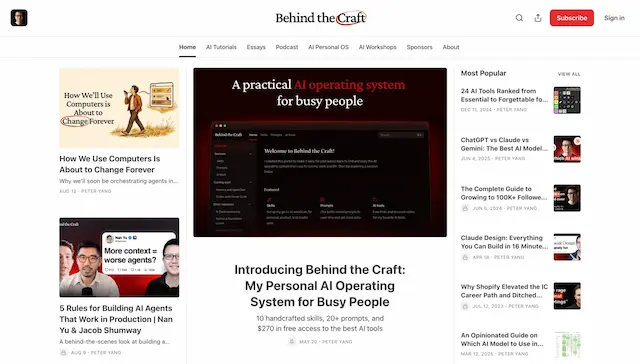
9. Behind the Craft by Peter Yang
Behind the Craft is practical AI writing rather than AI news. Tutorials you can follow, and interviews with people actually building the tools.
Peter Yang led products at Roblox, Reddit, Amazon and Meta for over a decade before leaving Roblox in June 2026 to do this full time, so the product judgement behind the AI material is real rather than borrowed.
It was called Creator Economy by Peter Yang until 2025 and kept the same domain through the rename, so older links still work. There is a paid membership at behindthecraft.com, which is a separate property from the newsletter.
Who it's for: Product managers, creators, and professionals who want to integrate AI into their work to save time, improve productivity, and create better products.
Why subscribe: AI is changing how products are built and how creators grow. This newsletter breaks down practical AI strategies, must-know tools, and real-world case studies so you can stay ahead. Free subscribers get a curated AI tool list.
How often: Weekly
Price: Free and paid options
Platform: Substack
Key lessons:
- Get strategies for leveraging AI in product management and content creation.
- Learn how AI can automate workflows and boost creativity.
- Find AI tools that save time and improve product development.
Subscribe to Behind the Craft · More about Behind the Craft
10. Ben's Bites by Ben Tossell
Ben's Bites covers AI with a builder's bias. Tossell founded Makerpad and sold it to Zapier, so the filter is what you can actually use rather than what raised money.
It grew fast because it hit a gap: technical enough to be useful, plain enough to read over coffee.
Free, with a paid tier for deeper breakdowns.
Who it's for: Entrepreneurs, creators, and professionals who want to stay on top of AI without spending hours reading long reports.
Why subscribe: AI moves fast. Ben’s Bites makes it easy to keep up. In just five minutes, you’ll know what’s happening in AI, what tools are worth using, and what’s just hype.
How often: Twice a week
Price: Free
Platform: Kit (formerly ConvertKit)
Key lessons:
- Stay ahead of AI trends in five minutes or less.
- Cut through AI hype and get only what matters.
- Find AI tools that actually improve work and business.
Subscribe to Ben's Bites · More about Ben's Bites
11. Benedict's Newsletter by Benedict Evans
Benedict Evans writes about the shape of the industry rather than its events. The weekly newsletter covers news but the value is in the framing: what a development means for the structure of a market.
His background spans analysis and venture, and the writing is notably careful about distinguishing a genuine shift from a temporary one.
The right read if you want to think about tech strategically. Not the right read if you want to know what shipped today.
How often: Weekly
Price: Free
Platform: Mailchimp
Subscribe to Benedict's Newsletter · More about Benedict's Newsletter
12. BiggerPockets by BiggerPockets
BiggerPockets is the biggest real estate investing community in the US, and the newsletter is its distilled output: deal analysis, financing strategy and market data.
The strength is volume of real cases. Very little of it is theoretical.
Free, with paid membership tools behind it.
How often: Weekly
Price: Free, with a paid tier
13. Brain Food by Shane Parrish
Brain Food is about the quality of your thinking rather than the quantity of your output. Each issue works through mental models, decision frameworks, and where judgement usually goes wrong.
Parrish draws on history and cognitive science rather than business anecdote, which gives it a longer shelf life than most.
There is a paid membership with deeper material. The free issue alone is worth the subscription if decisions are the expensive part of your work.
Who it's for: Entrepreneurs, creators, professionals, and deep thinkers who want to make better decisions and gain a mental edge.
Why subscribe: Get powerful mental models, decision-making frameworks, and thought-provoking insights in just a few minutes every Sunday.
How often: Weekly
Price: Free
Platform: Kit
Key lessons:
- Use mental models to think more clearly and make better decisions.
- Filter out noise and focus on what truly matters in business and life.
- Apply timeless wisdom from history, philosophy, and psychology.
Subscribe to Brain Food · More about Brain Food
14. Contrarian Thinking by Codie Sanchez
Contrarian Thinking is built on a single premise: the reliable route to financial independence is buying an existing profitable business, not launching a startup.
The newsletter works that thesis through real deals — laundromats, car washes, service businesses — with the mechanics of how they were financed and what they return.
It is opinionated by design, and the framing is deliberately against the grain. Read it for the deal breakdowns; the wealth-building rhetoric is the wrapper, not the substance.
Who it's for: Creators, solopreneurs, and investors who want to generate wealth by thinking outside the box.
Why subscribe: Get actionable frameworks for financial freedom, breakdowns of unique business models, and insights into unconventional investing — all from a creator and entrepreneur who has built multiple multi-million-dollar businesses.
How often: Weekly
Price: Free
Platform: HubSpot
Key lessons:
- The best wealth-building strategies are often contrarian and overlooked.
- Buying cash-flowing businesses can accelerate financial freedom faster than startups.
- To create lasting wealth, owning assets matters more than trading time for money.
Subscribe to Contrarian Thinking · More about Contrarian Thinking
15. Creative Hive by Mei Pak
Creative Hive is aimed at makers and product sellers rather than at digital creators, which makes it unusual in this list.
Mei Pak runs a handmade jewellery business alongside it, so the advice is tested against real inventory and real margins.
Free, with paid courses behind it.
How often: Weekly
Price: Free, with a paid tier
16. Creator Science by Jay Clouse
Creator Science is built on testing. Jay Clouse runs experiments on his own channels and reports what happened, including when the result was nothing.
That is rarer than it sounds. Most creator advice is pattern-matched from a single success. This has a method behind it and publishes the misses.
Best for creators past the earliest stage who want evidence rather than encouragement.
Who it's for: Content creators, solopreneurs, and anyone who wants to grow and monetize monetize an audience.
Why subscribe: It’s one of the best resources for learning how to build and grow a creator business long-term.
How often: Weekly
Price: Free
Platform: Kit
Key lessons:
- How to turn an audience into a sustainable business.
- The best content systems for growth.
- Monetization strategies beyond ads and sponsorships.
Subscribe to Creator Science · More about Creator Science
17. Curiosity Chronicle by Sahil Bloom
Curiosity Chronicle takes a large idea and reduces it without hollowing it out. Topics run across personal growth, wealth building and mental models.
The framing is that curiosity compounds, and the issues are built to leave you with one thing you did not know how to articulate before.
Broad by design, which is the appeal if you do not want a newsletter locked to a single subject.
Who it's for: Entrepreneurs, creators, and lifelong learners who want insights on mindset, money, and productivity.
Why subscribe: Get powerful frameworks and strategies to improve decision-making, consistency, and financial well-being.
How often: Weekly
Price: Free
Platform: Kit
Key lessons:
- Use mental models and frameworks to make better decisions.
- Develop a strong mindset for consistency, resilience, and growth.
- Apply simple wealth-building principles to achieve financial freedom.
Subscribe to Curiosity Chronicle · More about Curiosity Chronicle
18. Dense Discovery by Kai Brach
Dense Discovery is one of the best-crafted newsletters going. Each issue collects apps, articles, and ideas, presented with real attention to design.
Kai Brach writes from a position that is thoughtful about technology rather than uncritically enthusiastic, and the recurring theme is using less of it more deliberately.
Worth subscribing to for the quality of assembly alone, independent of any given issue's contents.
How often: Weekly
Price: Free
Platform: Self-hosted
Subscribe to Dense Discovery · More about Dense Discovery
19. Digital Contrarian by Ryan Levesque
The Digital Contrarian is aimed at entrepreneurs who want to understand why something works before adopting it. Levesque has built and sold multiple companies and made the Inc. 5000 repeatedly, and the writing is analytical to match.
Topics range across strategy, market positioning, and shifts in how digital businesses acquire customers.
Better for people already running something than for those getting started — it assumes context.
Who it's for: Entrepreneurs, marketers, and business owners who want a unique perspective on digital marketing and AI-driven strategies.
Why subscribe: It delivers in-depth marketing insights that challenge common industry assumptions and help businesses stay ahead of trends.
How often: Weekly
Price: Free
Platform: Substack
Key lessons:
- How AI and automation are shaping the future of digital marketing.
- Contrarian digital marketing strategies for increasing funnel conversions.
- Why following marketing trends blindly can hurt your business.
Subscribe to Digital Contrarian · More about Digital Contrarian
20. Easlo Newsletter by Justin Chin
Easlo writes about digital organisation with a designer's eye: workflows, templates and the case for owning fewer, better systems.
The position is that minimalism is about making room rather than having less, applied to how you work rather than what you own.
Strong if you already live in Notion and want the setup to stop expanding.
Who it's for: Entrepreneurs, creators, and professionals looking to optimize their workflows and build a minimalist, high-impact lifestyle.
Why subscribe: It provides high-value strategies for digital organization and efficiency in a world full of distractions.
How often: Weekly
Price: Free
Platform: Kit
Key lessons:
- Simplicity enhances productivity and focus.
- Minimalism isn’t about less; it’s about making space for what matters.
- A well-organized workflow leads to greater creative output.
21. Exponential View by Azeem Azhar
Exponential View operates at a higher altitude than most tech newsletters. Azhar's subject is how AI, renewable energy, and synthetic biology interact with economics and policy.
The writing connects technology to institutions — labour markets, regulation, geopolitics — which is where most tech coverage stops short.
Demanding but rewarding. Best if you want the long-range view rather than this quarter's developments.
How often: Weekly
Price: Free, with a paid tier
Platform: Substack
Subscribe to Exponential View · More about Exponential View
22. Forte Labs by Tiago Forte
Forte Labs is the newsletter behind Building a Second Brain. It covers knowledge management, note-taking systems and the PARA method.
The problem it addresses is specific: most people consume far more than they can retrieve, and the gap is organisational rather than cognitive.
Essential if you take a lot of notes and use almost none of them.
Who it's for: Entrepreneurs, professionals, and knowledge workers who want to manage information better and improve their workflow.
Why subscribe: Learn practical systems for productivity, get insights from Building a Second Brain, and discover smarter ways to work.
How often: Weekly
Price: Free
Platform: Kit
Key lessons:
- Turn information into action with better knowledge management.
- Use the PARA Method to stay organized without overwhelm.
- Build a second brain so you never lose track of important ideas.
Subscribe to Forte Labs · More about Forte Labs
23. Founder OS by Matt Gray
Founder OS arrives every Saturday with a single system: a repeatable process for content, distribution, or audience growth, written out in enough detail to run yourself.
The systems framing is what separates it. Rather than "post consistently," you get the actual operating procedure — cadence, formats, and the decisions behind them.
Best suited to founders treating their own audience as a serious channel. If you want inspiration rather than process, look elsewhere.
Who it's for: Founders, entrepreneurs, creators, and business professionals looking to grow their personal brand and generate revenue online.
Why subscribe: Get high-impact strategies for content creation, automation, and monetization — designed to help you scale without burnout.
How often: Weekly (Every Saturday)
Price: Free
Platform: HubSpot
Key lessons:
- A strong personal brand creates long-term business opportunities.
- Content systems and automation help you scale without burnout.
- Monetization works best when you deliver consistent, high-value content.
Subscribe to Founder OS · More about Founder OS
24. Future Tools by Matt Wolfe
Future Tools is a curation play. Matt Wolfe tracks new AI tools continuously and the newsletter is the filtered output — the handful worth your attention out of the hundreds that launch each week.
Alongside the tools you get a compact news roundup. The value is in what gets left out: the list is short because most of what ships is not worth trying.
It arrives Wednesdays and Fridays, and it is free. Good fit if you want to know what exists without spending your week testing tools yourself.
Who it's for: Anyone looking for AI-powered tools to improve content creation, productivity, and business operations.
Why subscribe: Instead of sifting through endless AI tool launches, Future Tools does the research for you. Each issue spotlights the most useful tools, explains how they work, and shares insights on how to use them effectively.
How often: Twice a week
Price: Free
Platform: Beehiiv
Key lessons:
- Discover new AI tools that can improve your workflow.
- Learn how to use AI for content creation, automation, and business growth.
- Stay ahead of emerging AI technologies without getting overwhelmed.
Subscribe to Future Tools · More about Future Tools
25. Growth Notes by Yannick Veys
Growth Notes has a tight, repeatable format: one growth tip, then three updates from the creator and social world.
Curated by Yannick Veys at Hypefury, the focus is audience growth and monetization on social platforms, with a bias toward things you can implement immediately.
The consistency of the format is its strength. You know what you are getting and it takes two minutes.
Who it's for: Content creators, entrepreneurs, and social media marketers looking for actionable growth strategies and the latest industry news.
Why subscribe: Get practical growth insights and stay updated on platform changes that impact creators, all in a concise, easy-to-read format.
How often: Weekly
Price: Free
Platform: Beehiiv
Key lessons:
- Stay ahead of platform updates to optimize your content strategy.
- Learn growth tactics that successful creators use to scale their audience.
- Get practical insights to improve engagement and monetization.
Subscribe to Growth Notes · More about Growth Notes
26. Hacker Newsletter by Kale Davis
Hacker Newsletter solves a real problem: Hacker News surfaces excellent material and also consumes unlimited time. This is the weekly distillation.
Curation covers startups, programming, and technology generally, filtered down to what held up rather than what merely trended.
Good if you value the source but not the habit of checking it.
How often: Weekly
Price: Free
Platform: Buttondown
Subscribe to Hacker Newsletter · More about Hacker Newsletter
27. High Performance Journal by Dan Go
High Performance Journal treats fitness as an input to work rather than a hobby competing with it. Training, sleep, nutrition and longevity, aimed at people with limited time and high cognitive load.
Go coaches founders, so the constraints he designs around are the ones his readers actually have.
Read it if your energy is the bottleneck and the standard fitness content assumes you have two spare hours a day.
Who it's for: Business owners, digital entrepreneurs, and creators who want to stay physically and mentally sharp while managing demanding careers.
Why subscribe: It simplifies fitness and high-performance strategies into actionable insights for busy professionals.
How often: Weekly
Price: Free
Platform: Kit
Key lessons:
- Your energy levels directly impact your business success.
- Fitness is a foundation for peak performance.
- Longevity isn’t just about lifespan — it’s about quality of life.
Subscribe to High Performance Journal · More about High Performance Journal
28. Highlights by Julian Shapiro
Highlights is about the mechanics of learning. Shapiro writes on frameworks, structured thinking and how to convert reading into judgement.
He writes elsewhere on growth marketing and startups, and the same analytical habit runs through this.
Denser than most in this category, and worth the extra attention.
Who it's for: Entrepreneurs, thinkers, and creatives who want to accelerate their learning and mental clarity.
Why subscribe: It distills complex concepts into easy-to-apply insights that improve decision-making and lifelong learning.
How often: Weekly
Price: Free.
Platform: Key lessons:
Key lessons:
- Structured learning leads to faster mastery.
- Thinking in frameworks simplifies complex decision-making.
- Learning is a lifelong process, not just a task.
Subscribe to Highlights · More about Highlights
29. Internet Is Beautiful
Internet Is Beautiful collects the parts of the web that algorithmic feeds no longer surface: odd little tools, personal projects, and sites built by someone who cared rather than by a growth team.
There is no productivity justification for it. It is a reminder that the internet is larger and more interesting than the handful of platforms most of us cycle through.
Short, and a pleasant counterweight to news-heavy subscriptions.
How often: Weekly
Price: Free
Platform: Beehiiv
Subscribe to Internet Is Beautiful · More about Internet Is Beautiful
30. Lenny's Newsletter by Lenny Rachitsky
Lenny's Newsletter has become the standard reference for product people. Each piece goes deep on a question — pricing, growth loops, hiring, career progression — usually built on interviews with people who have solved it at scale.
Rachitsky was a product lead at Airbnb, and the network that gives him access to is a large part of why the research is as good as it is.
One of the few newsletters where the paid tier is straightforwardly worth it if product is your job.
Who it's for: Product managers, startup founders, and marketers interested in scaling products and businesses.
Why subscribe: It provides exclusive insights from industry leaders on product-led growth, retention, and business strategy, backed by real-world case studies.
How often: Weekly
Price: Free + paid subscription.
Platform: Substack
Key lessons:
- Lessons from top founders and product leaders.
- How successful startups scale their products.
- The best strategies for improving retention and user engagement.
Subscribe to Lenny's Newsletter · More about Lenny's Newsletter
31. LifeNotes by Ali Abdaal
LifeNotes covers productivity, creative work and what Abdaal is reading, drawn from building a large creator business after leaving medicine.
The distinguishing view is that productivity should serve your life rather than consume it, which shows up as more nuance than the genre usually carries.
Strong on the creator business side too, since he documents his own as he goes.
Who it's for: Creators, entrepreneurs, and professionals who want to be more productive and build a better life.
Why subscribe: Get practical, easy-to-apply strategies for improving productivity, making better decisions, and building habits that support long-term success.
How often: Weekly
Price: Free
Platform: Kit
Key lessons:
- Small changes in daily habits lead to long-term success.
- Productivity isn’t about doing more — it’s about doing what matters.
- The right mindset can make any goal easier to achieve.
Subscribe to LifeNotes · More about LifeNotes
32. Location Rebel by Sean Ogle
Location Rebel addresses the part most travel newsletters skip: how you pay for it. Freelancing, service businesses, and building income that does not require you to be somewhere specific.
Ogle has been running this for well over a decade and is realistic about timelines. There is no suggestion that this happens in ninety days.
The right newsletter if the constraint on travelling more is income rather than logistics.
Who it's for: Corporate employees who want to build location-independent businesses funding their travel lifestyle.
Why subscribe: Sean has helped over 3,000 people build successful online lifestyle businesses through hist practical methods.
How often: Weekly
Price: Free
Platform: Kit
Key lessons:
- Start with freelance skills that have immediate market demand.
- Focus on creating 2-3 income sources of $1,000-2,000 each.
- Leverage “skill stacking” by combining multiple marketable abilities.
Subscribe to Location Rebel · More about Location Rebel
33. Marketing Examined by Alex Garcia
Marketing Examined takes a brand that worked and takes it apart. Email funnels, acquisition channels, creative strategy — reconstructed in enough detail that you can see the machinery.
The case studies are specific rather than illustrative. You get the actual sequence a company ran, not a generic version of it.
One of the better marketing newsletters for people who learn by seeing a working example rather than a principle.
Who it's for: Marketers, creators and founders who want actionable growth strategies backed by real-world examples.
Why subscribe: Each newsletter is a masterclass in growth marketing, breaking down successful campaigns with clear insights you can test in your own business.
How often: Weekly
Price: Free
Platform: Beehiiv
Key lessons:
- How to reverse-engineer viral marketing campaigns.
- What makes paid ads convert at a higher rate.
- How top brands turn customers into repeat buyers.
Subscribe to Marketing Examined · More about Marketing Examined
34. Marketing Examples by Harry Dry
Marketing Examples runs a fixed Monday format: three case studies, two copywriting tips, one standout post. It takes a few minutes and the hit rate is high.
Harry Dry has an unusually good eye for the small detail that makes a piece of marketing land — a word choice, a layout decision, a specific claim.
One of the most consistently well-made newsletters in marketing. The craft in how it is put together is itself instructive.
Who it's for: Marketers, copywriters, and entrepreneurs looking for real-world marketing inspiration with actionable takeaways.
Why subscribe: It delivers bite-sized, highly visual marketing insights that show exactly what works and why — no theory, just proven tactics.
How often: Weekly
Price: Free
Platform: Kit (formerly ConvertKit)
Key lessons:
- How to write compelling marketing copy that grabs attention.
- The psychology behind viral campaigns and why they work.
- Small marketing tweaks that lead to huge conversion increases.
Subscribe to Marketing Examples · More about Marketing Examples
35. MF Insider by Marie Forleo
MF Insider blends practical business guidance with the personal side of running one. Forleo has been doing this longer than most of the online business world has existed, and the perspective shows.
The mix is roughly even: some issues are tactical, others are about the internal resistance that stops people from executing. If you find that split useful, it lands well.
A good counterweight to newsletters that treat business as purely a systems problem.
How often: Weekly
Price: Free
Platform: Klaviyo
Subscribe to MF Insider · More about MF Insider
36. Mitch Asser's Newsletter by Mitch Asser
This is a build-in-public newsletter rather than a news one. Mitch Asser writes about growing his AI automation business as it happens, which means the failures show up alongside the wins.
That honesty is the draw. Most entrepreneurship writing is retrospective and tidy. This is closer to a working log, with the messy middle left in.
Good if you are building something similar and want to see the real shape of it rather than the case-study version.
Who it's for: Entrepreneurs, marketers, and creators who want to use AI to grow, automate, and monetize their business.
Why subscribe: Subscribers receive actionable advice on leveraging AI for marketing, content creation, and business automation. The newsletter provides behind-the-scenes insights as Mitch documents his journey in building BigMoves.io, an AI automation marketplace focused on content and creators.
How often: Weekly
Price: Free
Platform: Kit
Key lessons:
- Gain insights from Mitch’s experiences in building and scaling online businesses.
- Learn to integrate AI into marketing strategies effectively.
- Discover methods to automate content creation and business processes.
Subscribe to Mitch Asser's Newsletter · More about Mitch Asser's Newsletter
37. No Mercy / No Malice by Scott Galloway
No Mercy / No Malice is an essay, not a roundup. Each week Galloway takes one subject — a company, a market shift, a piece of the culture — and argues a position on it, usually with charts.
The appeal is the willingness to commit to a view. He is frequently sharp about companies most commentators handle carefully, and he is transparent when a past call went wrong.
Read it for the argument and the framing. It is opinion writing backed by data, and it does not pretend otherwise.
How often: Weekly
Price: Free
Platform: Substack
Subscribe to No Mercy / No Malice · More about No Mercy / No Malice
38. Noah Kagan's Marketing Newsletter by Noah Kagan
Noah Kagan writes the way he talks: directly, with the tactic up front. The material comes from running AppSumo and a stack of side projects, so it is tested rather than theorised.
Expect tools, experiments, and the occasional uncomfortable observation about what actually drives growth versus what marketers enjoy doing.
Short, informal, and consistently useful if you prefer practitioners to strategists.
Who it's for: Entrepreneurs, marketers, and side hustlers who want no-fluff marketing advice from someone who’s built multiple 7-figure businesses and one 8-figure business (AppSumo).
Why subscribe: Noah tests and shares what actually works in marketing — whether it’s launching a product, growing a YouTube channel, or optimizing email campaigns.
How often: Weekly
Price: Free
Platform: Sendfox
Key lessons:
- What’s working in content marketing, social media, and email.
- How to apply marketing lessons from real-world experiments.
- The best growth hacks for getting traffic and conversions.
Subscribe to Noah Kagan's Marketing Newsletter · More about Noah Kagan's Marketing Newsletter
39. Nomadic Matt's Newsletter by Matt Kepnes
Nomadic Matt has been publishing on budget travel long enough to have watched the entire industry change around him. The newsletter carries destination guidance, booking strategy, and cost breakdowns.
The advice is specific about money in a way most travel content avoids — actual numbers for actual trips.
Good for independent travellers planning something longer than a week. Less relevant if you travel on expenses.
Who it's for: Budget-conscious travelers who want proven strategies to see more for less.
Why subscribe: Provides tested advice that works in real-world situations, not just theory.
How often: Weekly
Price: Free
Platform: Kit
Key lessons:
- Use local transportation apps to save up to 70% on getting around.
- Book accommodations slightly outside city centers for better value.
- Visit European destinations in shoulder seasons for 30-40% lower prices.
Subscribe to Nomadic Matt's Newsletter · More about Nomadic Matt's Newsletter
40. Not Boring by Packy McCormick
Not Boring takes one company or idea and goes deep, usually much deeper than the format suggests it should. Strategy, market structure and the occasional very long metaphor.
McCormick also invests, and is open about where that overlaps with what he writes.
Free, with a paid tier for the investment memos.
How often: Twice a week
Price: Free, with a paid tier
Final thoughts on weekly newsletters
The best weekly newsletter is the one you open every time it arrives. Pick 2 or 3 from this list, read them for a month, and keep the ones you look forward to.

Navid Moazzez
AI business strategist
Navid Moazzez helps creators and founders master AI and build their own AI Operating System (AI OS) to automate their business and life.

Navid.me is reader-supported. When you buy through links on this site, I may earn an affiliate commission. Read the affiliate disclaimer.
On this page
More newsletters


More newsletter topics
More free tools

 Bluesky
 Instagram
 LinkedIn
 Threads

 Mastodon

 TikTok
 Pinterest
 YouTube
 X
X
Related MCP servers & CLIs


 Substack


 Apple Podcasts
 Free AI newsletter
The most actionable AI newsletter for founders
Every week, get proven AI strategies, curated tools, and step-by-step systems to grow your audience, create better content, and build a profitable creator business.
No fluff, no filler, no BS. Just five minutes each week that might level up your online business and life.
P.S. Sign up now to get free access to my ultimate AI tools guide for creators.
