



Theodore Roosevelt quotes
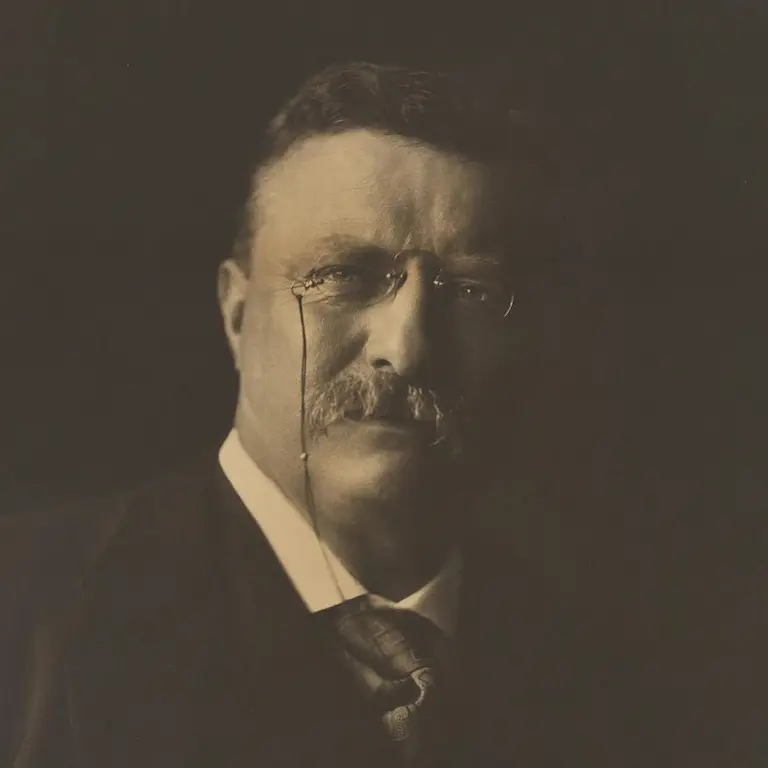
Theodore Roosevelt was the 26th President of the United States. These 38 quotes focus on life, mindset, leadership, and business, drawn from The Strenuous Life, The New Nationalism (1910), and Theodore Roosevelt's 1917 letter to S. Stanwood Menken.
 Curated by Navid Moazzez·Updated Oct 1, 2026·3 min read·Navid.me is reader-supported. When you buy through links on this site, I may earn an affiliate commission. Learn more.




Find a quote by what it means, play it on a scene with music, pick your favorite of 2, or make it an image. Quotes with a checked source come first.
Saved in this browser
“Most of us tiptoe through life in order to make it safely to death.”
This is a list of the best Theodore Roosevelt quotes.
In fact, you'll find 213 of them here, and 38 come with a source I checked.
So if you want the ideas straight from Theodore Roosevelt, you'll love this page.
Here's what's inside:
- Best Theodore Roosevelt quotes on life
- Theodore Roosevelt quotes on mindset
- Theodore Roosevelt quotes on leadership
And I keep adding to it as I check more of Theodore Roosevelt's quotes.
Best Theodore Roosevelt quotes on life
Theodore Roosevelt addresses the need to take bold risks, practice honest citizenship, and protect natural resources for future generations. Roosevelt also focuses on upholding the law equally and maintaining core American virtues.
Far better is it to dare mighty things, to win glorious triumphs, even though checkered by failure... than to rank with those poor spirits who neither enjoy nor suffer much, because they live in a gray twilight that knows not victory nor defeat.
Source: The Strenuous Life
A man who is good enough to shed his blood for the country is good enough to be given a square deal afterwards.
Source: Speech at Springfield, Illinois (4 July 1903), 1903
No man is above the law and no man is below it: nor do we ask any man's permission when we ask him to obey it.
Source: Third State of the Union Address (7 December 1903), 1903
Let us rather run the risk of wearing out than rusting out.
Source: Address at the opening of the gubernatorial campaign, New York City (5 October 1898), reported in "The Duties of a Great Nation", Campaigns and Controversies, vol. 14 of The Works of Theodore Roosevelt, national ed. (1926), chapter 45, p. 2, 1898
This country has nothing to fear from the crooked man who fails. We put him in jail. It is the crooked man who succeeds who is a threat to this country.
Source: Address in Memphis, Tennessee (25 October 1905), 1905
Probably the greatest harm done by vast wealth is the harm that we of moderate means do ourselves when we let the vices of envy and hatred enter deep into our own natures.
Source: Speech at Kennedy Plaza, Providence, Rhode Island (23 August 1902), Presidential Addresses and State Papers (1910), p. 103., 1902
To waste, to destroy our natural resources, to skin and exhaust the land instead of using it so as to increase its usefulness, will result in undermining in the days of our children the very prosperity which we ought by right to hand down to them amplified and developed.
Source: Seventh State of the Union (3 December 1907), 1907
Conservation means development as much as it does protection. I recognize the right and duty of this generation to develop and use the natural resources of our land; but I do not recognize the right to waste them, or to rob, by wasteful use, the generations that come after us.
Source: The New Nationalism (1910), 1910
Americanism means the virtues of courage, honor, justice, truth, sincerity, and hardihood - the virtues that made America.
Source: Letter to S. Stanwood Menken, chairman, committee on Congress of Constructive Patriotism (January 10, 1917). Roosevelt's sister, Mrs. Douglas Robinson, read the letter to a national meeting, January 26, 1917. Reported in Proceedings of the , 1917
A typical vice of American politics is the avoidance of saying anything real on real issues.
Source: "Platform Insincerity" in The Outlook, Vol. 101, No. 13 (27 July 1912), p. 660, 1912
Theodore Roosevelt quotes on mindset
Theodore Roosevelt urges people to pursue a strenuous life grounded in practical ideals, hard work, and self-reliance. Roosevelt values the courage to try and make mistakes over an easy existence without moral purpose.
Be practical as well as generous in your ideals. Keep your eyes on the stars, but remember to keep your feet on the ground.
Source: Address at the Prize Day Exercises at Groton School (1904), 1904
It is hard to fail, but it is worse never to have tried to succeed.
Source: The Strenuous Life
Justice consists not in being neutral between right and wrong, but finding out the right and upholding it, wherever found, against the wrong.
Source: p. 26
I wish to preach, not the doctrine of ignoble ease, but the doctrine of the strenuous life.
Source: The Strenuous Life
The worst lesson that can be taught to a man is to rely upon others and to whine over his sufferings.
Source: "How Not To Better Social Conditions" in Review of Reviews (January 1897), p. 39 · Full text online (with at least two typos — in the last sentence of the article) as "How Not To Help Our Poor Brother", 1897
No man should receive a dollar unless that dollar has been fairly earned.
Source: The New Nationalism (1910), 1910
Let us speak courteously, deal fairly, and keep ourselves armed and ready.
Source: Address in San Francisco, California (13 May 1903), 1903
If a man does not have an ideal and try to live up to it, then he becomes a mean, base and sordid creature, no matter how successful.
Source: Letter to his son, Kermit, quoted in Theodore Roosevelt by Joseph Bucklin Bishop (1915), 1915
We shall make mistakes; and if we let these mistakes frighten us from our work we shall show ourselves weaklings.
Source: National Duties
The only man who never makes a mistake is the man who never does anything.
Source: not checked yet
Theodore Roosevelt quotes on leadership
Theodore Roosevelt focuses on combining quiet strength with decisive duty, warning citizens against soft living and commercial lawlessness. Roosevelt also links responsible voting to good character and personal industry.
Speak softly and carry a big stick; you will go far.
Source: Letter to Henry L. Sprague (26 January 1900); this is the first known use of this phrase, which became a signature motto of Roosevelt's after he used it in a speech as vice president at the Minnesota State Fair:, 1900
The things that will destroy America are prosperity-at-any-price, peace-at-any-price, safety-first instead of duty-first, the love of soft living, and the get-rich-quick theory of life.
Source: Letter to S. Stanwood Menken, chairman, committee on Congress of Constructive Patriotism (January 10, 1917). Roosevelt's sister, Mrs. Douglas Robinson, read the letter to a national meeting, January 26, 1917. Reported in Proceedings of the , 1917
A vote is like a rifle; its usefulness depends upon the character of the user.
Source: Chapter V Applied Idealism
It is both foolish and wicked to teach the average man who is not well off that some wrong or injustice has been done to him, and that he should hope for redress elsewhere than in his own industry, honesty, and intelligence.
Source: "How Not To Better Social Conditions" in Review of Reviews (January 1897), p. 39, 1897
Those who advocate total lack of regulation, those who advocate lawlessness in the business world, themselves give the strongest impulse to what I believe would be the deadening movement toward unadulterated state socialism.
Source: The Thraldom of Names (1909), 1909
Nobody cares how much you know, until they know how much you care.
Source: not checked yet
In any moment of decision, the best thing you can do is the right thing, the next best thing is the wrong thing, and the worst thing you can do is nothing.
Source: not checked yet
The best executive is one who has sense enough to pick good people to do what he wants done, and self-restraint enough to keep from meddling with them while they do it.
Source: not checked yet
He who makes no mistakes makes no progress.
Source: not checked yet
Every reform movement has a lunatic fringe.
Source: not checked yet
FAQs about Theodore Roosevelt
The questions people ask most about Theodore Roosevelt, answered from Theodore Roosevelt's own words.
Theodore Roosevelt advised people to maintain a courteous demeanor while keeping sufficient strength ready to back up words spoken in negotiations.
Roosevelt summarized this approach with the rule, "Speak softly and carry a big stick; you will go far."
In Roosevelt's view, speaking courteously and dealing fairly works best when combined with remaining armed and ready.
Theodore Roosevelt believed that attempting worthwhile endeavors is essential even if defeat occurs along the way.
Roosevelt stated that "It is hard to fail, but it is worse never to have tried to succeed."
Roosevelt argued that letting errors terrify someone away from meaningful work shows weakness.
Theodore Roosevelt held that taking bold risks to achieve great triumphs is superior to living an uneventful existence.
Roosevelt criticized timid spirits who "live in a gray twilight that knows not victory nor defeat."
For Roosevelt, running risks is necessary because winning the greatest prizes in life requires daring actions.
Theodore Roosevelt insisted that every person in society must answer to the identical legal standard without exception.
Roosevelt stated plainly, "No man is above the law and no man is below it."
True justice requires enforcing the law equally rather than favoring any individual or special class.
Theodore Roosevelt asserted that large corporations exist because the state created and protected these entities.
Because these institutions receive public protection, Roosevelt maintained that the government is "duty bound to control them wherever the need of such control is shown."
Roosevelt warned that total lack of regulation in business would encourage a deadening movement toward state socialism.
Theodore Roosevelt advocated that workers who devote labor to industry deserve compensation that covers basic life needs.
In Roosevelt's philosophy, "We stand for a living wage."
Roosevelt noted that wages must ensure a proper standard of living, including education, recreation, family care, and reasonable savings.
Theodore Roosevelt believed that safeguarding natural resources is essential for the future safety and survival of the nation.
Roosevelt explained that "Conservation is a great moral issue, for it involves the patriotic duty of ensuring the safety and continuance of the nation."
Destroying or wasting land robs future generations of the prosperity that current citizens ought to pass down.
Theodore Roosevelt urged people to spend energy actively engaged in rigorous duty rather than slipping into inactive decay.
Roosevelt declared, "Let us rather run the risk of wearing out than rusting out."
Roosevelt considered hard work and the performance of duty to be the only elements that make life worthwhile.
Most of them come from The Strenuous Life, The New Nationalism (1910), and Inaugural Address (1905).
Every quote with a checked source shows it under the quote, so you can read it there.
I also have quote pages on Life, Mindset, and Leadership.
The quote finder searches every quote by what it means.

Navid Moazzez
AI business strategist & AI OS builder
Navid Moazzez helps creators and founders master AI and build their own AI Operating System (AI OS) to automate their business and life.

Navid.me is reader-supported. When you buy through links on this site, I may earn an affiliate commission. Read the affiliate disclaimer.
More famous quotes









More free tools


 Bluesky
 Instagram
 LinkedIn
 Threads
Related MCP servers & CLIs


 Substack
 Mastodon
 TikTok


 Apple Podcasts
 Free AI newsletter
The most actionable AI newsletter for founders
Every week, get proven AI strategies, curated tools, and step-by-step systems to grow your audience, create better content, and build a profitable creator business.
No fluff, no filler, no BS. Just five minutes each week that might level up your online business and life.
P.S. Sign up now to get free access to my ultimate AI tools guide for creators.
